
Blade Runner is the most famous movie adaptation of Philip K Dick. And it might be the greatest ever science fiction movie.
But Blade Runner, on the scale of PKDness, rates pretty low. Do Androids Dream of Electric Sheep is a much, much stranger book.
Minority Report is the least Dickish of all the major PKD adaptations. A Spielberg movie is a Spielberg movie.
Paycheck, Imposter and Next are from the noughties Hollywood that took a PKD concept and glued it onto a standard 3 act action movie.
Minimal Dick here.
The Adjustment Bureau is almost a Dick movie until it turns into more of a Matt Damon action movie vehicle.
1995s Screamers is really quite Phillipian. But it’s early PKD before the true paranoia set in.
This will be controversial, but Paul Verhoeven’s Total Recall is semi-Dicked. The action sequences aren’t Dick. But the impossibility of ascertaining true reality, or trusting another human, is quintessential Dick.
But for the full Dickhead experience only one film comes close
A Scanner Darkly

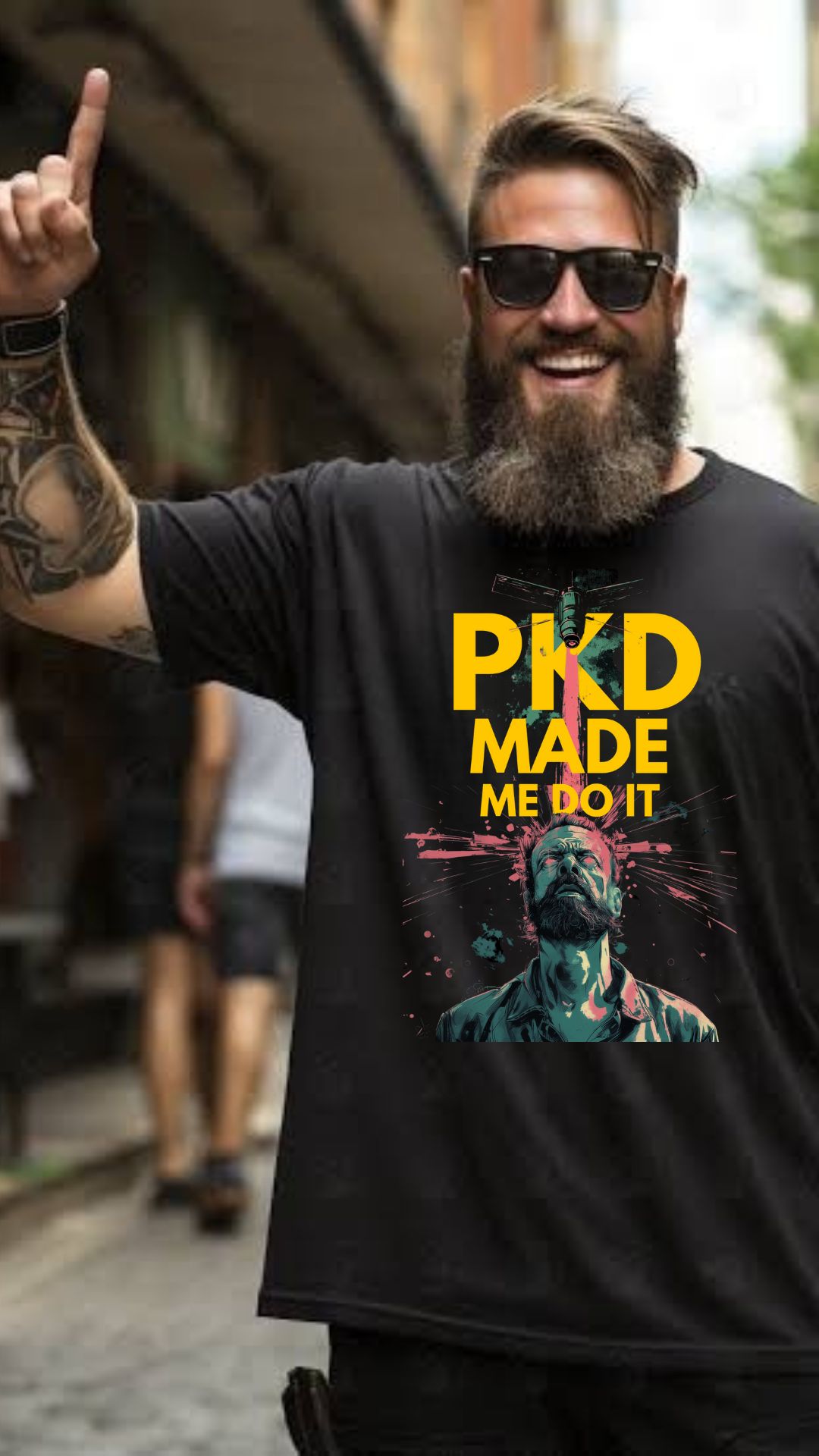
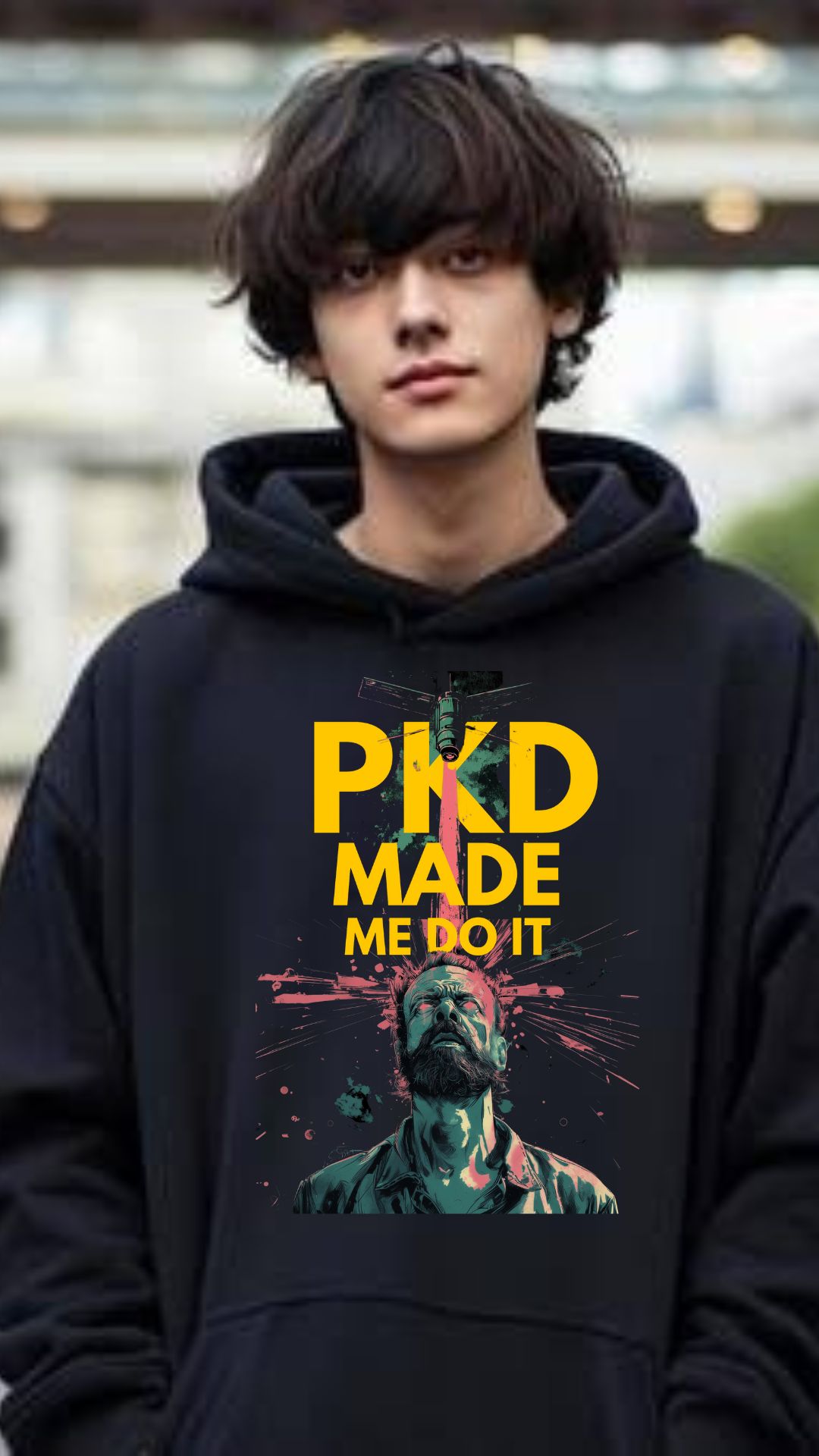
Shop the PKD Made Me Do It Collection
https://my-store-ef7a8e.creator-spring.com/listing/pkd-made-me-do-it
Philip K Dick’s partially autobiographical chronicle of 70s hippie drug culture takes place under the eternal sunshine of southern California. Even the book’s nighttime is saturated with the electric glare of strip mall lighting and the glow of the television screen.
The darkness of A Scanner Darkly isn’t in this color saturated 24 hour consumer culture. It’s the darkness of those who fall through the fractures of that culture. The darkness of intellectual and emotional fragmentation.
The darkness of
insanity.
Philip K Dick’s struggles with mental…
what do we call it…illness? Or awakening?
…shaped his life and his writing. Philip Kindred Dick was a restless soul and neurotic personality who married and abandoned multiple women, and his own children, drifted between cities to escape debts and lost himself in drug addictions, that he only kicked in his fifties, before a stroke killed PKD aged 54.
And somehow PKD also wrote arguably the most important body of science fiction literature of the 20th century. His peak-decade of the 1960s gave us classics like The Man In The High Castle, The Three Stigmata of Palmer Eldritch, and Do Androids Dream of Electric Sheep…
…the book that became Blade Runner, the movie without which Dick might be one of many great but forgotten sci-fi authors.
Roger Zelazny, PKDs collaborator on Deus Irae, who is near lost today, was a better writer by almost every measure
But PKD was a visionary
In life those visions manifested as insanity. In fiction as prophecy.
And the greatest and most prophetic of PKDs fiction came from the examination of his own insanity.
Watch the full video essay
Dick dissects modern insanity through the cypher of Bob Arctor.
Arctor…actor. Get it? The everyman archetype
Arctor is a man on the fringes of society. A man who realises one day that he hates his suburban existence, and so trades it in for a life among the hippie drop-outs, drug addicts and street people of Orange County, California.
But Arctor is also Agent Fred, an undercover narcotics officer whose identity is hidden even from his police handlers by a “scramble suit” that makes him appear as an unmemorable blur.
When an administrative error results in Agent Fred being assigned to monitor Bob Arctor, Arctor/Fred has the deranging experience of monitoring his own activities through the holographic scanning equipment that gives the novel its title.
Which is a play on Ingmar Bergman’s 1961 movie Through A Glass Darkly, which shares the themes of insanity and psychic collapse that A Scanner Darkly will unpack.
#
A Scanner Darkly is something like a thematic sequel to 2001s Waking Life, the two movies marking the rotoscope phase of indie moving making legend Richard Linklater
Linklater is best known to mass audiences for School of Rock with Jack Black. Because even the most indie of movie makers need a bankable commercial hit now and again.
Slacker (1990) exemplifies three factors in Linklaters career. The first is the city of Austin, Texas, where Slacker is set, which Linklater almost single handedly defined as America’s indie movie making mecca.
The second is the DVD rental market for movies in the 90s and 00s. Linklater made low budget movies that didn’t need to be box office hits because they were popular rentals in the era of the DVD.
The third is Linklater’s status as the moviemaker of Generation X, the Slacker generation, back when dropping out to work in a coffee shop was rebellion, rather than the only available career option for a humanities graduate. Douglas Coupland may have named Gen-X
but Linklater projected the Gen-X psyche onto the cinema screen in his breakout hit Dazed and Confused, the coolest teen movie ever made, and the film that gave us Matthew McConaughey
The Before trilogy follows the romance between Ethan Hawke and Julie Delpy over a twenty year arc. Linklater doubled down on temporal moviemaking in 2014s Boyhood, shooting one sequence with the same cast each year for twelve years to show child actor Ellar Coltrane age through his boyhood in real time.
It’s Linklater’s masterpiece. Watch it.
Waking Life in 2001 is a ramble through dreams and philosophy in which Linklater uses the rotoscope animation effect to indicate the simultaneous presence of dream and reality on the cinema screen. An effect he repeats in A Scanner Darkly.
Which is unmistakably a Linklater movie. Beneath the rotoscope is the most Gen-X cast imaginable. Is that Winona Ryder? Of course it is. These are literal slackers, and much of the in-scene dialogue is improvised.
But the prophetic vision of Philip K Dick burns through the rotoscoping like the truth of God through lies and evil.
Scanner Darkly is a PKD movie down to its platonic forms
As an obsessive reader of Philip K Dick and wannabe indie movie maker in the early 00s, if you’d asked me the director who could do justice to PKD on the big screen
I would have said Richard Linklater
So, obviously, I completely missed A Scanner Darkly when it was released in 2006.
Keanu Reeves is a non-entity
But the intensity of his beauty and the half dozen facial expressions he deploys in place of acting make him the ultimate movie star.
Because a movie star isn’t an actor. A movie star is a human that you want to become. For the time you watch them on a screen.
As the working stiff cop Agent Fred, Keanu is pretty damn good, especially as the Fred persona is on the borders of collapse.
But as loser dropout Bob Arctor, Keanu is out of his depth
Keanu has never had to wonder why his chick won’t sleep with him. Keanu has never been a loser. Arctor is a role Joaquim Phoenix, king of losers, would nail.
Watching Keanu Reeves on screen is like watching an animated void.
Which ultimately does make Keanu Reeves the perfect star for a story about watching screens, being watched on screens, being on the screen being watched and watching others watch on us
on screens
#
But the rest of the casting in A Scanner Darkly is
well
A Scanner Darkly is a story about nobody’s
The characters in A Scanner Darkly are on a scale from people still working in a convenience store in their late 30s, at the doing well end of the scale, to zombie shuffling on fentanyl, at the doing bad end of the scale.
Robert Downey Jnr, even in his mid-career slump, and Woody Harrelson at the peak of his fame, just aren’t nobody’s enough. They’ve never really even known any nobody’s. So their performances in A Scanner Darkly are somebody’s doing a pantomime clown act of what they think nobody’s might be like
Keanu, Robbie, Woody and Wynonna certainly help bring in an audience. But it’s an audience who come expecting the thing those stars usually do, wrapped in rotoscope, which isn’t what we get.
The most common response to A Scanner Darkly is “depressing”. Examine that in detail and you realise it means that A Scanner Darkly forces us to deal with gritty bits of reality we go to movies to escape from.
It’s ironic that Philip K Dick is a poster-boy for the use of drugs to escape to reality. Because what PKD actually wrote about the life of drug addiction is all too real.
A Scanner Darkly is late-phase Dick.
Bob Arctor’s life is really Philip Dick’s life over a two-year period, from 1970-72, after his fourth wife Nancy left him.
Finding himself alone again, Dick filled his four-bedroom house with drifters and fell fully into drug addiction.
A Scanner Darkly was born from this period and is a fascinating portrait of 70s Californian counter-culture.
But Scanner Darkly was actually written in 1977, at the height of PKDs late period of spiritual struggle.
In 1974 Dick underwent a routine dental procedure. After a lifetime of drug abuse it was a dose of sodium pentathol that pushed him over the edge, into psychosis, or a violent spiritual awakening
Depending on interpretation
The events of what PKD came to call 2-3-74, as with all the best prophetic awakenings, vary depending on the testimony
PKDs own accounts vary wildly, and his biographers all embroider them to meet the story we want to tell about PKD
Either dosed on painkillers, or expecting a delivery of painkillers, PKD opened the door to a delivery woman wearing a fish pendant, sparking a long series of revelatory visions / hallucinations including geometric patterns, Christian symbolism, the Christ himself, and ancient Rome.
It’s disillusioning to many semi-Dickheads to discover that the man was for most of his adult life an Episcopal christian, and held socially conservative views, especially those against abortion expressed in his story The Pre-persons, that sparked his feud with Joanna Russ. PKDs “Conspirituality” was of the kind that today tends to vote MAGA.
PKD claims then to have been struck by a pink beam of light that came down from a satellite that was also a divine entity. This beam downloaded a mass of information into PKDs brain that he would spend the last decade of his life decoding, leading to his historical conspiracy theory that Rome Never Fell, and inspiring his late novels VALIS, Radio Free Albemuth and The Divine Invasion, and his epic Exegesis of the Christian faith.
Psychotic hallucination? Divine revelation? The inventions of a scifi writer who understood personal mythologising as a tool of self-promotion?
You decide.
#
Bob Arctor is an actor. In his own life.
He is a man caught in a performative trap.
On one hand Arctor is a drug addict in thrall to the mysterious narcotic Substance D. Is it killing you or awakening you? Is there really any difference?
On the other hand Arctor is a police informant, who has by an administrative error been assigned to investigate and inform on…
…himself.
Arctor is hence made to both experience the events of his life as a drug addict, and to see these events as an external observer, in the absolute immersive reality of the Scanner
Darkly
The early 1970s of Southern California already contained the seeds of today’s surveillance society. Terrified by the experience of having to pass through a police body scanner, PKD began to imagine a future of mass surveillance.
And in doing so sensed something even more massive coming down the pipeline from that future
Social media is too benign a name for the technological hall of mirrors we have constructed for ourselves.
An experience that once only deranged movie stars, who had the capacity to adapt to it, now deranges half of the global population, who do not.
We video our lives. We show our videos to others. We watch others watching our lives. We live in 24 hour daylight, not only of mass surveillance by Big Brother, but of the attention of Big Other
We live in the Scanner Darkly
 Damien Walter