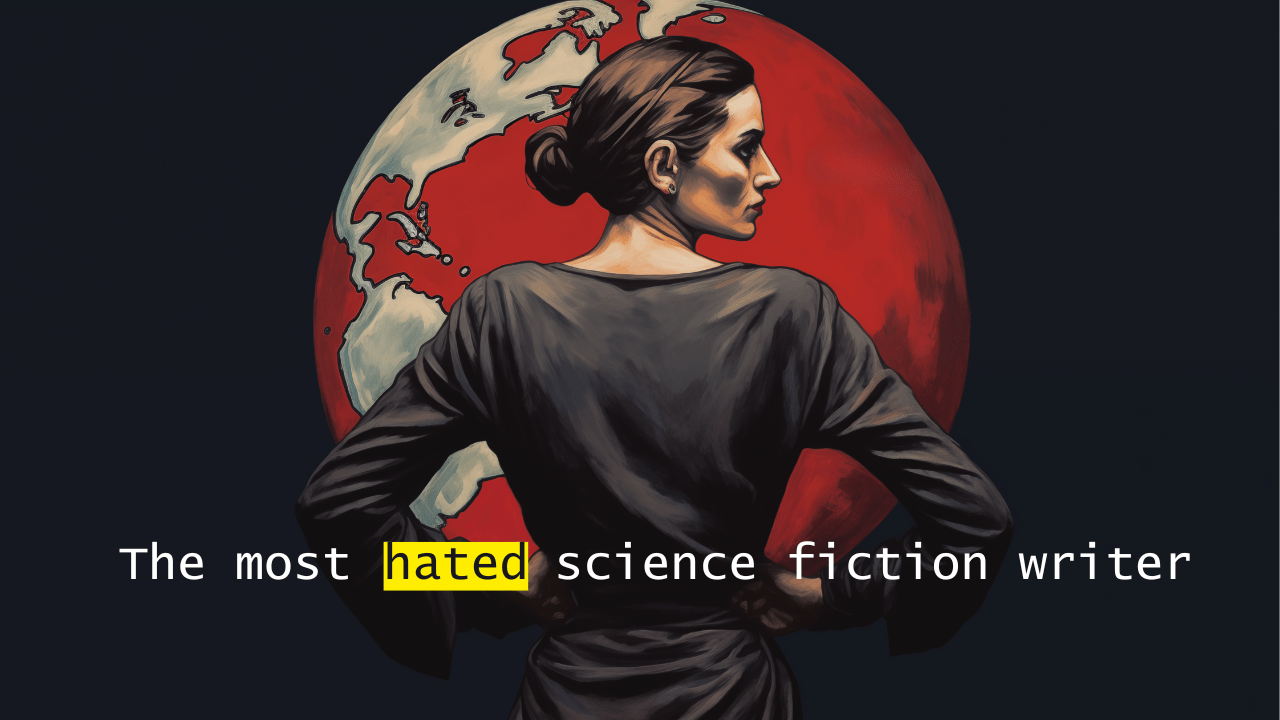
It’s rare for a sci-fi writer to be famous enough, to be known enough, to be truly, deeply… hated.
Robert Heinlein. Dominated American science fiction in the mid 20th century. With novels like The Moon Is A Harsh Mistress and Starship Troopers. Amazing ideas!
Ideas like
CHECKS NOTES
Only military veterans get to vote?
and
Bombarding humanity with meteorites because you’re not a fan of the Deep State?
Wowzers.
Watch the full video essay
People called him a fascist. But RAH was more like your crazy contrarian uncle who just says mad sh*t at Thanksgiving to get a rise out of those darn kids.
Then you’ve got L. Ron Hubbard. Widely, and I think we can all agree, justifiably reviled for turning space opera into a celebrity-endorsed cult that is phoning its lawyers as I speak. Also, his books were just…unremitting trash.
HP Lovecraft’s racist poetry. Orson Scott Card’s open homophobia. Isaac Asimov for being a gropey old man.
And a lot of die-hard fans really, really hate Andy Weir for basically being the Nickelback of science fiction.
But none of them. None of them…attract the kind of intense, sustained, white-hot rage reserved for one woman.
Ayn Rand.
#
And yes! Yes, Rand is a science fiction writer. Don’t even start.
With over 10 million copies sold, Atlas Shrugged might be the best-selling adult sci-fi novel by a woman in the last century. Margaret Atwood’s The Handmaid’s Tale? 8 million. Ursula K. Le Guin’s The Left Hand of Darkness? Maybe 2 million. And as Rand is her mirror-dimension evil twin, Le Guin really should be winning this!
In the words of Science Fiction community member Michael Maindi my-indy
“A revolutionary mystery about trains and unobtainium and zero point energy and superweapons that culminates with a cloaked city in Colorado?”
Ayn Rand wrote science fiction. But people deny it. Why? Because it’s standard human behavior to deny any credit to those we hate.
And we really, really hate
Ayn Rand.
“Rand’s novels are just poorly written adolescent power fantasies. Utterly unreadable.”
True but this does also describe every book written by Brandon Sanderson and he’s beloved! And like Sanderson, while Rand’s sentences may be…shody…her training as a screenwriter gives her books compelling dramatic structure.
“Let’s remember Rand died in poverty and on welfare after a lifetime railing against handouts. Hypocrite!”
Half true. Rand died quite wealthy from book sales, with a large Manhattan apartment and an estate worth millions in today’s dollars, but nonetheless claimed welfare for medical expenses. So, not a regular hypocrite. More of a rich hypocrite.
“Ayn Rand is the patron saint of selfish sociopaths. Her books are a great way to find out which of your friends lacks basic empathy.”
Not true. Rand is a minor but important contributor to a philosophical tradition of selfishness. And the questions posed by that tradition are
why we hate Ayn Rand
#
Let’s play
Who Do You Hate More
Is it Jordan Peterson, tearful adoptive dad to Generation Incel? Or Judith Butler, rebellious grandma to a generation who change their gender as often as earlier youth changed their taste in music?
How about Michel Foucault, the bald French academic who called everything a prison? Or Roger Scruton, the tweed-clad Brit who thought beauty died in 1780?
And for the main event: Friedrich Nietzsche, the mustachioed German who killed God then went mad, or Karl Marx, the *bearded* German who literally wrote the book on capitalism?
It’s an actual hobby of mine to go to evangelical churches and gun clubs in the American midWest and drop Karl Marx into conversations
Or
Or. To hangout on the lawns of expensive liberal arts colleges while reading 12 Rules For Life and Atlas Shrugged.
The true sign of greatness in our polarised online times isn’t who loves you, but who hates you
And why
#
If Ayn Rand had only written one science fiction book, she’d probably be applauded alongside George Orwell as the “mother of socialist dystopia”. Her first SF novel, Anthem, came out a decade before 1984.
If a nightmare future of collectivist conformity where the word “I” has been lost sounds familiar, it might be because she cribbed it from Yevgeny Zamyatin’s novel We.
Whether Rand read Zamyatin before writing Anthem is a matter of some scholarly flamewars and shitposting.
But either way, if Ayn Rand had stopped writing after Anthem she would likely be occasionally lauded as a classic of science fiction.
But Rand did not stop writing.

Ayn Rand’s life is a heroic story of individual self-creation worthy of an Ayn Rand novel. Born Alisa Rosenbaum to a middle-class Jewish family in Russia. Her family loses everything in the revolution. She survives, gets a state-funded education in screenwriting—thank you, Lenin!—and escapes to America to become a writer. A young woman refugee who becomes a screenwriter, a best-selling novelist, a public intellectual, and the founder of her own philosophy. It’s a heroic arc.
And it’s all built around one question. The question at the heart of Ayn Rand’s work:
Who gets to create?
#
Ayn Rand’s entire career rests really on only two books, published 14 years apart.
We’ll start with the second and most famous.
The best word for Atlas Shrugged is…unhinged.
Rand by 1957 is wealthy, famous, surrounded by flatterers, addicted to amphetamines and commands cult like adoration among the followers of her new philosophy.
Rand is basically the 1950s Jordan Peterson. Including bad tempered pseudobabble when challenged in interviews.

Rand’s fame peaks with the publication in 1957 of her magnum opus Atlas Shrugged, the science fiction novel which illustrates most of her worst ideas.
The “Atlas” of the novel are the wealthy capitalist elite of the United States who, sick of oppressive state regulation, decide to go on strike.
The best thing about Atlas Shrugged is the painfully bad 3 part movie adaptation it inspired in the early noughties.
Haters claim the movies miss the spirit of the books, but in truth this cheesy low budget love child of Falcon’s Crest and The Avengers is the perfect adaptation of Rand.
If you ever need to convince someone of the absurdity of capitalism or the ridiculousness of capitalists as a class of people
Atlas Shrugged does the job splendidly
Atlas Shrugged is an absurdly self-serious novel that becomes inadvertently hilarious as the capitalist elite disappear up Galt’s Gulch and…
…nobody really notices.
The huge mistake…the cripplingly massive mistake…at the heart of Atlas Shrugged and much of Rand’s work
is Rand’s answer to her central question “who creates?”
Rand somehow believes that America’s capitalist elite, that bankers, and newspaper barons, and the industrialists that Rand adores, are the creative engine of American civilization
And they simply aren’t. Capitalist elites practice not wealth creation, but wealth extraction. They extract wealth from the creativity of others. So when John Galt and the other capitalist parasites disappear
American’s barely notice
So you should read…speed read…don’t waste too much time on it…Atlas Shrugged as an accidental exposé
of the pantomime at the heart of American right wing politics
John Galt and his cult are fighting against the meddling power of government. But in reality the US government is almost entirely controlled by capitalists like John Galt.
Then when the resulting mish-mash of conflicting private interests leads to complete state stagnation, the capitalist elite deny responsibility by blaming Big Government.
Atlas Shrugged gives the right-wing a nightmare fantasy of the Deep State to hate, and a utopia of capitalist freedom to dream of.
Galt’s Gulch is arguably the only true capitalist utopia ever written. The forerunner of Peter Thiel’s seasteading fantasies, Balji Srinivasan’s Network State, and the emerging plan to make Gaza a tech billionaire Mediterranean retreat.
Libertarians hate utopia, unless it’s their utopia.
The Objectivist philosophy that Rand puts into the mouth of John Galt in his famously dull and ridiculously long monologue is
Fine. Objectivism is just Aristotle’s virtue ethics with extra bells and whistles. Of course humans should aspire to high virtues.
But the real philosophical discussion, which Rand never touches, only begins when we get real about our failure to reach those virtues.
The American capitalist class have never, and will never, fulfill even the basic qualities of Rand’s Objectivism. Elon Musk is never going to be courageous and temperate, it’s just not in his porn addicted K-hole personality to be a Marcus Aurelius.
Ayn Rand’s most famous novel is a work of flattery directed at the American right wing elite, that inadvertently shows you everything wrong with that elite.
But Rand’s other great novel is a very deliberate and quite brutal critique of America’s other elite.
Atlas Shrugged accidentally shreds conservatives
The Fountainhead aims at and hits the heart
of liberalism
#
Logan Roy is the kind of selfish billionaire that Ayn Rand adored
The Roy’s throw their money behind conservatives, and ultimately behind fascism, because the Roy’s are entirely selfish, and they can’t comprehend that anyone would ever be unselfish
In what is, for my money, the greatest episode of HBOs Succession
The new money Roy’s fly out to meet their foils in the drama, the old money Pierce family
Who support liberal causes, give to liberal charities, and use their media empire to fight for the values of liberalism. The Pierce’s are the good elite.
Kind of. But when we dig into the details the Pierce’s are every bit as selfish and greedy as the Roy’s. They’ve just being doing this longer, and have learned that it’s better to hide their sins
Behind a mask of liberal…virtue
After season’s of hating the Roy’s we finally have somebody worse to hate
Because at least the Roy’s are honest about who and what they are

Howard Roark is a massive cock.
But. Despite this, the protagonist of The Fountainhead, manages to be the only sympathetic leading man that Rand ever wrote.
Roark is not a billionaire industrialist, but a young architect struggling to fulfill his authentic vision. At which he does SPOILER ALERT eventually succeed.
And in narrating the heroic arc of Howard Roark, Ayn Rand delivers a brutally honest answer to her question
Who gets to create?
Peter Keating is the early antagonist of The Fountainhead. While Roark struggles for an authentic vision, Keating simply conforms to the incentives of the capitalist system. As a consequence he becomes a successful architect, delivering the dul, garishl buildings that generate the most profits. He gets the money, the wife, the Manhattan apartment.
While Roark ends up doing manual labour in a quarry.
But when the tables are turned Peter Keating discovers a terrible truth. As his career declines Keating takes to painting. He even shows his paintings to Roark, now the city’s leading architect, who bluntly dismisses them by saying “it’s too late, Peter.”
Not for revenge. But because it’s the truth.
#
The Fountainhead is not a work of science fiction. But it’s also not a realist novel about New York architects. The book is a New York fantasy. A modern myth.
The 1949 movie adaptation starring Gary Cooper, Patricia Neal and Raymond Massey
(known to scifi fans from his starring role in HG Wells’ Things To Come)
Is really quite good, and Cooper forcefully ravishing Neal is a trope of mid-century Hollywood.
The movie and Rand’s novel were a major influence on Mad Men and the iconic character of Don Draper, the closest 21st century culture has given us to a Randian hero.
“I don’t think of you at all” https://youtu.be/-X6zx3CaaOo?si=-u0B59aAFwdOA7b0
Draper is Roark, Pete Campbell is Peter Keating, and Draper is given a copy of The Fountainhead in season 1.
Don Draper is a liar and a fraud living a false life. Most of all Don is selfish. Utterly and intensely self centred in all things.
But Don is a creator. Literally the creative director of his ad agency. Don Draper calls all the shots when it comes to creative.
Not because he’s a good person.
But because he’s a selfish person.
#
The German philosopher Martin Heidegger explored the question of who creates in his seminal work Being and Time and gave the answer as Eigentlichkeit. Eigen-tlik-kite
Most often ranslated as “authenticity”.
Only those who make choices that are genuinely their own, rather than passively conforming to societal norms, will fulfil what Heidegger calls their creative self.
Only those who are truly selfish will ever be truly creative.
Authenticity is the value that lead a generation of hippies to turn on, tune in and drop out of maintaining their personal hygiene, and many of those hippies, like Steve Jobs founder of Apple, went on to create the techno-dystopia we all live in today
And then there are the Nazis.
Heidegger wasn’t only a Nazi member, his philosophy of authenticity helped shape Nazism. There’s no idy more selfish than a Nazi, and what’s more authentic than being your truly murderous self?
“Our salvation lies not in knowing, but in creating!” Freidrich Nietzsche
Friedrich Nietzsche had earlier given an even more radical answer to the question; who creates?
For Nietzsche the creative “Will to Power” justified human hierarchies, and even “slavery in some sense or other”
Because for some men to have the free time to create, others must do the work. And the only men fit to create were those who had freed their minds from “herd mentality”.
Is there anything more selfish than enslaving other men so you have time to write an aphorism?
Aristotle, Ayn Rand’s philosophical hero, presents creativity as the act of self creation. Only men who have cultivated their higher virtues have the wisdom to create, and what those men create in turn defines their own self, making creativity for Aristotle the exclusive domain of a natural aristocracy.
The authenticity of Heidegger, the will to power of Nietzsche, the aristocracy of Aristotle are all illustrated in the heroic character of Howard Roark.
Rand is not the equal of her philosophical influences. Heidegger and Nietzsche hid their message in dense prose and aphorisms so only the educated elite would read it.
Ayn Rand just straight up shouts the quiet bit out loud.
Only the most selfish people get to create.
This makes The Fountainhead an intoxicating read for the selfish, and a painful lesson for everyone else.
If you’ve ever complained about not having “time to write”, if you’ve ever had a dream, a project, something you wanted to make, and you let it die because you were too busy, or too scared, or you listened to the wrong people… this book will slap you in the face with a caricature of your own excuses.
It’s brutal.
And the problem is that, based on the world we live in, Rand is right.
#
The Fountainhead contrasts Howard Roark’s heroic arc of individual creative fulfilment against the corporate conformity of New York’s professional managerial class.
Peter Keating is the first victim of corporate conformity. A life spent climbing the corporate ladder means that when Peter starts to paint, to create, he has no authentic self left to express.
Gail Wynand is the capitalist at the top of these conformist corporate structures, a newspaper baron who joys in torturing idealistic journalists by making them betray their values in exchange for a regular paycheck.
I mean I can’t think of any prominent New York based journalists and media personalities who basically get their paycheck directly from billionaires in exchange for saying what they’re told to
Except maybe all of them.
AG Sulzberger…stop whipping Ezra Klein…he’s recording that “Billionaires are great, really!” podcast as fast as he can!
It’s widely speculated that Succession’s Pierces are based on the Ochs-Sulzberger family who have owned the New York Times since 1896.
And the NYT and other elite liberal media have never stopped publishing hit-piece after hit-piece on Ayn Rand, ever since The Fountainhead was published, almost a century ago.
Elsworth Toohey is an influential newspaper columnist who in The Fountainhead shapes the values of liberal New Yorkers.
Toohey preaches values of selflessness, but only to fulfill his own selfish desires. Toohey controls people by demanding they live selflessly, then shaming their inevitable failure.
Toohey was Woke before woke was a thing, an aggressive hyper-liberal using shaming and scolding as weapons in his own struggle for
creative control
#
Ayn Rand’s two most famous novels are often claimed as critiques of socialism
But really they are brutal, and perhaps accidental critiques, by a Russian emigre, of the two elite cultural elites that own the greatest capitalist nation on Earth.
Atlas Shrugged is a genuinely ridiculous novel by a complacent late career Ayn Rand that destroys the capitalists it is trying to flatter.
The Fountainhead is also often ridiculous. There’s a lot of semi-naked flame haired Howard Roark standing on mountain tops, or skyscrapers, or other tall things, staring into the horizon while being certain of his own greatness.
But the Fountainhead is a young, hungry Rand making a brutal caricature of the 1930s liberal elites of New York.
Liberal elites that will, over decades to come, give us deindustrialisation, globalisation, privatisation, mass incarceration, forever wars, and the other costs of late stage capitalist neoliberalism.
#
Whether you hate Ayn Rand or just despise her, she was a rare creator.
The list of Russian women dissident Hollywood screenwriters only has one name on. Bestselling female science fiction writers in the 1950s? Again, just one name. 20th century female philosophers who founded their own ideologies? It’s a very, very short list.
Because she lived up to her values in one way – she was completely selfish.
And when we look at the capitalist reality Rand adored, and that has only grown stronger since Rand’s death in 1982.
At the dark carnival of social media influencers, billionaire owned journalists, algorithmic content creators, video game streamers, Only Fans online hookers, professional conspiracy theorists, NFC collectibles artists, self-help gurus, internet pimps
and the reality tv star president literally presiding over this fucking inferno
it is only the selfish who get to create in this world
that’s why for the true artist the only thing worth creating
is a better world
Listen to the audio podcast here
 Damien Walter