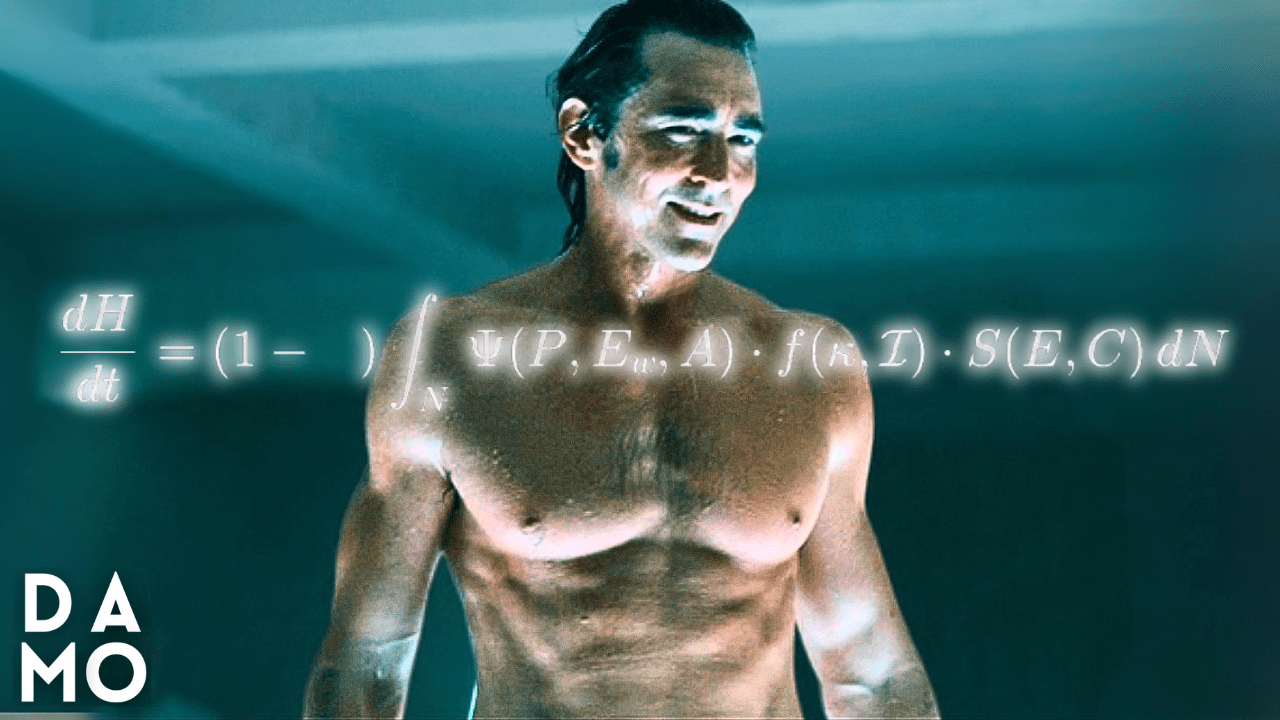
We are in a crisis…
…of crises.
We are in a crisis of geopolitics as we move from a unipolar world of one global hegemon to a multipolar world of competing powers.
We are in a crisis of economics as our elites hoard more and more wealth, immiserating the working and middle classes.
We are in a crisis of nationalism as people turn to populists, authoritarians and fascists for simple answers to complex questions.
We are in a crisis of ecology as the over-extraction of natural resources destroys the only home we have.
The existential threat of nuclear weapons or global pandemic. High speed population growth and collapse. Digital disinformation and propaganda.
The emergence of AI.
We are in a crisis of complex and interlocking crises.
Some call this the Polycrisis. Others the Metacrisis.
But there’s a better way to understand our crisis of crises.
We are in a Seldon Crisis.
Watch the full video essay on the Science Fiction channel
The Foundation Saga was born from a personal crisis.
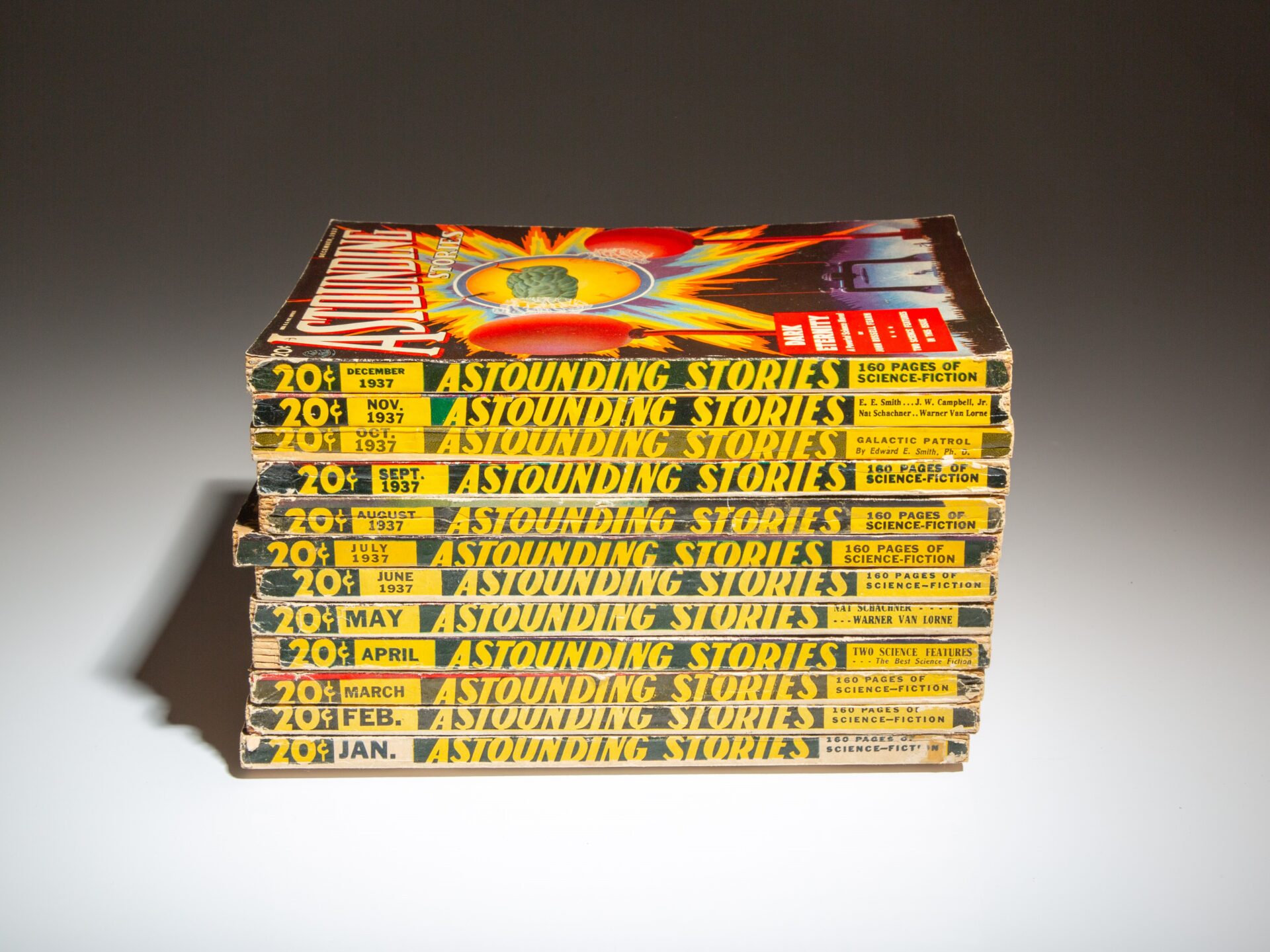
A young Isaac Asimov, on his way to a pivotal meeting with the formidable editor of Astounding magazine John W. Campbell, had no story to pitch.
Campbell was reshaping American scifi from its roots in pulp adventure stories, to a harder edged artform that took science seriously.
Asimov found last minute inspiration in his reading of Edward Gibbon’s The Decline and Fall of the Roman Empire.
If the greatest empire in Earth history could collapse, what would the decline and fall of a galactic empire look like? And more importantly, how could civilization rise again?
This question became the seed for one of science fiction’s most powerful myths. Asimov rewrote the genre of space opera to explore profound ideas of politics and history, and made the galaxy a mirror for the future of humanity.
Asimov’s answer to the question of civilisational collapse, the novum or new idea at the heart of his story, remains perhaps the greatest high concept in all science fiction
The science of Psychohistory
“It was the science of human behavior reduced to mathematical equations. The individual human being is unpredictable, but the reactions of human mobs, Seldon found, could be treated statistically.”
Imagine we can predict the future state of human civilization, in the same way we can predict the future state of a cloud of gas particles.
Using a mathematical equation.
But there are limitations.
The human population must be on the scale of 75 billion for statistical patterns to hold, so this is only viable for a human civilization on a galactic scale.
The resolution of statistical predications is no greater than three generations.
The human population must remain predominantly ignorant of the predications or they will feedback into the system.
And predictions can only be made for the mass of humanity, not the individual.
This is the science of Psychohistory.
Combining the statistical modelling of mathematics with the insights of psychology to create a science of human history.
Psychohistory predicts that the galactic empire will fall and thirty thousand years of chaos will follow.
But this can be prevented by founding a new civilisation of pure reason, of science and technology, the first Foundation.
Who must be secretly guided by a Second Foundation, who alone have knowledge of the science of Psychohistory.
All of this is predicted by Hari Seldon, the scientist creator of Psychohistory
And the prophet
of a new religion
It’s one of the most alluring ideas in human history
That we can somehow see the future, and avert catastrophe
Or prevent the fall of a civilisation
By communing with god. By sacrificing a goat. By reading the entrails. Or the tea leaves.
For thousands of years these powers were claimed by priesthoods, whose arcane abilities to speak to the gods were
Bullsh*t
Nothing changes
#
What might a mathematical model of Psychohistory actually look like?
With a helping hand from Gemini and Grok here is an approximation of a unified model of Psychohistory
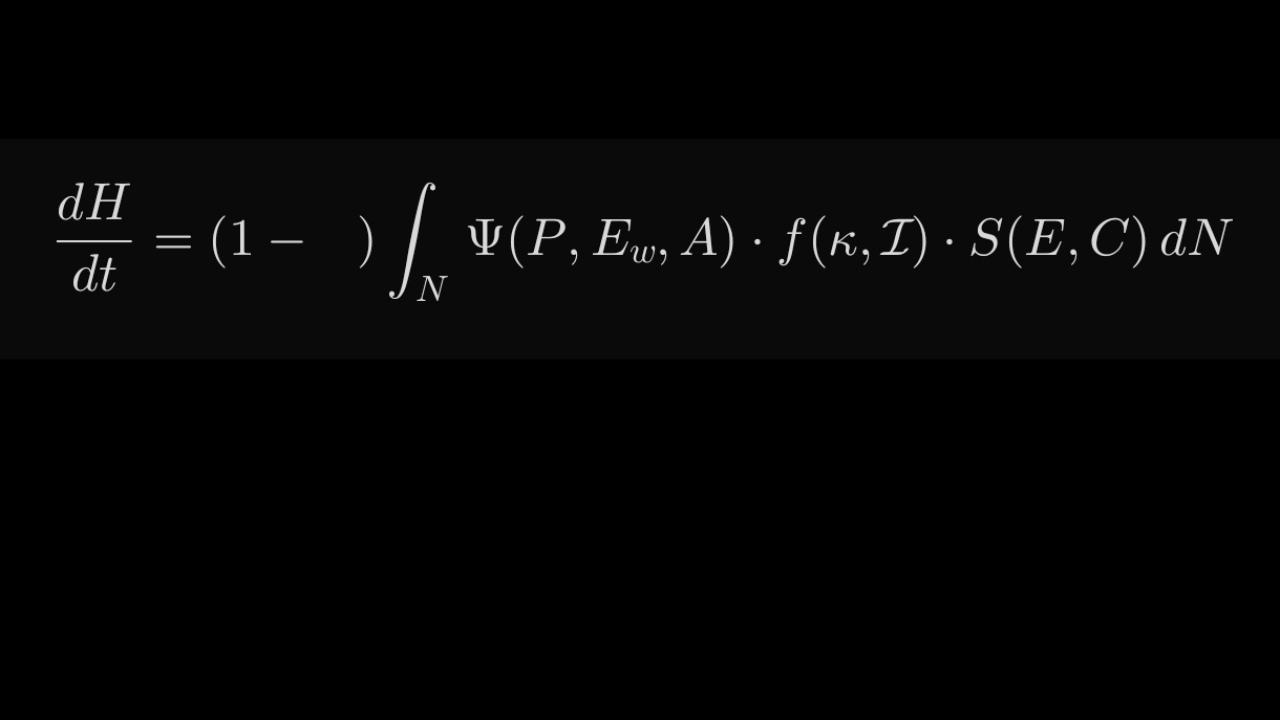
Which you’ll also find on our latest t-shirt in the Science Fiction merch store
This is a differential equation of the kind used in economics, physics, ecology and other disciplines.
So. We’re in the ballpark.
It aims to find the rate of historical change for a large human population represented in this differential, where H is a state vector describing the total condition of a society. Its components including technological level, average economic output, political stability indices, dominant cultural values, population health, etc, etc, etc
The Axiom of Mass Action here embodies Asimov’s First Law of Psychohistory: that the laws of history can only be applied to very large populations NOT individual actions.
This part captures Asimov’s Second Law of Psychohistory: that the population being studied must remain ignorant of the psychohistorical analysis, with Omega representing the fraction of societal awareness of the psychohistorical model itself.
Did I mention this tee shirt is in the merch store? Also hoodies.
Next the Core Behavioral Integrand is the product of three distinct functions.
The Cliodynamic function which models Population Pressure, Elite Dynamics and State Authority.
The Network Information function charting the flow of information across a population.
And the Stimulus Function, a measure of the potential of a population to respond to events.
And finally the Stochastic Peturbation, or “Mule” factor.
A concession to the limits of…
…determinism.
Now, the problem with all this isn’t just that it’s obvious bullsh*t. The kind of AI generated “vibe physics” beautifully mocked by Angela Collier here.
It’s not just that this AI generated equation is bullsh*t
It’s that any mathematical model of complex human behavior is equally bullish*t
But it sure is pretty looking bullsh*t so you can buy it on a tee shirt in, that’s right,in the merch store.

Stephen Wolfram’s principle of Computational Irreducibility provides one explanation for why Psychohistory
or any science of history
is bullsh*t.
Introduced in his 2002 book A New Kind of Science, Wolfram’s idea, greatly simplified, is that only small pockets of reality can be mathematically predicted.
Most of reality is complex beyond the powers of any equation to model or predict
This contradicts the prevailing orthodoxy of determinism
Which states that all reality emerges from the initial conditions of the system. If we knew the initial conditions we could model anything and everything.
For the determinist a science of Psychohistory is a theoretical possibility. For complexity scientists like Wolfram it is an absolute impossibility.
The determinist offers the same familiar certainties of all priesthoods.
Simply trading the whims of a celestial monarch for the cold, unyielding gears of a cosmic machine.
We sought to escape a universe governed by a plan and found ourselves in one governed by an equation. The ancient priest said your fate was written in the book of life by a divine hand. The strict determinist says your fate was written in the initial conditions of the Big Bang. Every action, every thought, every seemingly spontaneous choice was an inevitable consequence of prior events, a ripple in a causal chain stretching back to the emergence of spacetime.
Both views offer a totalizing explanation for everything. Both erase the terrifying chaos of true randomness. Both assure us that the story is already written, that we are merely playing out our assigned roles. The comfort is the same; only the author has changed. It’s the same deep-seated need for an ultimate order, just stripped of personality and cloaked in the language of mathematics and logic.
Determinism is God for nerds.
And those who claim to be able to calculate the pre-determined patterns of reality are our new priests and prophets
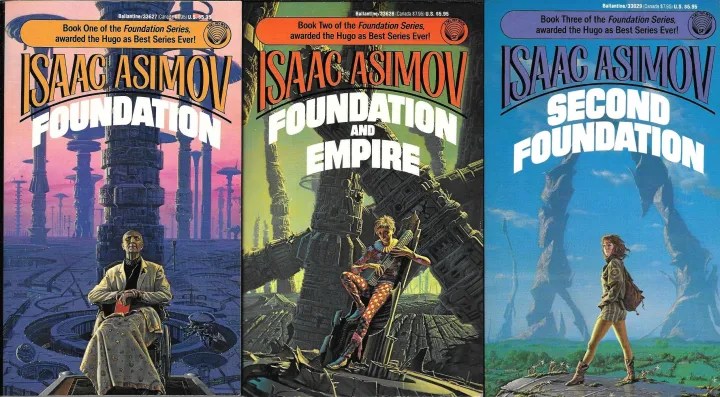
Isaac Asimov’s Foundation and Frank Herbert’s Dune are two visions of the same future.
Foundation is the most influential science fiction saga ever written.
Without Foundation there would be no Star Trek, no Star Wars, and worst of all
no Warhammer 40k.
Foundation is the story of a galactic empire that has stood for ten thousand years, that will collapse into thirty thousand years of chaos
Unless it follows the plan of Hari Seldon.
Ten plus thirty. Set forty thousand years in our future, Warhammer is the galaxy that didn’t listen to Hari.
Frank Herbert’s Dune is a direct response to, and critique of, Asimov’s Foundation.
Both works of science fiction chart the evolution of galactic civilizations. Both feature prophetic leaders and secret societies who believe they can see the future, and guide humanity forwards.
In Foundation the science of psychohistory promises to lead humanity to a golden age.
But in Dune we see the true outcome of blind faith in priests and their powers of prediction, as prophecy plunges humanity into a new dark age.
#
Which is why Asimov never shows us the equations of Psychohistory
Asimov doesn’t create Psychohistory because he has blind faith in determinism
Instead, in Foundation, Asimov establishes a dialectic between Hari Seldon’s attempts to order the galaxy with his science of Psychohistory
and the terrifying chaos and randomness of true reality
From the first stories Hari Seldon is an ambivalent savior. He has lured the new citizens of the Foundation into mortal danger, with only his plan to have faith in
The science of Psychohistory that predicts the mass is entirely derailed by one individual, the Mule, a human with inhuman powers
In the later sequels Asimov eclipses his science of Psychohistory entirely with the collective groupmind of Galaxia
And finally Asimov undermines the premise of Foundation entirely. History is not a complex system that humanity struggles to know
it is instead the product of a single consciousness, the robot character R Daneel Olivaw, who has been guiding events through Asimov’s Robot, Empire and Foundation sagas
Got to he honest, I think Asimov’s decision to unify all his books in on Deus Ex Machina is one of the worst narrative decisions since Bobby Ewing’s death was revealed as just a dream.
Until that twist, in Asimov’s universe, history is not only stranger than we know, it is stranger than we can know
#
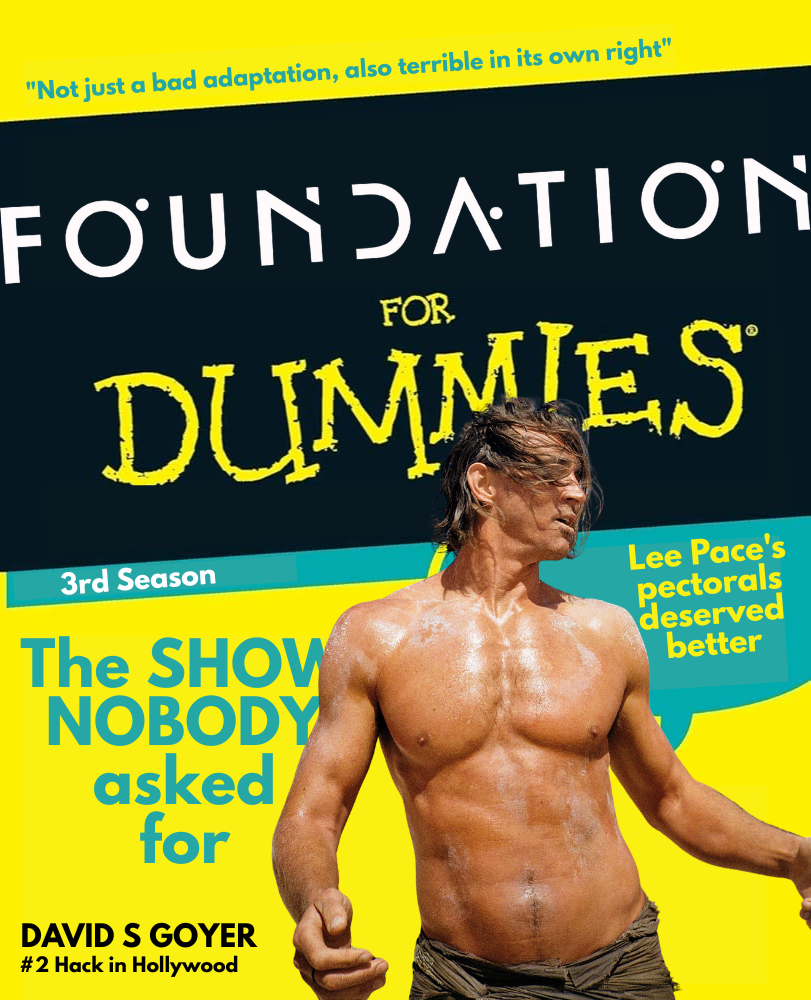
If you’ve been watching the Apple tv show Foundation and are wondering where all of Asimov’s ideas have done.
They aren’t in there.
Asimov wrote Foundation to make pulp adventure space opera into serious hard science fiction.
In a perverse twist the makers of the show decided to turn hard SF back into badly written pulp space opera.
We live in an era where high concept, intelligent science fiction is smashing the box office and winning all the awards in Dune, Severance and Andor.
Meanwhile, the dumbed down Foundation is barely watched, with its few fans only tuning in for Lee Pace’s bare chest.
Turning Foundation into Scifi For Dummies doesn’t work, because we aren’t dummies.
Foundation is a story about the impassive patterns of history, which the show reduces to Space Dictator vs Space Wizard snarling at each other.
Some of the visuals are ok though so I put them to better use in this video.
The failure of the Foundation show is a huge lost opportunity. Because Asimov’s saga is the guide to civilizational crisis we needed.
In the midst of our ongoing Seldon Crisis.
The Foundation saga is structured around the major crises faced by the Foundation.
These crises are predicted by psychohistory and the plan of Hari Seldon, hence they are dubbed Seldon Crises.
The Crisis of Anarchy sees the Foundation as an impoverished planetary colony outsmarting its neighboring warlords.
The Crisis of Religion charts how the militarily underpowered Foundation uses religion as a powerful tool.
The Crisis of Commerce narrates the emergence of Merchant Princes, and the Crisis of Empire pits Foundation against the empire that birthed it.
Crises of Anomaly, Guardianship and Purpose follow in later sequels.
Each major crisis emerges as the Foundation enters a new stage of its development as a civilization.
And it’s this progress from one stage of civilization to the next that causes each major Seldon crisis.
In a dialectic of history.
#
A dialectic Asimov understood from real attempts to make a science of history
As a Russian emigre, whose family survived the Bolshevik revolution, and a member of the radical Futurians, Asimov was certainly familiar with the philosophy of German idealism.
And its most famous son.
Immanuel Kant had revolutionised philosophy in the 1700s with his “transcendental idealism”.
Kant argued that history was guided by the power of human reason towards an ever more rational, just and enlightened future.
In the 1800s GWF Hegel built upon Kant to develop his Hegelian dialectic, a grand model which showed history and civilization progressing in stages of development.
Each stage represented a new idea, or thesis, of freedom. But over time this idea would would come into conflict with its antithesis, and from the conflict, via a process of sublation, a synthesis new idea would emerge.
With this process driving history forward.
Then in the 1900s a “young Hegelian” would reinvent the dialectic, rejecting the idealism of Kant and Hegel and replacing it with a materialist critique.
The dialectical materialism of Karl Marx.
Marx’s claim that he had made a “science of history” is based on the German definition of science as an an organised body of knowledge, not the Popperian ideal of falsifiability.
Nonetheless, few people other than fundamentalist Marxists believe in Marxism as a science. It is inarguably the most influential philosophy of the modern era, it suffers from the failings common to all ideologies that Marx himself critiqued, which lead him in later life to declaim only that he knew he was not a Marxist.
And it fulfills many of the messianic and millenistic criteria of religion.
Which may be the most interesting way to understand Psychohistory.
Because Hari Seldon is at least in part a reimagined Karl Marx. Psychohistory is a science of history like Marxism.
And the Foundation is a civilisation in the grip of a a charismatic prophet who speaks with the authority of science.
And whose predictions guide the state to a utopian future, and define its exceptional purpose.
A definition that could fit both the Soviet Union and the United States in the 20th century.
And can tell us something important here in the 21st century.
About our Seldon Crisis.
Our Seldon crisis…
…is a Crisis of Reason.
We have armed ourselves with unprecedented analytical power yet stand paralyzed by the sheer complexity of the systems we have created.
The very tools of reason we honed to master the world now reveal its fundamental unpredictability. We build intricate models to forecast economic trends, climate change, and geopolitical shifts, yet we are repeatedly blindsided by the equivalent of Asimov’s “Mule”—the unforeseen outlier, the black swan event, the eruption of the irrational that defies all reason.
This is not a failure of reason, but a failure of our faith in determinism. We pore over the digital entrails of big data, promising salvation through algorithms while ignoring the lessons of both history and science fiction.
There is no unified equation, no grand theory, that can account for the future.
Instead our faith in models blinds us to where the future truly comes from.
The future is not a problem to be solved by a grand equation, but a story we are writing ourselves.
Together.
Which is why science fiction matters so much today.
You should read Foundation not because Asimov could see the future, he could not.
But because it reminds us that there is a future ahead of us.
And its potential is limited only by our powers to imagination.
What we want our story to be.
#
And by the shadowy cabal using the secret science of Psychohistory to manipulate us all.
 Damien Walter