This essay is one half of a collaboration with the Feral Historian youtube channel. You can find both videos linked below.
Cricket is a game that we British invented and exported to the world, assuming that having invented the rules, we would always win by them.
In fact the whole point of cricket was that it didn’t have real rules. Cricket is a game so slow and tedious that the winner is whoever can stay awake to the end.
While drinking gin.
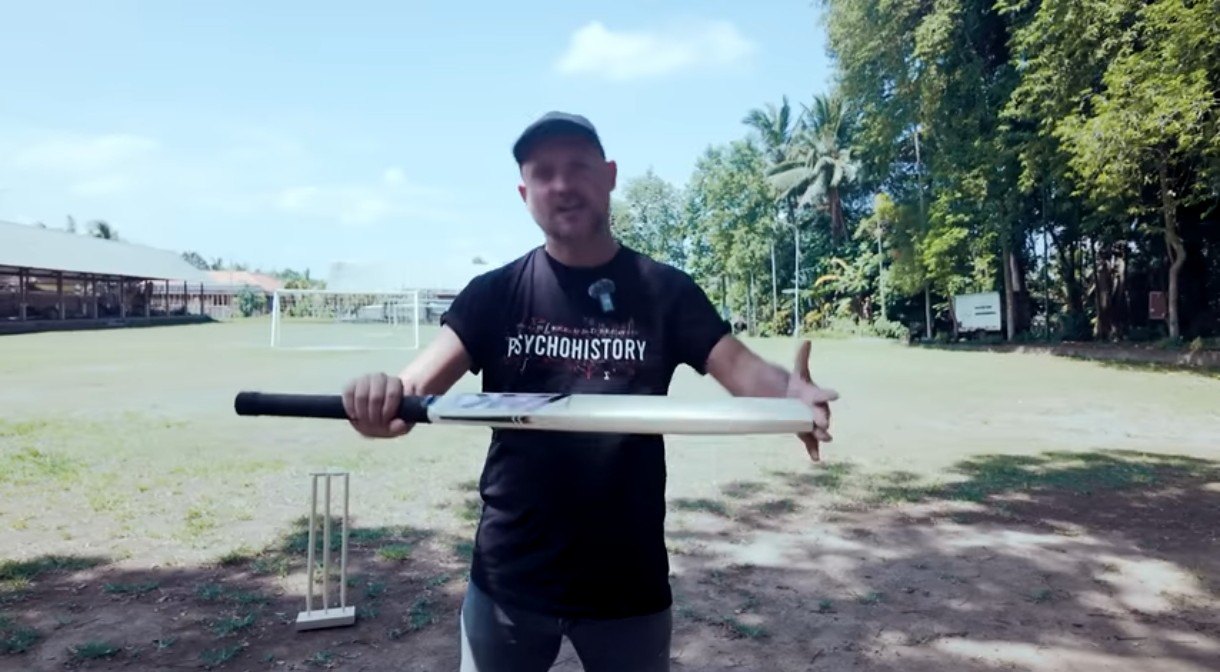
But we British had a problem. We had built a global trading network AKA Empire, that covered a quarter of the world’s landmass. But it turns out that governing an Empire is very VERY expensive. So we were trying to get the Empire
to govern itself
but still give us money.
What if the disparate British “colonies” governed themselves in their own ways, but within an agreed Rules of Cricket? We even thought about re-naming our empire The Federation.
The Brits came this close to founding a federal World State.
And in the unlikely event any of our colonies ever came close to winning at “cricket” we, the English, knower of the rules of cricket, could just invent some new rules to make it so we win.
Welcome
to the rules based global order.
FH: Or “lawyers, guns, and money” but in reverse order.
Watch the full video essay here
“Look again at that dot. That’s here. That’s home. That’s us. On it everyone you love, everyone you know, everyone you ever heard of, every human being who ever was, lived out their lives.”
Carl Sagan
Seen from the orbit of Saturn, Earth really is just a Pale Blue Dot.
Any god-like alien entities surveilling us would no doubt be astounded to discover some two-hundred polities, plus an assortment of non-geographic alternatives, competing for dominance of this insignificant speck of mud and biomass.
And historians of the future will wonder how those 200+ polities made it to…whatever year we eventually nuke each other.
Or are swept away by climate conflicts.
Or collapse under resource depletion.
Or. Or. Or.
The Pale Blue Dot poses us a question. How do we, in the words of Carl Sagan, preserve the only home we’ve ever known?
That’s a question with no easy answers. Every great philosopher who ever lived has asked how humans can better live together.
But maybe we can find some ideas in science fiction.
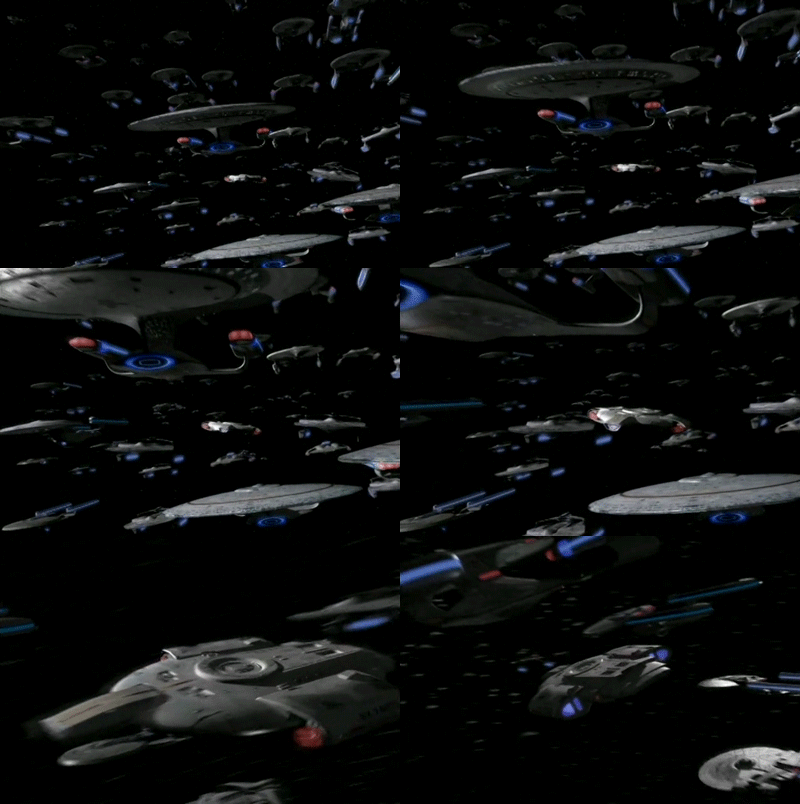
Star Trek remains – almost six decades on from its inception – the most optimistic and achievable vision of a positive human future.
We can definitely do worse.
MAD MAX / THE ROAD / IDIOCRACY CLIPS
By achievable I don’t mean we’re going to be riding Alcubierre Drive starships to the Vulcan homeworld anytime soon.
Because Star Trek isn’t really a story about warp drives, matter transporters and replicators. These are merely plot devices which allow Gene Roddenbery’s vision to unfold.
Star Trek is the story of…worlds. Strange new worlds. And how those worlds are governed. Star Trek introduced billions of us to the idea that we could think of worlds as a whole.
And how our world as a whole is governed.
Star Trek is about a galactic federal government – the Federation – modelled on the federal government of the United States.
And the efforts to expand the federal model of governance to the world, or galaxy, via the United Nations.
Star Trek is an idealised representation of federal government, that has arisen after a global nuclear war, and the idea that federal governance could bring peace first to Earth, then to the galaxy.
And that is the Star Trek vision we could achieve. The governance of Earth, as a federation of states, unified within a federal World State.
ALDERAAN EXPLOSION
I feel a disturbance in the comment section, as if millions of libertarians cried out in terror.
Absolutely, 100%, the reality of such a federal world state would not be the fantasy of Star Trek.
But it would at least be government of humanity, by humanity, for humanity.
Not machine.
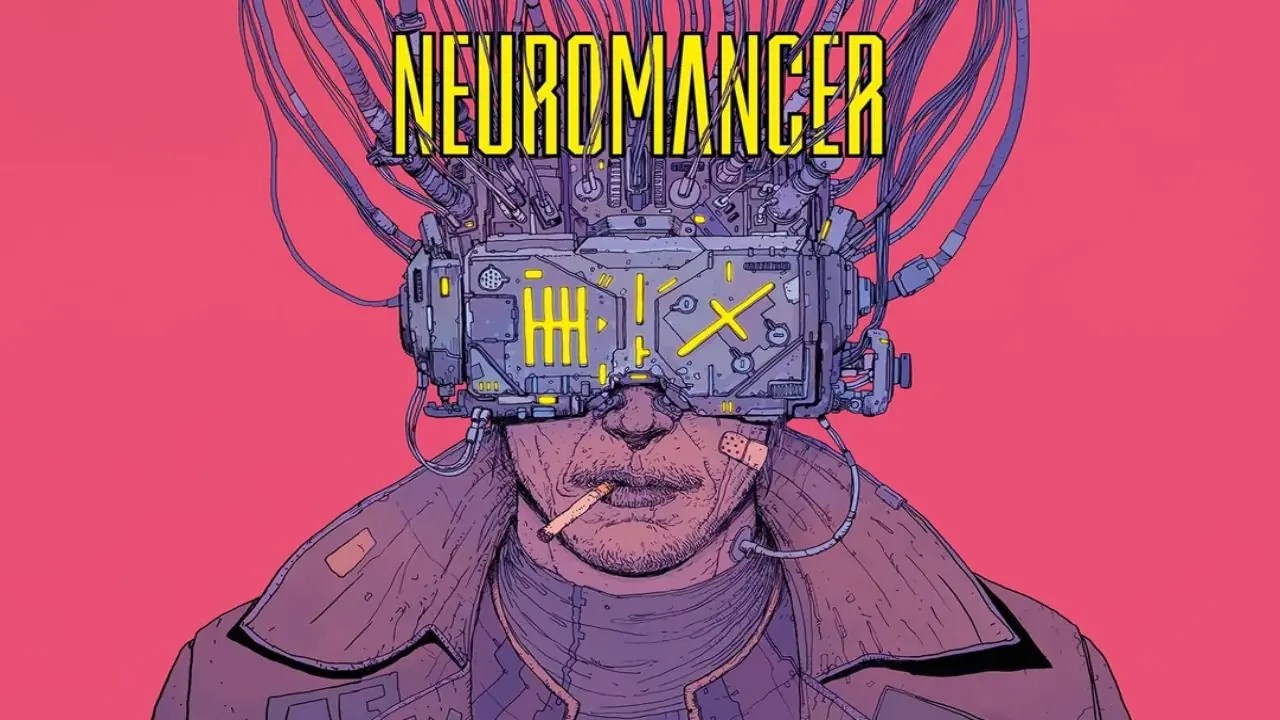
William Gibson’s Neuromancer is a world where humans are becoming machines.
It has some interesting parallels to Star Trek. The novel which invented cyberpunk is also set after a global war has collapsed national governments.
But instead of rebuilding a federal world state, Earth is now owned by competing corporate oligarchies.
Who have, with cloning and cryogenics, achieved virtual immortality.
There are no dates in Neuromancer. The story could be happening in 2025 or in 2125. The world is trapped in an endless now, a relentless cycle of capitalist exploitation, with elite wealth extraction driving the conversion of our world into one vast machine.
So Neuromancer, published in 1984, seems eerily like 2025.
On a timeline where humanity is becoming the Borg.
The essence of cyberpunk is the replacement of the human with the machine. Limbs replaced with cybernetic implants, imagination substituted with virtual reality.
Neuromancer is a future where the human animal is being transformed into a cybernetic machine.
Science fiction *can* imagine infinite futures. But I fear that our realistic choices from here in 2025 are between
Neuromancer
and Star Trek.
Between global machinic oligarchy.
Or a fallible, all too human, world state.
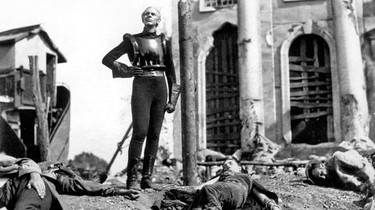
The argument over the World State in science fiction began with the near simultaneous publication of
Aldous Huxley’s Brave New World in 1932
and HG Wells The Shape of Things to Come in 1933.
Well’s is an…optimistic?…vision of a World State emerging to bring peace to Earth after a world war. It could almost be seen as a prequel to Star Trek.
Wells was a vocal supporter of a federal world state. But his depiction of its emergence is…problematic.
Mass aerial bombing is how the World State brings “peace”, in an eerie premonition of the decades that followed.
20TH C AERIAL BOMBINGS CRUISE MISSLES ETC
And once established the World State looks and sounds scarily totalitarian. If not fully fascist.
FH: The British Union of Fascists thought so too. I suspect if social media existed in the 1930s, the BUF would have successfully co-opted the film for their own ends.
Also spookily accurate.
The worrying thing about Huxley’s World State is how many people today actually think it sounds quite alright really.
Brave New World’s satire of American liberalism, with material plenty, a genetically enforced class system and infinite drugs to dull the boredom.
Looks near identical to Francis Fukuyama’s End of History. The future that liberals want.
Is like fascism seen from the inside.
Together Wells and Huxley show us the dark side of the World State.
Its tendency to technocratic control, the decay of individualism into hedonism, and the unfortunate habit of liberalism, when times get tough, to turn into fascism.
So if the World State comes with the constant threat of totalitarian fascism.
So what are our alternatives for a state…
…without a state?
FH: I heard “without a State” and I’d like to know more. <with Starship Troopers style graphics>
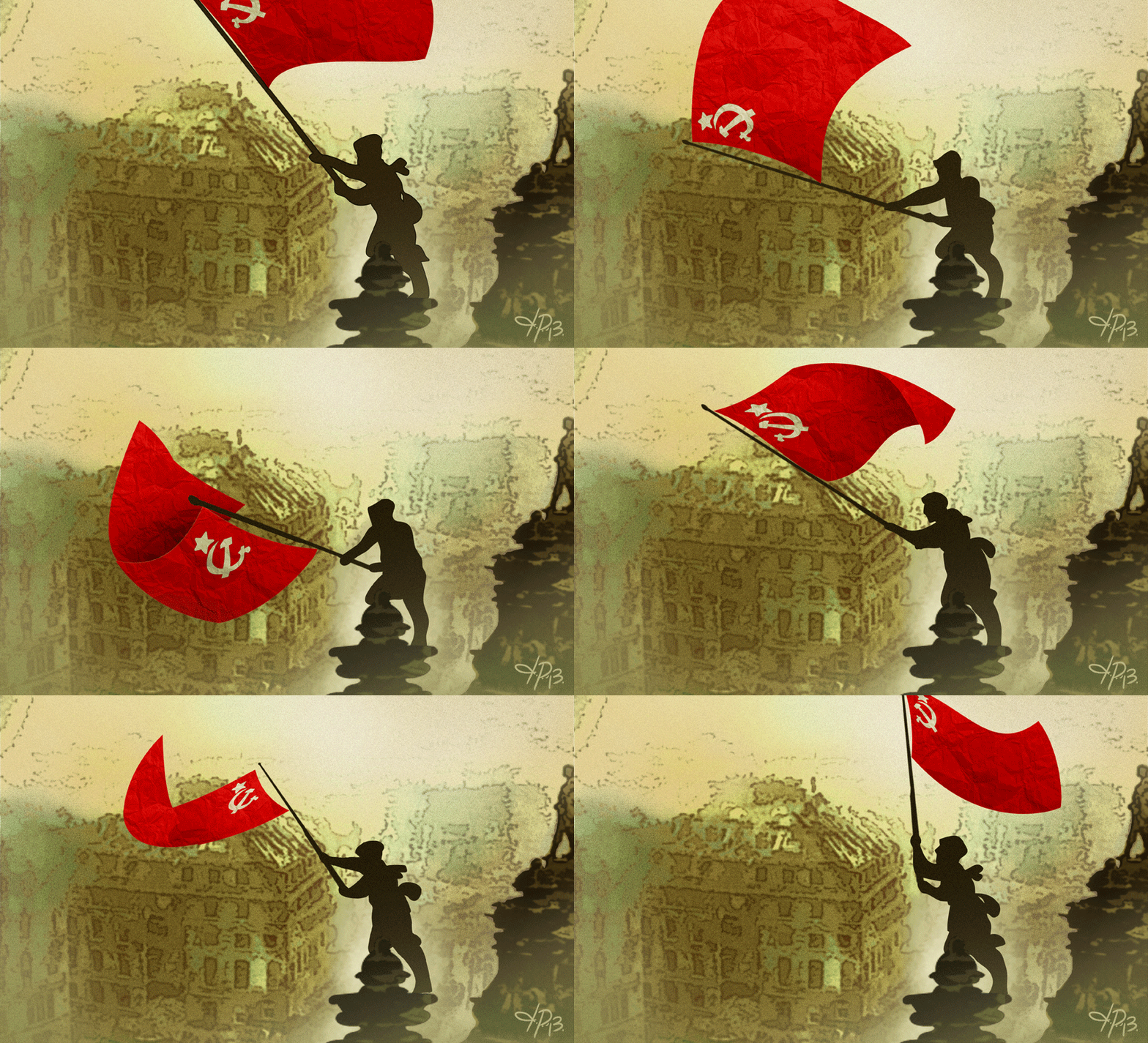
One of the great ironies of the 20th century is how and why socialism became, in the minds of many, equal to statism.
When socialism in all its varieties aims for the complete dismantling of the state.
Early works of utopian socialist science fiction like Edward Bellamy’s Looking Backward (1888), William Morris’ News From Nowhere (1890) and Alexander Bogdanov’s Red Star (1908).
Have in common varied depictions of the classless, and stateless, society that had come to be called communism.
But short-lived attempts at the communist “stateless state” like the Paris Commune of 1871 lead political philosophers like Karl Marx and others to theorise the need for a temporary state structure during the transition to communism.
Which Marx called the “dictatorship of the proletariat”.
The problem was that this dictatorship became, in practice, far from temporary.
Anarchist thinkers like Mikhail Bakunin correctly predicted that Marxism, in power, would lead to not temporary but permanent dictatorship.
George Orwell’s 1984, and the novel which somewhat inspired Orwell, Yvgenny Zamyatin’s We, both illustrate the inevitable collapse of Marx’s dictatorship of the proletariat into bureaucratic totalitarianism.
But state dictatorship is the failure state of socialism.
The real lesson of 20th century socialism is that attempts to do away with the state inevitably lead to the worst and most brutal forms of
the state.
But if the left can’t do without the state…
…what of the right?

Works of capitalist utopian science fiction are relatively rare.
Ayn Rand’s Atlas Shrugged is, arguably, the only truly significant work of capitalist utopian science fiction.
The capitalists, lead by the enigmatic John Galt, decide to go on strike and establish their own capitalist utopia to show the statist liberals and socialists how its done.
And…nobody notices.
What Atlas Shrugged inadvertently but quite hilariously demonstrates is that the high speed technological progress which drives profits for the capitalists.
Is actually a net negative for most of humanity, who lead happier lives without capitalists, just at a slower rate of progress.
FH: And the kind of progress that capitalism has excelled at for the last 80 years or so is the sort built on programmed obsolescence and throwaway products. But how much better might our products be, and how much more efficient our use of resources, if brand loyalty was built on a generational timescale rather than just as hype for next year’s model? Is throwaway capitalism a perversion or an inevitable result?
Nonetheless, Atlas Shrugged is the inspiration for a wave of scifi novels posing as non-fiction from ambitious tech bros capitalists including Alex Karp’s Technological Republic and Balaji Srinivasan’s Network State.

If these right wing visions of a techno-utopian stateless state were ever realised one of two things would happen.
Either the Silicon Valley elite would disappear up their own Galt’s Gulch
Or they will become the capitlist corporate oligarchies
of Neuromancer

In the grip of an amphetamine induced psychotic break
his delusions shaped by multiple readings of William Gibson’s Neuromancer
the British philosopher Nick Land wrote his famous work of “theory-fiction”
MELTDOWN
The work which defined the extreme right-wing philosophy of Accelerationism.
And a hyper-dense examination of the “techno-capitalist singularity”.
From the invisible hand of Adam Smith, to Karl Marx vampire of dead labour, to the rhizome of Deleuze and Guattari,
philosophers have speculated that capitalism is best understood, not as a simple economic system
but as a self governing cybernetic entity.
Deterritorializing human civilisation, and the human being
and reterritorializing us as the body of a new cybernetic lifeform emerging from the techno-capitalist singularity.
If you want a picture of the future imagine all human life on Earth assimilated into the Borg, not by a cube from outer space, but by a cybernetic God born from the logic of capitalism.
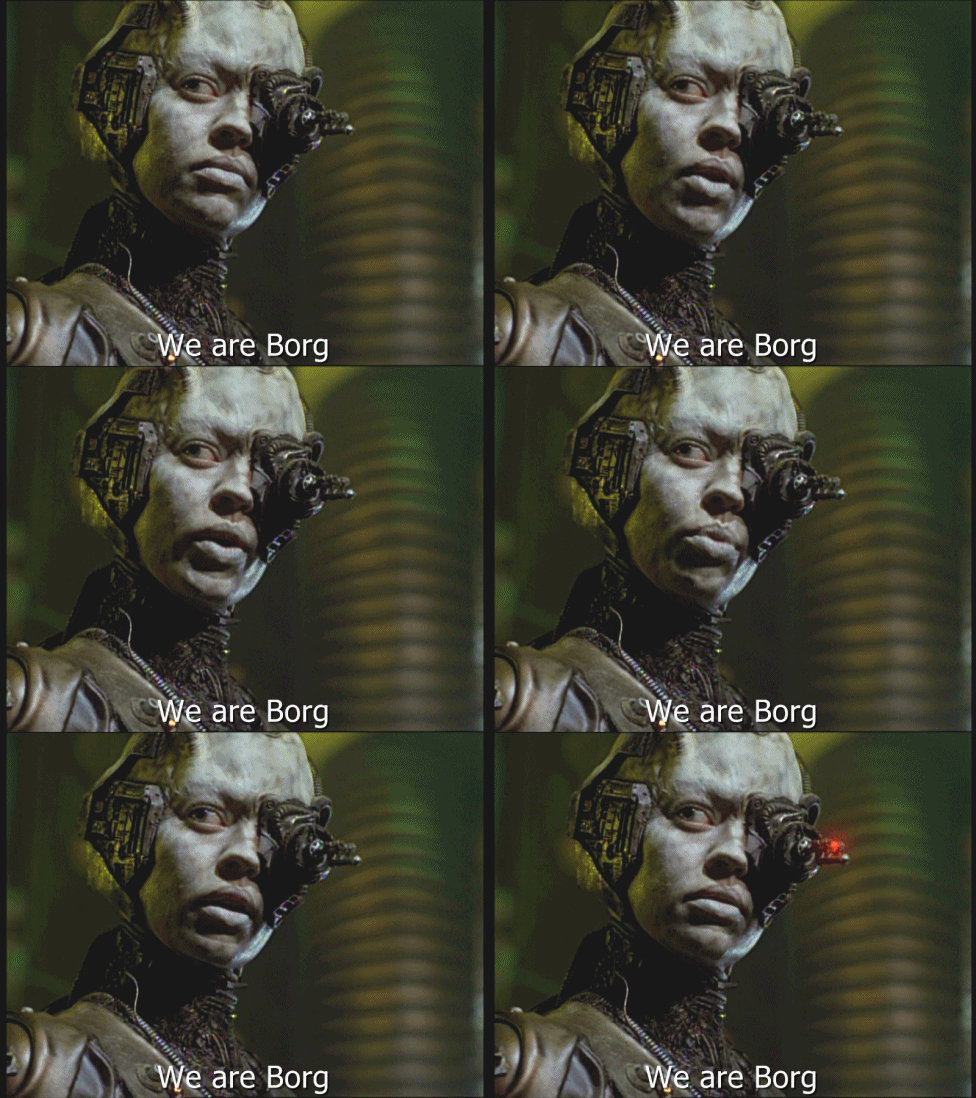
Neuromancer is the *toned down* version of the posthuman, transhuman Accelerationist nightmare.
And the only thing we know of in the galaxy that can defeat the Borg…
…is the Federation
#
But we were talking about cricket
We Brits invented cricket as a game we would always win, and then proceeded to lose at cricket in ever more humiliating ways for over a century.
The British empire laid the foundations of a federal world state from a mixture of self-interest, corruption, power maneuvers and lofty idealism.
And the American empire built on them for the same mix of reasons.
The irony for the conspiracy minded who fear a globalist New World Order is we’ve been living in that order since 1945.
The US federal government has been the de facto government of a world state since the end of WW2. For better or worse, it’s likely the only reason we haven’t nuked each other yet.
And now like cricket, the other players in the game of the federal world state are increasingly learning to win, or even rewrite the rules.
It’s corrupt, chaotic, at times brutal, unfair and heartbreaking.
But the most important thing about our federal World State
is that it’s human.
This sickening, fascinating geopolitical mess is what human self-government looks like.
And it’s the only thing that can keep humanity in the game of determining our own future.
Against the relentless opposition of the Machine.
Star Trek or Neuromancer.
If we want our future not to be posthuman or transhuman or as inhuman as the Borg.
The World State isn’t just inevitable.
It’s our best…bat
#
Watch Feral Historian’s case for NO here
Predict the future of humankind with the equation of Psychohistory on a t-shirt from the merch store

 Damien Walter