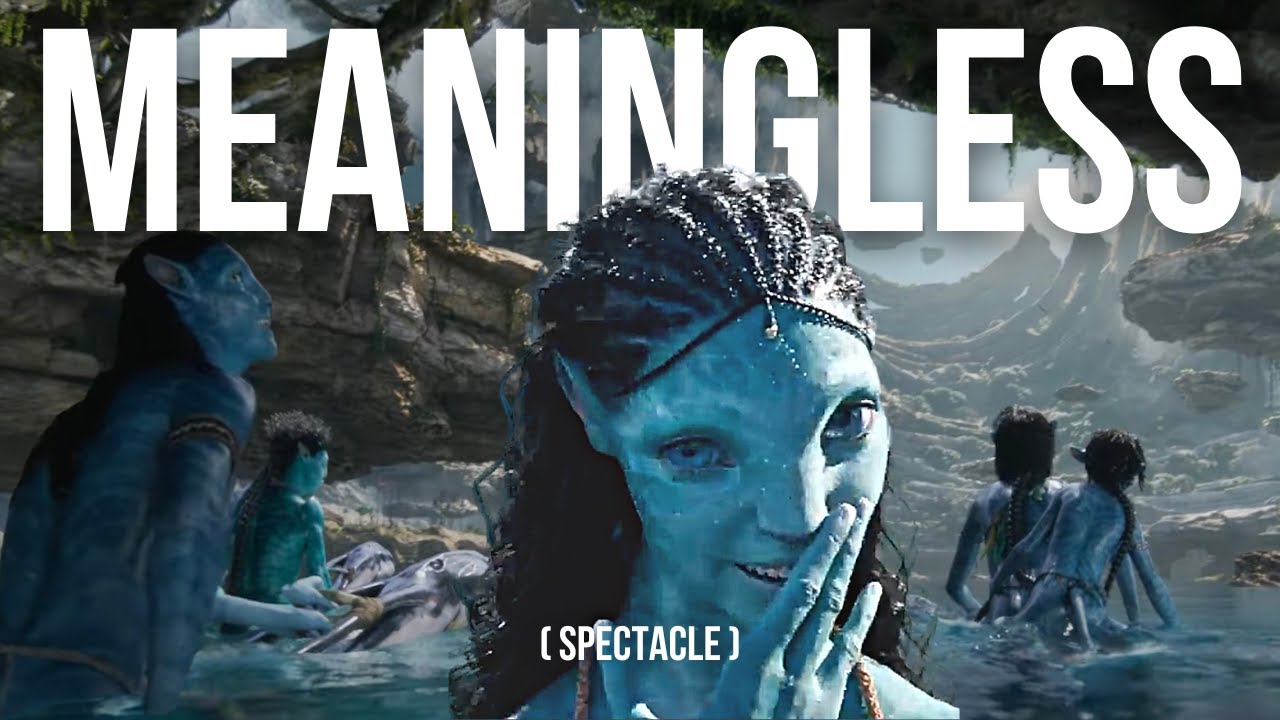
The Paradox of Avatar
The Avatar franchise idolizes the “primacy of the primitive.” It revels in the natural existence of the hunter-gatherer tribesperson, placing the most basic forms of human civilization on a pedestal as “the good.” And then it says: fuck that shit. We want high technology, we want glittering imagery, and we want the Society of the Spectacle.
Watch the video essay
The History of Cinematic Spectacle
Back in 1896, the Lumière brothers released the first blockbuster: a train arriving at a station. Audiences were so flabbergasted by the moving image that it became a sensation. Of course, showing a train today wouldn’t be a blockbuster, because the criteria for what we consider a spectacle are always moving.
If one director has followed the course of the spectacle in the modern era, it’s James Cameron. From the underwater landscapes of The Abyss to the liquid metal of Terminator 2 and the sinking of the Titanic, Cameron has always been there pushing the boundary. But for decades, he combined that spectacle with classical storytelling—Titanic was a romance, after all.
That changed with Avatar. Cameron became so engrossed in the technology that, while he created a massive hit, there was really nothing to enjoy on the front of story.
The Society of the Spectacle
This isn’t a review of Avatar: The Way of Water. I didn’t find enough meaning in it to critique it. Rather, this is an essay about how such a meaningless story can be so successful. We live in the greatest contest of spectacles human civilization has ever seen, exactly as predicted by the French Marxist philosopher Guy Debord.
In his 1960s text The Society of the Spectacle, Debord argued that the profit motivation of capitalism leads us to select the spectacle over the social. In cinema, this means we choose explosive CGI over subtle stories about real human relationships.
Spectacle eats meaning. As we choose the blockbuster again and again, the systems providing our culture are rewired. The local theater showing meaningful art is replaced by the multiplex in the shopping mall, which must show mass-produced spectacles like Marvel or Avatar to survive.
Systemic Capture
This capture extends beyond movies. It consumes the political: our elections, once fought between experienced politicians, are now battles between reality TV stars. It consumes the personal: in the age of Instagram and TikTok, we choose friends and actions based on who is most “spectacular” or who generates the most likes.
As Debord wrote, spectacle is “the sun that never sets over the Empire of modern passivity.” The British Empire ruled through violence; the modern capitalist empire rules through distracted passivity.
Avatar 2 is a Relic
Here we are with Avatar: The Way of Water, the perfectly evolved predator for the multiplex era. The problem is, that era peaked over a decade ago. Avatar now feels like someone in 1905 showing you a train pulling into a station—it’s not quite a spectacle anymore.
James Cameron has lost his grip. Today, the true Society of the Spectacle lives on social media. Audiences accustomed to highly engaging, 10-second clips on TikTok are not turning up for a three-hour movie they’ve essentially seen before. We are bored of the spectacle. We are demanding story and meaning again, which is why we are turning to shows like House of the Dragon or Andor—a sophisticated Star Wars story for grown-ups.
The AI Threat
I worry for James Cameron. He is planning more Avatar movies just as AI tools like Midjourney and ChatGPT are emerging. We are only a few years away from “Avatar Infinite”—AI-generated worlds of blue dudes and meaningless hero’s journeys churned out faster than any human can consume them. Cameron’s role will be lost in a world where computers generate the spectacle for us.
Conclusion
Thousands of years ago, our ancestors used mud and stone to paint caves, creating stories so meaningful they shaped human civilization. Our culture does not have to be eaten by the spectacle. The artists creating meaning are still there, in the cracks between the Disney Corporation and the tidal wave of AI content. We simply have to find them.
Listen to the podcast audio
 Damien Walter