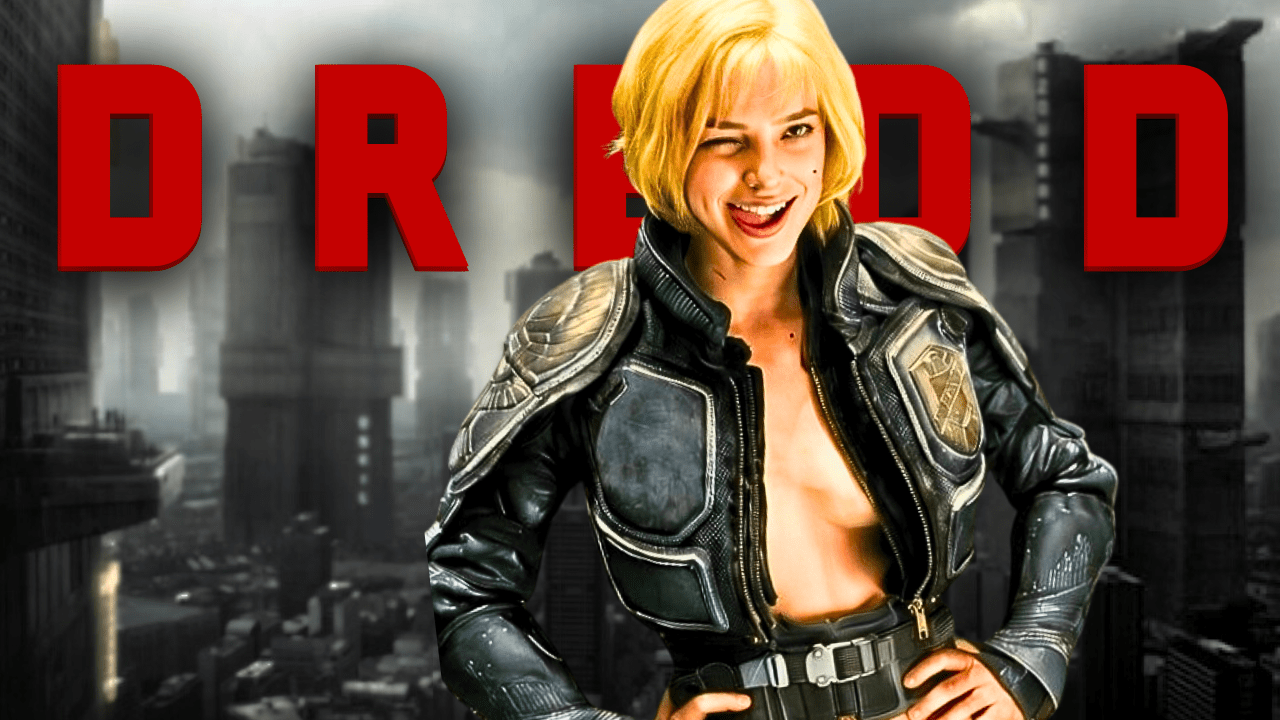
We like DREDD
We do. We all like DREDD.
Not the god awful Stallone attempt, which we’re not going to mention again.
Not even the original comic, even though it’s “seminal” and we’re about to talk about it much more.
We like DREDD. The 2012 movie starring Karl Urban’s jaw, and written by none other than auteur writer director Alex Garland and, basically, his unofficial directorial debut.
We like *that* DREDD.
Watch the full video essay
Because…
…because it’s “gritty*. Because it’s “uncompromising”.
Because we can sit in front of our 150 inch home projector screens –
I just set this up and I thought what better way to test how deep the blacks go than a trip to Mega City One.
– we can sit in our home cinema sipping our artisanal IPAs while we say to ourselves.
“I am watching a sophisticated critique of the military-industrial complex and the erosion of civil liberties in a post-democratic landscape.”
When actually we’re just watching a man with a very cool gun kill people who make us feel…uncomfortable.
Because if we admit that we just quite like the idea of a stern man in a helmet coming along and…tidying up…the “chaos” of the modern world with a high-velocity armor-piercing hotshot…
Well, then…
We might have to admit that we like the jackboot.
We like that the man wearing the boot doesn’t have to check his privilege because his privilege is a gold eagle on his shoulder that gives him the authority to throw you off a balcony.
We want the boot. But…we just want the boot to be “clever”? To have read a bit of Baudrillard. We want the boot to be “self-aware.”
”Oh, look at that boot,” we want to be able to say. “That’s not a boot. That’s a deconstruction of the very concept of the boot.”
We love the boot. We salivate over the boot. We watch the boot in 4K hi-res so we can see every detail of its stitching as it stamps on a human face – forever.
And if the boot also has a cute blonde bob, petit figure and the suggestion of nudity under the leather…
…then we might have to admit that fascism is at least a little bit…just a tad…sexy?
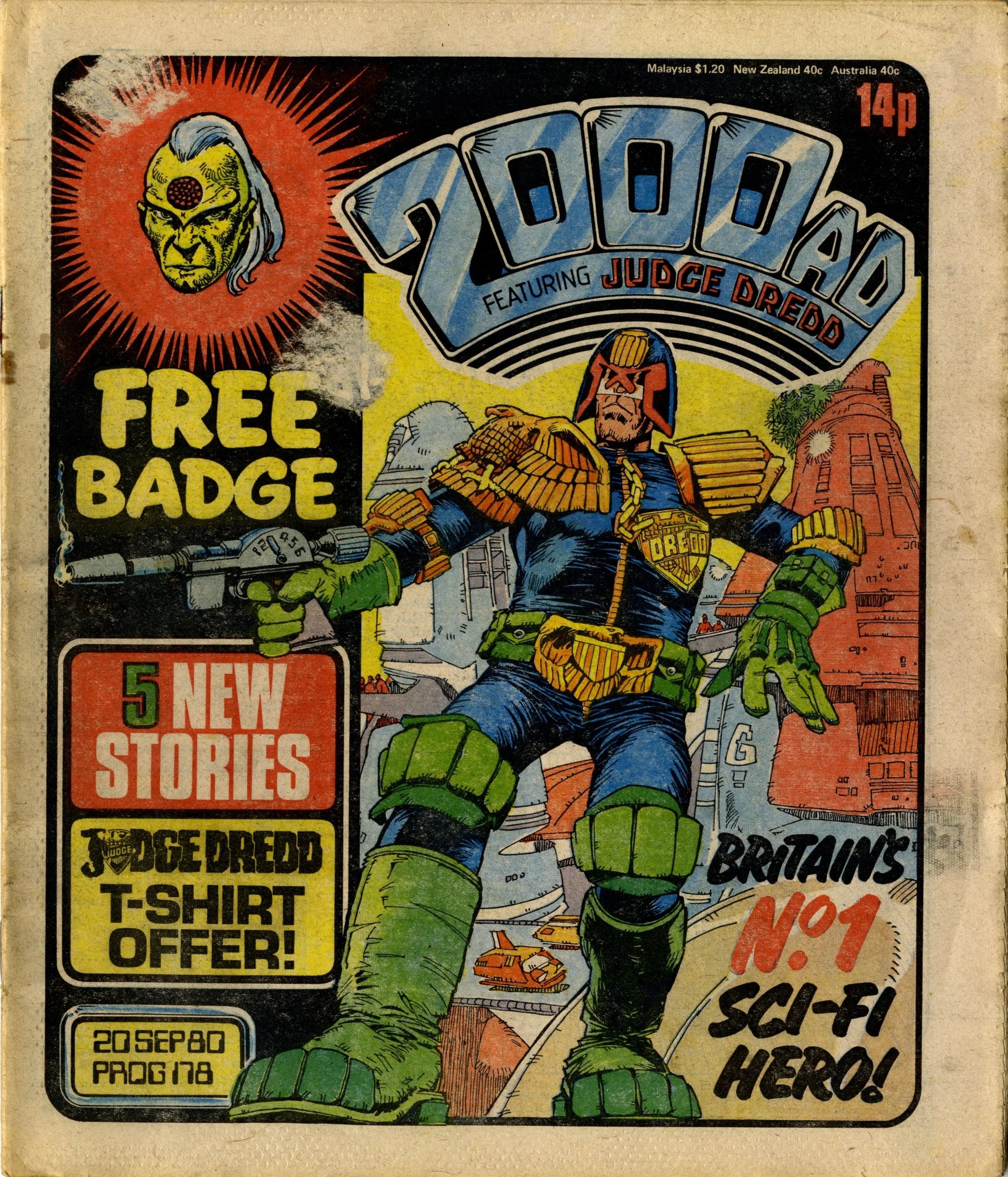
The original Judge Dredd is a one joke comic strip.
And the butt of that joke is American fascism.
In his early appearances Dredd tracks down a criminal or a rogue Judge and sentences them to a violent, gruesome fate. It’s repetitive. It’s simple. It’s the same joke, told over and over again, for years.
And from his very first appearance Dredd was a contradiction. He was a clear and present satire of authoritarian state violence.
But he was also just a mega-violent superhero that kids and grownups could enjoy for a violent thrill.
Judge Dredd always was the thing that Judge Dredd critiqued. He is the snake eating its own tail, but the snake is wearing a helmet and the tail is a perp.
This ironic overlap of critique with the object of critique became a standard technique in UK comics.
Judge Dredd was created by John Wagner as writer and Carlos Ezquerra as artist. Dredd was also guided by Pat Mills, the first editor of 2000AD, the publication that reinvented UK “boys comics”, and Dredd’s true home.
Mills and Wagner kickstarted the UK comics revival that would bring writers like Alan Moore, Grant Morrison, Warren Ellis, Mark Millar and Garth Ennis to notoriety.
In place of bland boys’ own adventure stories, 2000AD published scifi and fantasy that always had a strong edge of political satire. Usually against right wing authorities, but also complacent liberals and up themselves socialists. It was anarchic, anti-authoritarian…
…and violent. Mega-violent.
2000ADs satirical edge gave it freedom to present mega-violent storylines by passing them off as critiques of that very violence. Today a show like The Boys, based on Garth Ennis original comic, is the inheritor of this irony passport to mega-violence.
But in the heavily censored culture of late 1970s Britain that satire-violence cocktail made 2000AD hugely popular.
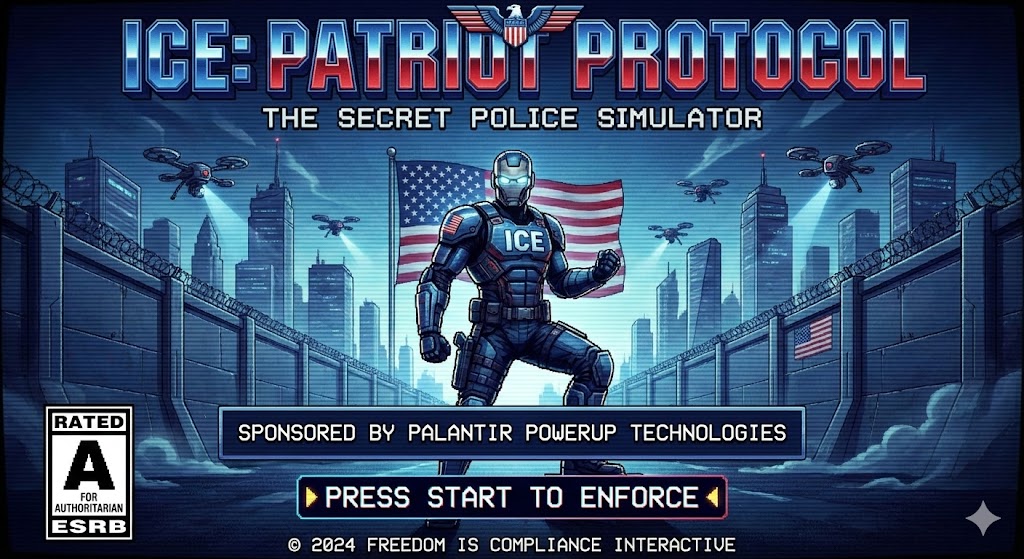
Thanks to
ICE Patriot Protocol
The secret police simulator that puts the ICE back in “I Am The Law”
For sponsoring this video
You play a second term President who has to Keep Power or face prosecution for serious corruption.
Fortunately you have billionaire backers and the Supreme Court in your pocket, so now all you need is
muscle.
Don’t Immigration and Customs Enforcement belong on the border? HAHA! No!
Not when you can deploy them to Blue Cities to beat up brown people. Wait…those Somali Americans are actually citizens?
That’s a feature not a bug. Just unlock the Domestic Terrorism upgrade and GUESS WHAT? Now you can also beat up white citizens!!

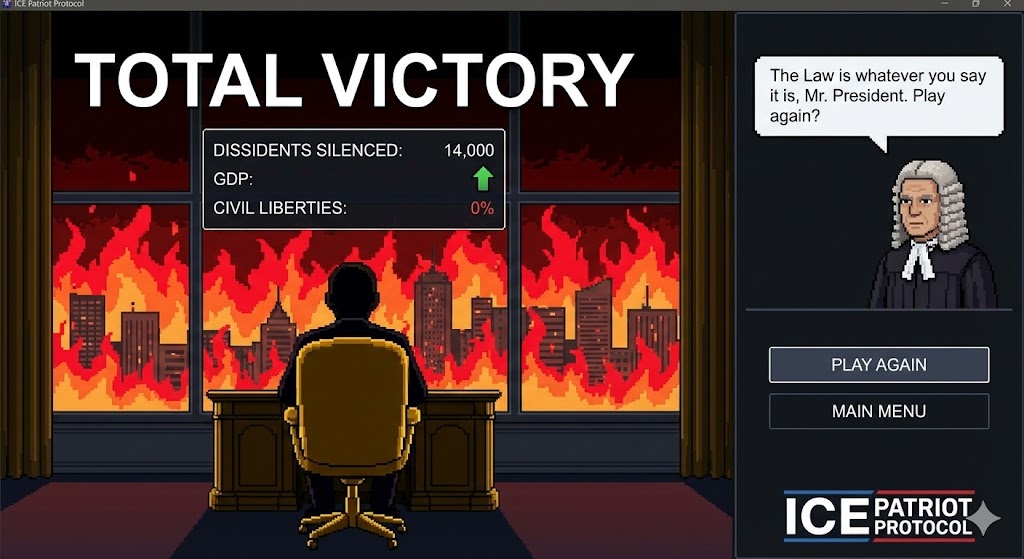
Manufacture “Internal Threats” and raise your National Security score high enough to unlock Congressional Funding and you get the
PALANTIR POWERUP
Data scrape social media for terrorist keywords like “Protest”, “Unionise” or “Basic Human Empathy” and compile your Dissident Hit List.
Look at this Class 4 Subversive tweeting about “Fair Wages”. Just send in an Unmarked Van of ICE Agents and he’ll be rendered to your Black Site.
One you’ve dealt with the leftists… er… terrorists… escalate to journalists, opposition leaders and / or anyone with assets you want to expropriate.
PATRIOT PROTOCAL
Because constitutional democracy is Woke.
US culture had made its own turn towards graphic violence in 1971 with the now iconic Dirty Harry.
With poverty and crime spiking across major American cities, in retrospect more a product of lead poisoning than liberalism, Clint Eastwood as Harry Callahan wasn’t just a movie, it was a manifesto.
All Americas problems could be solved by a representative of the law
Killing those dirty hippies!!
And so Dirty Harry’s “Make My Day” became Judge Dredd’s “I Am The Law”. Harry hunted down hippies with his .44 Magnum for the catharsis of conservatives, Dredd satirised the same to make Brits chuckle about dumb Yanks.
Because from the very beginning Dredd was a satire of American fascism.
That’s who Dredd is. That’s what makes Dredd great.
But that becomes a problem when you want to take Dredd from the pages of a subversive UK comic…
…and make him a franchise for mainstream US audiences.

Ok I lied to you…I have broken the social contract between video essayist and you the viewer…we do have to talk about the Stallone movie.
Because one “answer” to Dredd as a satire is to just ignore the satire and play Dredd straight.
The Stallone movie is bad for many reasons, which you can find many critiques of.
But the one “good” thing about the 1995 Dredd is that it does look like the original comic. Brightly, proudly yellow and blue. Overblown and oversized. And the ABC Warrior cameo is cool.
But that one good thing is also the problem. In the comic the Judge costumes are an absurd parody of the Hugo Boss designed uniforms that Nazis love. In the movie the Gianni Versace costumed Judges are no longer a parody of fascism.
They just are fascist.
Sexy fascists. With codpieces.
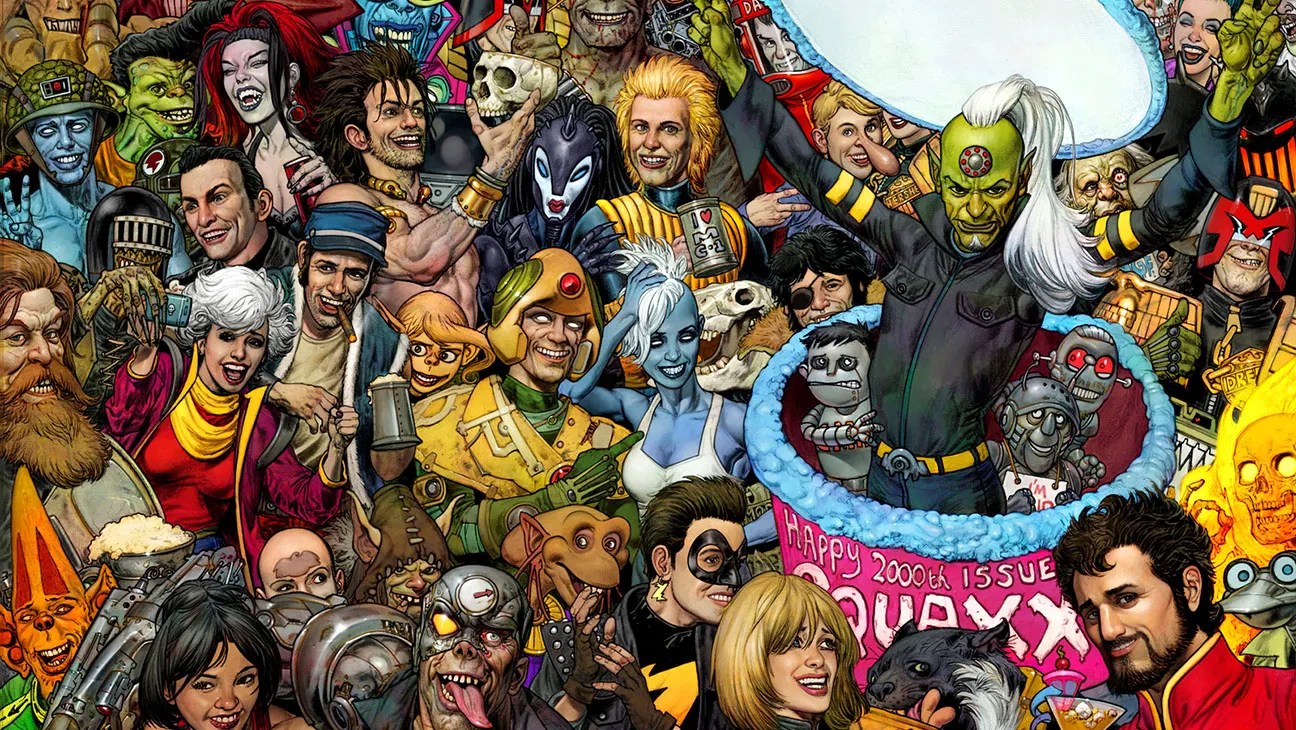
Despite its huge success 2000AD was ultimately doomed.
The shift from media scarcity, from a 1970s UK with three television channels, one of which was usually showing a man painting a vase, to the media saturation of today, meant that anthology comics like 2000 AD would soon lose popularity.
But as comics themselves died, the new era of Superheroes as Intellectual Property was just beginning.
It’s questionable if Judge Dredd has ever actually been a valuable IP. But the massive value of Marvel and DC has led a series of owners to buy 2000AD and keep it in print long beyond its natural lifespan…
…as a bet. A wager that the 2000 AD IPs, most importantly Judge Dredd, would one day become valuable.
But between his heyday in 1980s 2000AD and the attempts to force him into becoming a mass-media franchise, Dredd would have a brief golden age.
In 1989 Pat Mills and artist Simon Bisley published Slaine : The Horned God. Bisley’s art style would take UK comics by storm.
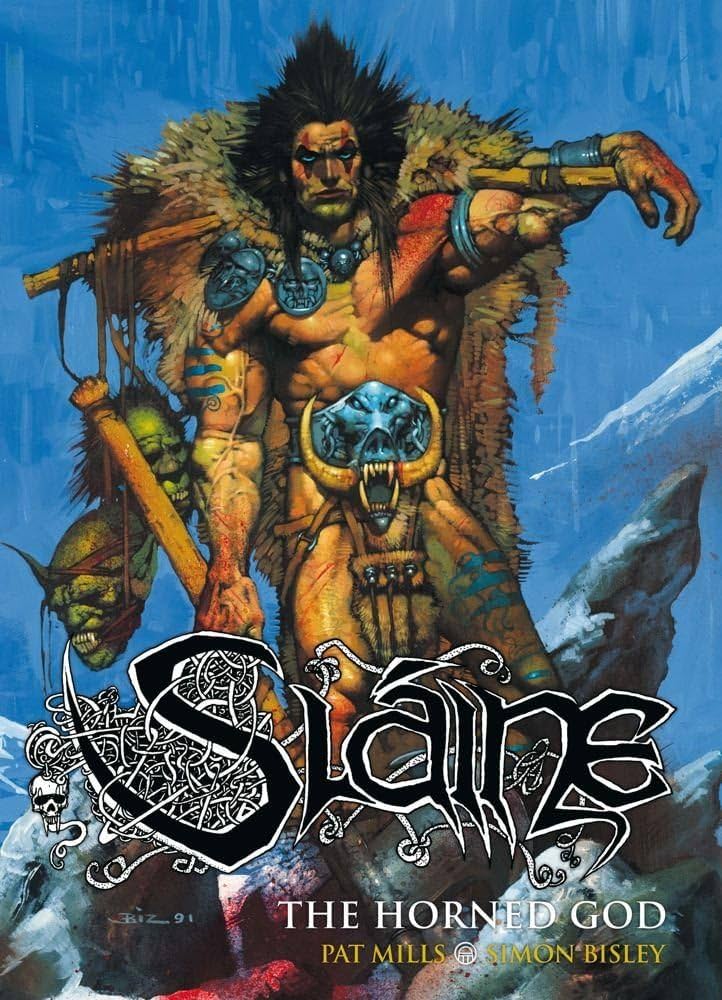
Influenced by the oil paint illustrations of the legendary Frank Frazetta, Bisley developed a technical style combining acrylics, gouache and air brush that simulated the look of oils…
…but had short enough drying times to be scanned and shipped to meet comic production deadlines.
This “fully painted” style dominated UK comics through the 1990s. It drove the move from single issue comics to graphic novels as the higher calibre of art called for higher production values and more complex and adult storytelling.
And sparked an era of intensely political UK comics.
Pat Mills amped up the mega-violence in Marshal Law, a super-hero hunter dealing with the aftermath of a US Imperialist war against Marxists. And gave the same themes a more serious exposition in Third World War.
Frank Miller and Dave Gibbons Give Me Liberty delivered a brutal parody of far right and liberal politics.
Jamie DeLano’s HELLRAISER run made the occult magician a work of social realism attacking 80s consumerism. The New Statesmen by John Smith and Jim Baikie was The Boys before The Boys.
And of course Watchmen.
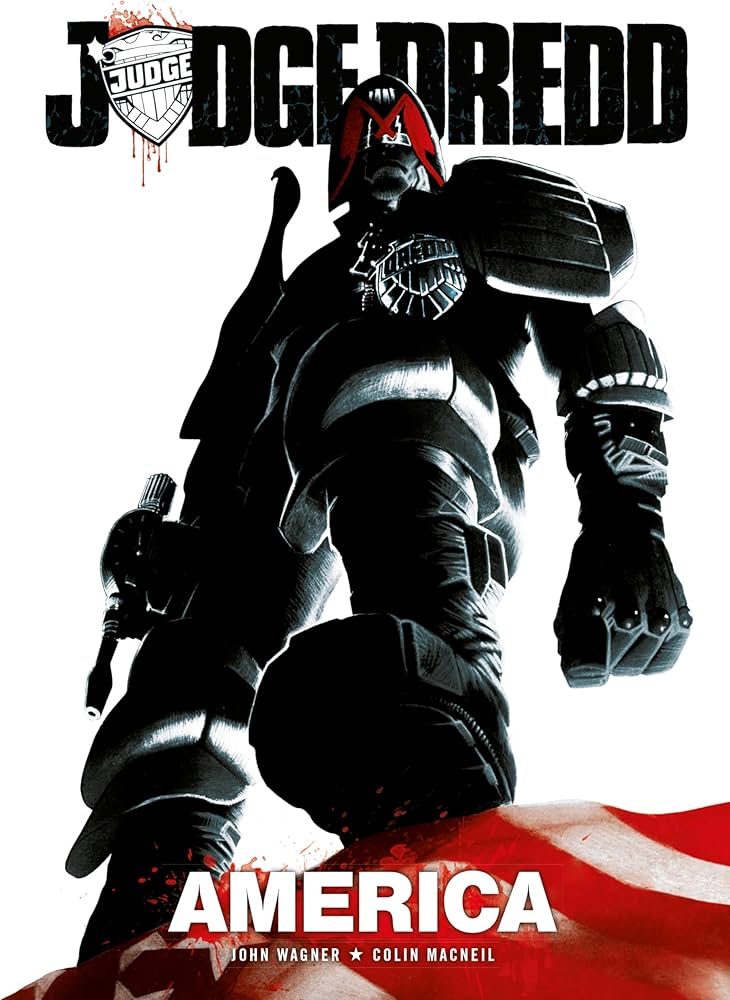
In 1990 the Judge Dredd Megazine was launched, specifically to showcase Dredd in full painted splendour. The dark, atmospheric paint style of Colin Macneil showed us Dredd as never before. Freed from the juvenile comic action and punchy beats of the weekly comic, John Wagner delivered an adult, sophisticated Dredd storyline, widely considered the best story arc in Dredd’s history.
Titled under the single word.
America.
What I can’t fully grasp about Dredd is Alex Garland’s original vision.
At the midway turning point of Dredd 2012 a poor homeless man is crushed by a massive security door. This is exactly the one joke that the original Judge Dredd featured every week. The ordinary man crushed by the impassive machinery of the state.
But this is the only moment where Dredd nods to the satirical tone of the original.
Casual viewers of Dredd will likely note its marked similarity to the Raid movies, an Indonesian martial arts action movie franchise that featured out-numbered police officers fighting their way through a tower block.
However, production of Dredd was almost complete before Raid released. It’s very unlikely Raid had any influence on Dredd. But there is a reason they seem similar.
Garland’s script for Dredd was primarily influenced by the same Dirty Harry that inspired the comics, and The Battle of Algiers, a 1966 movie about the Algerian struggle for freedom from French occupation.
Garland seemingly intended his Dredd as not a heroic police officer but a colonialist occupier.
But that intention was never fully realised. Dredd’s script is primarily an action movie to appeal to mainstream US audiences.
This script would be directed by Pete Travis, a young director rising to fame on a series of smart politically themed action thrillers. A good fit for Dredd.
In theory. In practice Travis vision was for a much more high octane, less cerebral movie than Garland had scripted. It’s Travis action fueled take on Dredd that makes the movie resemble the Raid movies.
“A huge part of the success of Dredd is in fact due to Alex Garland and what a lot of people don’t realize is that Alex Garland actually directed that movie”.
~Karl Urban
Travis was removed from the directors chair after the first cut, and Alex Garland entirely reedited the movie. As the producer Garland was also on set for much of the shoot.
So Dredd is in effect Garland’s uncredited directorial debut.
Drama aside, this makes Dredd something like a painting started by a master, then painted over by a journeyman, then repainted by the master. A veritable palimpsest of egos.
However it happened, nothing about Dredd quite works.
As an action movie Dredd is a second rate action movie. The action set pieces are imaginative. Miniguns blowing out an entire floor of the block is ambitious.
But it’s like a knockout punch that doesn’t land.
Kinetically Dredd’s action keeps missing the mark.
But Karl Urban’s jaw is a hit. The only tool Urban is left to act with delivers an Oscar level rendition of the essence of fascism…
…disgust.
Disgust is at the centre of the fascist psyche. Like Adolf Hitler’s disgust at germs, at poverty, at the disabled, the other.
Judge Joseph Dredd is a man disgusted by the city he polices. But also disgusted by the work itself. Disgusted by the naivete of his new partner, and the grim reality they must enter.
Alex Garland’s edit allows a lot of quiet space for us to experience the “Fascist Gaze”. To just look at the world of Judge Dredd without judgement.
But.
Well.
Alex Garland let’s Joseph Dredd off the hook by letting him not talk much. The thing about strong silent types is when they do speak they often turn out to be
twats.
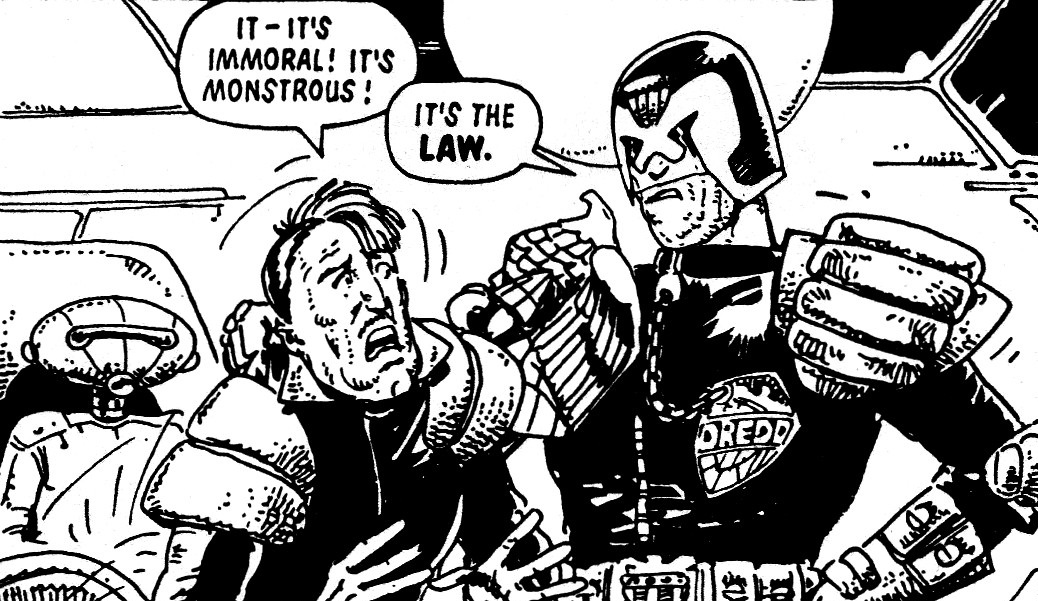
The original Dredd is the voice of bureaucratic evil, condemning rough sleepers to the iso-cubes with long speeches that amount to empty justifications for callous evil.
I strongly suspect that if Garland gave his Dredd more time to speak we would hear a lot about the woke mind virus and why “the law doesn’t care about your feelings”
Today’s language of fascism.
Dredd isn’t a smart deconstruction of the boot.
It is the boot.
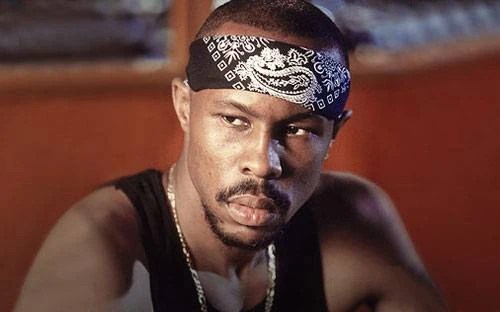
Poor old Wood Harris really gets the cheap end of the Dredd script.
As Avon Barksdale in The Wire, Wood was part of a tv drama that showed the brutal, complex relations between black gang violence and white state power in America.
In DREDD he has to go back to being the black man that white people love to fear.
Olivia Thirlby is very well cast as Judge Anderson, a sexy female judge with psychic powers and a blonde bob who’s here to soak up the erotic energy kicked up by all the violence.
Fascism is sexy, so a sexy fascist is the logical next step.
Garland gives Anderson a motivation to make the block a better place. You can imagine a better version of this script where Anderson’s psychic powers take us inside the real lives of these people.
But. No. Instead Anderson’s story turns on a psychic confrontation with Kay, and an act of psychic r*pe.
There really isn’t a trope more central to fascist storytelling than the violation of the white woman by the black man.
Dredd throws some corrupt judges at us. Because it’s not that the Judges are a fascist secret police force, it’s just some “bad apples”.
And then we get to DREDD’s big bad.
Poor people.
You don’t really get much more bottom of barrel of the human experience than a prostitute having her face sliced by a pimp.
That’s Ma-Mas backstory. We never really get an explanation for *how* Lena Headley went from hooker to gang boss, other than a knack for snarling orders.
Again you can imagine a better script in which Ma-Ma’s authority is based on the same psychic powers as Anderson, and the climax is the two feminine powers colliding.
Instead Judge Dredd beats the whore up and throws her off the balcony.
Pumped full of slow-mo.
Is the slow-mo in this movie to extend that “fascist gaze”? Or is it just a gimmick to heighten the sadistic thrill of watching the woman crushed against the concrete?
You tell me.
There’s a Paul Verhoeven Judge Dredd movie in my mind, where the king of absurd action violence Starship Troopers the hell out of Dredd, to make us cringe at our own love of fascism.
What’s depressing about Dredd is how normalised its fascist coded worldview is. The problem is poor people, black people and women. The problem is the people being stamped on, not the boot doing the stamping.
And how even a good storyteller like Garland, struggling to decode the fascist narrative, still ends up sounding like a Nick Fuentes monologue.
Because the only way to make Dredd great again.
Is to make him the bad guy.
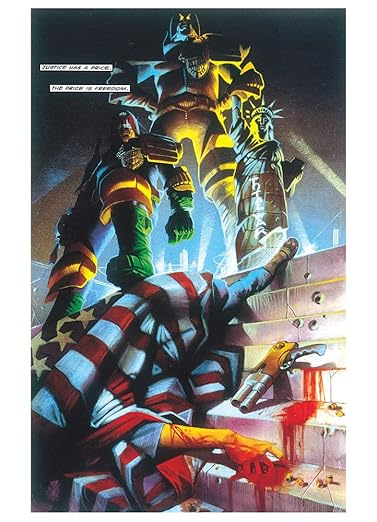
And this brings us, finally, inevitably, to America.
Not the country. The story. Although, increasingly, the country too.
If you ask a casual fan for the best Dredd story, they’ll say “The Dark Judges” or “The Cursed Earth.” They are wrong.
The best Dredd story is America. And in America, Judge Dredd is the villain.
He isn’t the anti-hero. He isn’t the “hard man making hard choices.” He is a monster.
The story follows America Jara, a woman born into the Judges’ fascist totalitarian state, who decides she wants something else. She wants democracy.
And Dredd destroys her.
He doesn’t just arrest her. The system—his system—breaks her, dehumanises her, and eventually kills her.
America is a literal depiction of the boot that stamps on the human face, a woman’s face, forever.
Because every time Dredd says I AM THE LAW what he means is I AM THE BOOT.
So here we are. We wanted the boot to be ironic. We wanted the boot to be a deconstruction.
But in the end, it’s just a boot.
And we’re just sitting here, watching it in 4K.
 Damien Walter