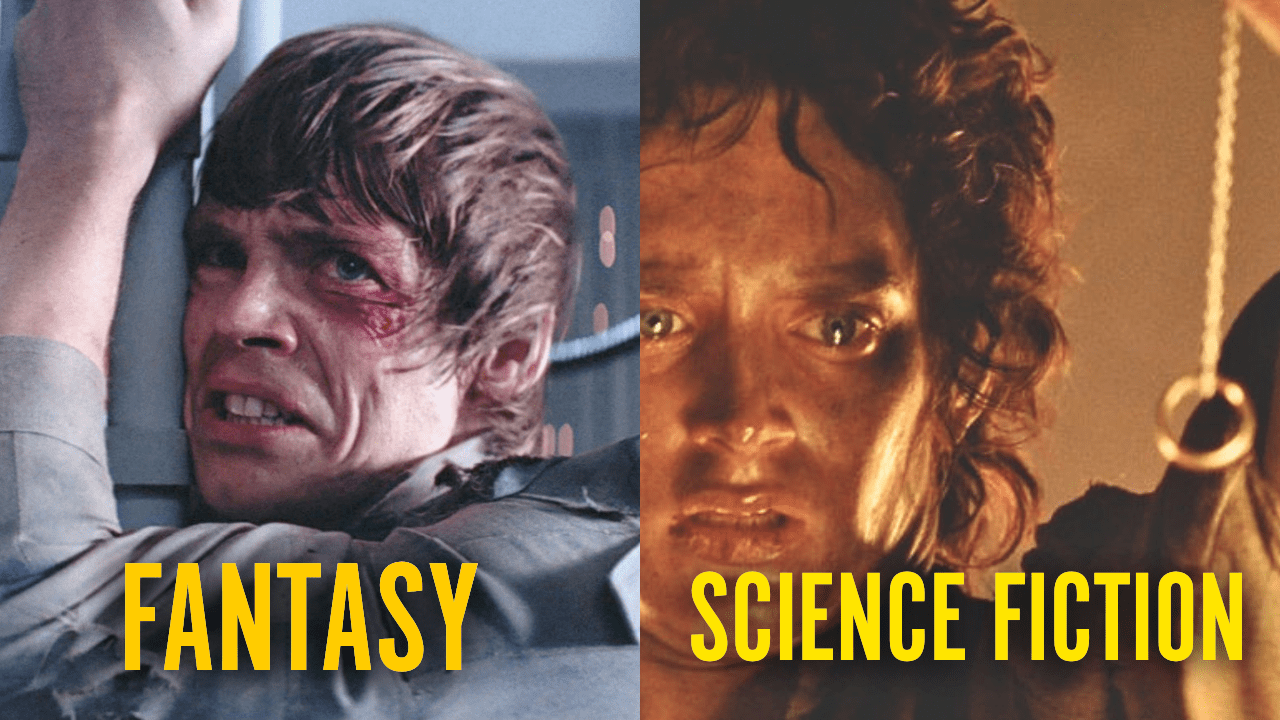
There is a single narrative technique that connects almost every multi-billion dollar science fiction franchise ever made. It is the invisible engine powering the most successful stories of the last century. And yet, if you ask ten working Hollywood screenwriters what it is, nine of them will give you a blank stare—and the tenth will probably try to sell you a $200 course on “worldbuilding.”
Think about the heaviest hitters in science fiction today.
Take Fallout. The reason that universe is so compelling isn’t just because Bethesda really loves 1950s aesthetics and dank radiation memes. It’s built on one specific, structural cheat code. Look at Jurassic Park. The terror doesn’t actually come from the CGI T-Rex; it comes from one, very isolated scientific premise. Or look at the box office juggernaut Project Hail Mary – Andy Weir didn’t write a sprawling space opera, he built a meticulous puzzle box around exactly one new rule of biology.
Members get full access to all videos and posts
This isn’t just a modern blockbuster trend, either. This is the foundational DNA of science fiction.
It is the exact same tool Mary Shelley used to accidentally invent science fiction with Frankenstein back in 1818 just because she was bored on vacation. It’s the same mechanism H.G. Wells used to absolutely terrify Victorian readers by showing them what it was like to be invaded by Victorian colonialists in The War of the Worlds. It is so deeply fundamental to the mechanics of creating a meaningful scifi world that every great from Arthur C Clarke to Ursula K Le Guin uses it without even giving it a name.
Even fantasy writers, when they can stop calculating the exchange values of the seven major currencies in their world, actually do this. Even if J.R.R. Tolkien would probably rise from the grave to write a strongly worded letter in Elvish denying it. It’s RIGHT there in Lord of the Rings. Like a One Ring of power.
Yes I did write that whole paragraph to make that pun. But it’s also true.
Every great sci-fi writer is using this tool, whether they know the academic term for it or not. It is the ultimate storytelling power-up. And once you see it, you will never look at a “worldbuilding bible” the same way again.
Right now I can divide you all into two groups. Group A are the ambitious power hungry young writers who want to be the next Brandon Sanderson by using this one easy trick.
Group B are the creative purists who are recoiling in horror “NO! I will not sully my unique artistic vision with this HACK!”

But all I’m doing is putting a new, powerful, sonic screwdriver in your scifi toolkit. What you do with it is all about you. And if you have no interest in telling scifi stories, this is also just a great way to understand them.
Aaaand Group C…who already clicked ahead in the timeline to find out what the fuck I am talking about while muttering about getting to the point.
So let’s get to the point.

But before we get to the point of giving this thing its proper, intimidatingly academic name, let’s look at what screenwriters usually call it when they’re trying to sound smart in a pitch meeting.
A lot of writers refer to it as the “One Big Lie.” This is the single, massive falsehood you demand your audience swallow right on page one, just so the rest of the story can function. It’s the author holding the reader hostage and saying, “Look, just accept that we can fold spacetime using spice addicted worms, okay? How do the warp drives *work*? Dilithium Crystamathingy. Do not look at the math, we have a socio-political metaphor disguised as a planet to get to.”
Futurists and tech-adjacent folks like to call it the “Shock.” This is the specific piece of fictional technology that drops into a society and immediately shatters the status quo. Just take any William Gibson novel, extract the unique tech, that’s the Shock.
Meanwhile, the alt-history buffs call it the “Point of Divergence”—the exact moment on the timeline where the fictional world violently swerves away from our actual, exponentially more depressing reality.
All of these are…fine? They vaguely point at the right idea. But the sharpest, most precise term for this tool—the one that will actually fix your broken script and stop you from wasting another three weeks designing the fictional tax code of a moon colony no one cares about—is The Novum.
Latin for “the new thing.” It’s a term coined by literary scholars who desperately needed to sound rigorous while analyzing tentacle faced aliens wielding space lasers in the 1970s.
That literary scholar being Darko Suvin. The OG of the academic field of science fiction studies. Think of Professor Suvin as your Severus Snape, here to teach you Defence Against The Dark Arts…and we all know what that really means.
But we’ll come back to Cognitive Estrangement.
Because in practical storytelling terms, the Novum is the scientifically plausible innovation, discovery, or historical shift that forces a society to completely rewire itself. It isn’t just a cool gadget your hero uses to shoot the bad guy. It is the inciting incident not just for your plot, but for your entire fucking universe.

INTERVAL: The Crucial Distinction (Or: Why a Novum is NOT a F***ing MacGuffin)
Before we get to the master list, we need to clear up a massive misconception. Because right now, there is a very specific type of aging film student watching this who is confidently thinking, “Oh, I get it. The Novum. It’s just a MacGuffin.”
No. Stop. Put the glowing briefcase down.
Alfred Hitchcock popularized the concept of the MacGuffin. It is an object, a device, or a piece of information that all the characters desperately want. It exists solely to give everyone a reason to be in the same room. The Death Star plans in Star Wars. The Ark of the Covenant in Raiders of the Lost Ark. The glowing briefcase in Pulp Fiction.
But here is the defining trait of a MacGuffin: It is entirely, one hundred percent arbitrary.
You can completely swap out the glowing briefcase in Pulp Fiction for a bag of blood diamonds, the nuclear launch codes, or a mint-condition holographic Charizard card, and the plot remains exactly the same. Vincent and Jules still show up at the apartment, they still shoot Brett, and they still go get breakfast. The MacGuffin only drives the plot.
The Novum is entirely different. The Novum drives the world.
You cannot swap it out. It is structurally load-bearing. If you swap the viable dinosaur DNA in Jurassic Park for a bag of stolen diamonds, the entire universe collapses. There is no theme park. There is no catastrophic failure of a biological ecosystem. There is just an eccentric old billionaire staring at a shiny rock in a helicopter.

If you swap the simulated reality of The Matrix for a stolen microchip, you don’t have a cyberpunk philosophical awakening; you just have a very confusing Keanu Reeves action movie where people wear too much leather indoors.
A MacGuffin is just a lazy excuse for your characters to run around and shoot at each other. A Novum is the foundational rule of physics that dictates why they are running, how they are shooting, and the structural reality of the very ground they are running on.

TWO: The Kinda Complete List of Sci-Fi Novums
The Blockbuster Novum
Let’s start with the crowd-pleasers. This is the Novum distilled into pure, highly marketable adrenaline.
The Blockbuster Novum doesn’t require the audience to hold a degree in sociology, and more importantly, it doesn’t require a studio executive to read past page one of the treatment. It is the ultimate elevator pitch. Instead of rewriting all of global human society, the Blockbuster Novum creates a highly isolated, extremely volatile sandbox where things can spectacularly blow up.
Look at Jurassic Park. The Novum is perfectly constrained: Viable dinosaur DNA can be extracted from fossilized amber. That’s it. It doesn’t cure cancer. It doesn’t solve world hunger or alter global geopolitics. It just acts as the singular scientific catalyst for a standard, hubristic tech billionaire to build a theme park that immediately eats its own lawyers.
Or consider Inception. The Novum is the PASIV device—a machine that allows for shared dreaming. Christopher Nolan doesn’t waste time explaining how this technology affects the global economy or the healthcare system. He just uses it to upgrade the standard corporate espionage thriller into a heist movie set entirely inside the human subconscious.
When done right, this type of Novum is an instant engine for action. It’s the single “What If” that launches a billion-dollar franchise.
Cue the rapid-fire action montage:
- The Terminator: A defense network achieves localized self-awareness and invents time travel strictly to clean up its own administrative errors.
- Minority Report: Three mutated humans can accurately predict murders before they happen, turning the justice system into an inescapable, pre-emptive bureaucracy.
- District 9: Aliens aren’t invaders or philosophers; they’re just working-class refugees whose ship broke down over Johannesburg, instantly creating a localized apartheid state.
- Avatar: A planetary ecology functions as a biological internet, which unfortunately sits right on top of the most valuable rock in the universe.
- Edge of Tomorrow: Exposure to alien blood physically resets the temporal day upon death, turning a galactic war into a lethal video game speedrun.
- Back to the Future: The Flux Capacitor makes time travel entirely possible, provided you have access to weapons-grade plutonium and a DeLorean that can somehow hit 88 miles per hour in a mall parking lot.
These are the cash cows. They take one impossible thing, make it the law of physics for exactly two hours, and let the chaos unfold.
The Literary Novum
Now we shift gears from the Hollywood executives to the authors who want to win Hugo awards and make the reader feel slightly inadequate about their intellect.
The Literary Novum isn’t built to optimise action figure sales. You aren’t going to get a lot of space battles or laser swords here. Instead, these are pure sociological thought experiments. The author takes one fundamental, unshakeable rule of human existence or the physical universe, alters it, and then meticulously—almost clinically—tracks the psychological and cultural fallout.
Take Ursula K. Le Guin’s masterpiece, The Left Hand of Darkness. The Novum is a biologically ambisexual human race. The inhabitants of Gethen only manifest a sex drive or specific gender characteristics for a few days a month. By removing fixed sexual dimorphism from the equation, Le Guin builds a complex society completely free of the patriarchal and matriarchal power dynamics that define our entire history. It’s a Novum so powerful it actually turns our own real-world gender constructs into the “alien” concept.
Don’t worry if you didn’t understand any of that. That is kind of the point of Literary Novums?…Novae?
Or look at Cixin Liu’s The Three-Body Problem. The Novum is the titular three body problem: a neighboring star system with three suns that create an unsolvable, wildly chaotic orbital cycle. It forces the native alien civilization into a perpetual cycle of apocalyptic trauma. This single astrophysical fact perfectly and logically explains exactly why they would be so ruthlessly, coldly focused on stealing our boring, stable planet.
And it’s also a clear metaphor for the Capitalist powers that colonised China, when you think about it.
This type of Novum is heavy, thoughtful, and usually leaves you staring at a wall for twenty minutes after finishing the book.
Cue the montage of literary devastation:
- Dune: A narcotic dust called the Spice Melange allows for prescience and faster-than-light travel, instantly turning a miserable, giant-worm-infested sandbox into the ultimate economic choke point of a galactic feudal monopoly.
- The Handmaid’s Tale: A catastrophic global plummet in human fertility is immediately weaponized to build a theocratic nightmare.
- Fahrenheit 451: We figured out how to make all houses completely fireproof, so society logically repurposed the fire department to exclusively burn contraband literature.
That’s a joke. Do NOT leave that pedantic comment! Just checking you’re paying attention and haven’t been virtually lobotomized by hyper saturated media that destroys your capacity for critical thinking.
- Neuromancer: The invention of the cybernetic deck, which allows hyper-caffeinated hackers to jack directly into a visual, navigable consensus hallucination called cyberspace. Or…is cyberspace the novum? Hmmm.
- Children of Time: Spiders. Something about space spiders.
- Do Androids Dream of Electric Sheep? / Blade Runner: The invention of “replicants” who are more human than human, testing our capacity for empathy.
The Ideological Novum
Now we move from sociology to pure politics. This is where the Novum stops being a fun thought experiment and becomes a weaponized worldview.
The Ideological Novum bends the physical rules of reality into Attack Mode. The author is essentially rigging the game. By inventing a specific physical or biological law, they create a universe where their personal political philosophy isn’t just an opinion – it’s a mandatory survival tactic.
Look at China Miéville’s The City & the City. The Novum here is geographic and psychological: Two hostile cities occupy the exact same physical space, and the citizens are legally and mentally conditioned to “unsee” the other. If you acknowledge a building or a person from the other city, you are disappeared by a shadowy secret police. Miéville takes the very real, very mundane concept of urban inequality and class segregation and turns it into a physical, unbreakable law of physics.
Or consider Robert A. Heinlein’s Starship Troopers, a novum that rewrites the social contract: Political authority and the right to vote can only be earned through grueling, highly lethal Federal Service. Heinlein rigs the universe to prove his point. In the world of the book, this isn’t fascism; it is the only logical way to build a stable, hyper-competent society that doesn’t collapse under its own weight. To be clear Starship Troopers doesn’t just contain this novum, the entire book exists to present the case for Heinlein’s idea.
And power armour.
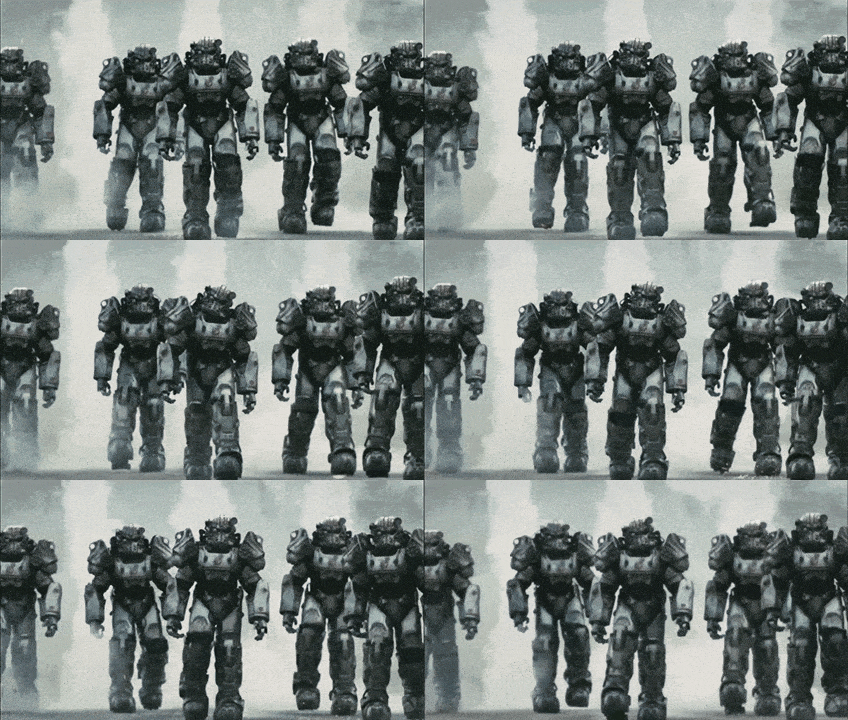
Mieville and Heinlein are political ideologues who know exactly what they are doing.
But then, you get the fascinating category of Accidental Ideologue. This is when an author creates a Novum that completely exposes their own unexamined, unconscious biases, usually while trying to write something else entirely.
Consider Ernest Cline’s Ready Player One.
Cline clearly thinks he is writing a punk-rock, anti-capitalist rebellion against a tyrannical mega-corporation. But look at his Novum: The OASIS, a fully immersive global VR utopia whose ownership is locked behind a Willy Wonka-style scavenger hunt of 1980s pop culture trivia. Cline’s Novum accidentally reveals a completely consumerist, neoliberal ideology. In this universe, the highest possible form of human achievement isn’t art, science, or empathy – it is furiously consuming and memorizing late-20th-century media. The “heroic” solution to this dystopia isn’t dismantling the horrifying techno-feudal monopoly; it’s just making sure the right kind of hyper-obsessive nerd is sitting on the corporate throne at the end. Klein accidentally wrote a glowing defense of late-stage techno-oligarchy, simply because his unexamined ideology is that pop-culture trivia makes you morally superior.
When you start looking for the Ideological Novum, it is everywhere. Cue the politically charged montage:
- Foundation (Isaac Asimov): The Novum is Psychohistory—a mathematical formula that accurately predicts the future of large populations. It perfectly exposes Asimov’s unconscious, mid-century technocratic elitism: the belief that the masses are basically mathematical cattle, and true governance should be handed to a secretive elite of STEM majors doing advanced calculus.
- The Mote in God’s Eye (Larry Niven & Jerry Pournelle): An alien species biologically trapped in a cycle of unstoppable overpopulation, making diplomacy mathematically impossible and neatly justifying a pre-emptive, imperial defense stance.
- Brave New World (Aldous Huxley): The Bokanovsky Process allows for the biological mass-production of cloned, predestined embryos, physically manifesting the rigid British class system into inescapable genetics.
- Roadside Picnic (The Strugatsky Brothers): Aliens visit Earth, but they don’t conquer us or share wisdom. They just stop on the side of the cosmic highway, throw their incomprehensible, deadly trash out the window, and drive off.
- Warhammer 40,000: Faster-than-light travel literally requires flying your ships through a dimension of pure, sentient Hell (The Warp), perfectly justifying the paranoid, hyper-fascistic, violently xenophobic Imperium of Man.
The Negative Novum
Finally, we arrive at my personal favorite. The Negative Novum.
This is the ultimate exercise in subtraction. The author doesn’t invent a magical new technology, a faster-than-light drive, or a biological mutation. Instead, they just walk up to the historical timeline, firmly grasp one absolutely crucial Jenga block, pull it out, and watch human civilization warp itself around the newly created void.
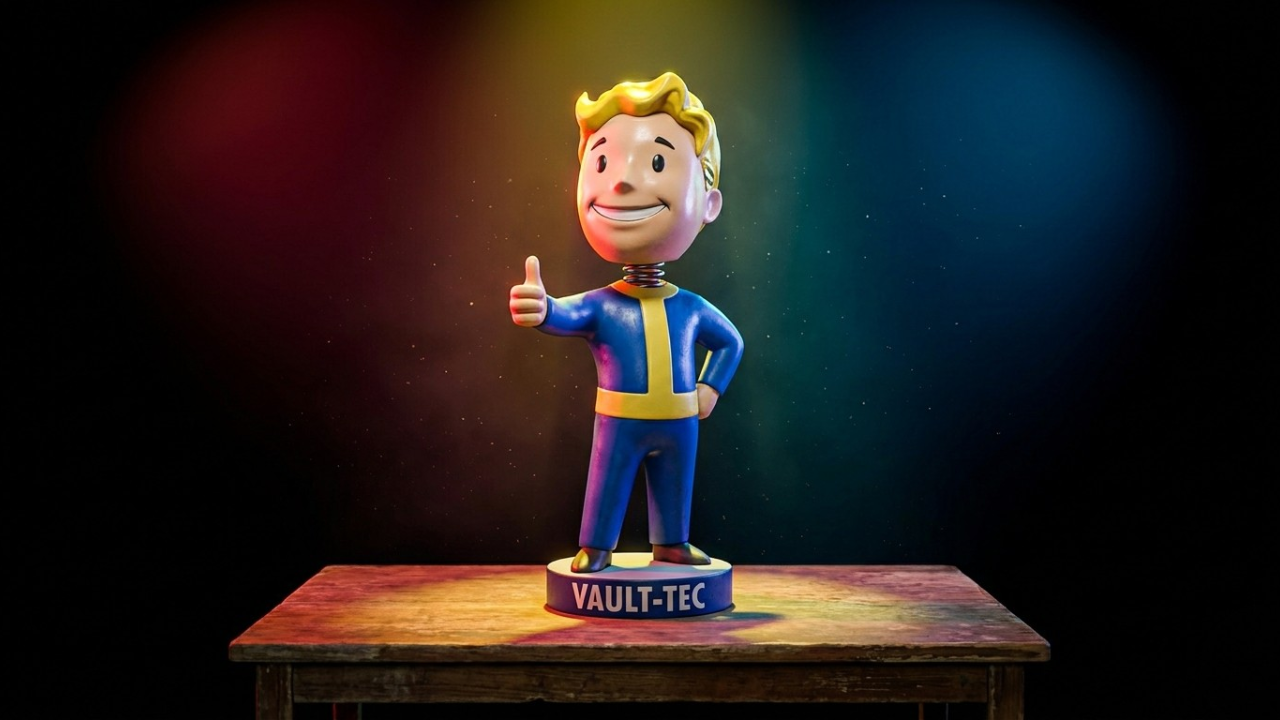
The most brilliant modern execution of this is the Fallout franchise.
If you ask a casual fan what makes Fallout special, they’ll probably point to the Power Armor, the Vaults, or the relentless 1950s doo-wop music playing over a nuclear wasteland. But all of that is just window dressing. The actual engine of the universe—the Negative Novum—is incredibly simple: The transistor and the microchip are never invented. Or, at least, they are invented centuries too late to matter.
Look at the ripple effects of that one missing piece of silicon. Because miniaturization never happens, the Information Age is completely aborted. Computers remain massive, clunky, room-sized monoliths running on vacuum tubes and dangerous atomic fusion. Because technology is bulky and terrifying, the cultural zeitgeist gets permanently trapped in 1950s atomic-age optimism and Red Scare paranoia. There is no internet to globalize the culture.
And finally, the conflict: Without the micro-efficiency of the transistor, the world rapidly and violently burns through its remaining fossil fuels and uranium. This technological dead-end leads directly to the Resource Wars, and eventually, the inevitable nuclear fire of 2077.
The apocalypse, the Vault-Tec experiments, the super mutants – every single iconic piece of that multi-billion dollar IP stems entirely from the premise of not inventing a tiny computer chip.
When you remove something fundamental, the world has to desperately compensate.
Cue the montage of things we desperately miss:
- Children of Men: The complete, unexplained cessation of human fertility. There are no zombies or aliens; the apocalypse is just the quiet, devastating absence of a next generation.
- The Road: The total death of the biosphere and a permanently blocked sun. No intricate lore, just the complete absence of ecology and hope, leaving only gray ash and cannibalism.
- The Difference Engine: The microchip isn’t needed because Charles Babbage successfully built his steam-powered mechanical computer in the 1800s. The absence of the electrical age gives us Victorian cyber-punks.
- A Canticle for Leibowitz: The “Flame Deluge” purposefully wipes out all modern scientific knowledge. Humanity violently removes its own understanding of the universe, causing an artificial return to the Dark Ages where electrical blueprints are venerated as illuminated holy texts.
- Never Let Me Go: The quiet, polite removal of basic human rights—and the philosophical concept of a “soul”—from a specific underclass of artificially created organ-donor clones.
- Station Eleven: The Georgia Flu instantly wipes out the global power grid and most of humanity. It’s the sudden, overnight absence of global connectivity, reducing modern civilization to a traveling Shakespeare troupe in the ruins of the Midwest.

The Exceptions of Why Star Wars is Fake Sci-Fi
If you really want to understand how a structural rule works, you have to look at the massive, billion-dollar properties that completely ignore it. And if you want to guarantee a thousand angry comments on your video—which the YouTube algorithm absolutely loves—you tell your audience the truth:
Star Wars is not science fiction.
Under the strict definition of the Novum, George Lucas didn’t write a sci-fi masterpiece; he wrote a high-fantasy fairy tale that just happens to have a very shiny, metallic coat of paint.
Think about it. The Force is not a Novum. It is not a scientifically plausible point of divergence or a technological innovation that logically rewires the economics and politics of the galaxy. It is literally just magic. It is an ancient, mystical energy field that cares deeply about bloodlines, prophecies, and farm boys with grand destinies.
A lightsaber isn’t a technological disruption; it’s just Excalibur with a D-cell battery strapped to the hilt. The Death Star isn’t a sociological thought experiment; it’s a dragon sitting in a dark tower waiting for the white knight to find its perfectly engineered, two-meter-wide weak spot.
This is why Star Wars has more in common with Game of Thrones or Harry Potter than it does with Jurassic Park or The Left Hand of Darkness. They don’t operate on “Cognitive Estrangement.” They don’t want to make you uncomfortable about your present reality. They operate on Myth. They run on the Hero’s Journey, universal archetypes, and emotional resonance.
And to be clear: That doesn’t make them bad. Space Fantasy is a glorious, highly lucrative genre.
But if you are a writer sitting at your keyboard trying to build the next Matrix or the next Fallout, and you are using Star Wars as your structural blueprint, you are going to fail. You will end up with a messy, bloated universe full of lasers and aliens that doesn’t actually say anything.
Because “fake” sci-fi just throws futuristic aesthetics at a standard fantasy plot. But real sci-fi fundamentally alters reality using the Novum
Ahk-tually, LotR is science fiction (it can be argued)
Before the international Tolkien Society puts a bounty on my head and sends a strike team of Oxford philologists to my house, let’s entertain a highly structural, slightly dangerous thought experiment.
If we strictly define science fiction by the presence of a Novum—a technologically or scientifically plausible disruption that forces a society to react—you can make a surprisingly aggressive argument that The Lord of the Rings is actually a science fiction story disguised in a trench coat of Elven mythology.
To see it, you have to look at what Tolkien was actually reacting to. He wasn’t just daydreaming about fairies. He was a traumatized combat veteran writing a direct, visceral response to the mechanized slaughter of World War I and the aggressive, soot-choked industrialization of the English countryside.
With that context, look at the One Ring.
If you strip away the glowing Elvish script, the Ring isn’t a mystical, magical trinket. It is a piece of technology. Specifically, it is a machine of mass surveillance and absolute industrial control. Sauron isn’t just a dark wizard; he is a hyper-industrialist trying to establish a global, mechanized monopoly.
The Ring functions exactly like a Novum. It is a concentrated technological leap (forged in the fiery R&D labs of Mount Doom) that fundamentally distorts the reality of Middle-earth. Whoever holds the Ring gains access to a network of absolute power, but the “technology” is so advanced and inherently corrupting that it overrides the operator’s free will, turning them into a slave of the machine itself.
Look at Saruman. He doesn’t fall to “dark magic.” He falls to the allure of industry. He literally tears down the ancient forests to build foundries, replacing nature with “a mind of metal and wheels.” He is essentially a 19th-century robber baron who discovered the efficiency of strip-mining and genetically engineered super-soldiers (the Uruk-hai).
Therefore, the entire plot of The Lord of the Rings isn’t a traditional heroic fantasy quest to secure a magical boon. It is a desperate, apocalyptic black-ops mission to decommission a weapon of mass destruction. The Fellowship is trying to un-invent the nuclear bomb because they realize their society is not morally equipped to wield that level of technological power.
So, yes, it has wizards and goblins. But structurally? It operates on the exact same engine of “cognitive estrangement” as the best sci-fi. It takes the real-world horrors of the Industrial Revolution and the mechanization of warfare, wraps them up in a Novum called the One Ring, and forces the audience to look at their own factories and war machines with a deep, creeping sense of dread.
Wait, cognitive what-now?
Oh right I didn’t tell you yet. Woops!

THREE: The Ultimate Novum (And How to Wield It)
The Final Boss of Sci-Fi Theory
Now it is time to meet the Final Boss of sci-fi theory. We’ve talked about the blockbusters, we’ve validated the literary heavyweights, and we’ve thoroughly alienated Star Wars fandom. Now, we drop the actual academic payload.
In the 1970s, a Yugoslavian-born scholar named Darko Suvin officially coined the term “Novum.” Suvin was essentially an academic who desperately needed a rigorous, scholarly way to explain to his university colleagues that reading about time machines and android sex bots was actually a profound intellectual pursuit.
But Suvin didn’t just name the tool. He identified exactly what the tool was built to do. He argued that the ultimate goal of science fiction is to achieve a psychological impact called Cognitive Estrangement.
The Mirror, Not the Crystal Ball
”Cognitive Estrangement” sounds like a legal defense for a messy divorce, but it is actually the secret engine of scifi.
Let’s break the biggest myth in science fiction right now: scifi is not supposed to predict the future. It isn’t a crystal ball, and honestly, whenever it tries to be, it is usually hilariously wrong.
The goal of a great Novum isn’t to show you what the year 2300 looks like. The goal is to take your present reality, alter one massive variable, and force you to look at your own society with fresh, uncomfortable, alienated eyes.
”Cognition” means the premise is rational and scientific—it’s not magic. “Estrangement” means it makes you feel like an alien in your own home. It takes the mundane absurdity of our real-world economics, our politics, or our social norms, and makes them look utterly bizarre by contrast.
The Ultimate Novum: The Monolith
If Cognitive Estrangement is the ultimate goal, what is the most perfect, undistilled example of a Novum ever put on screen?
It isn’t a time machine. It isn’t a cloned dinosaur.
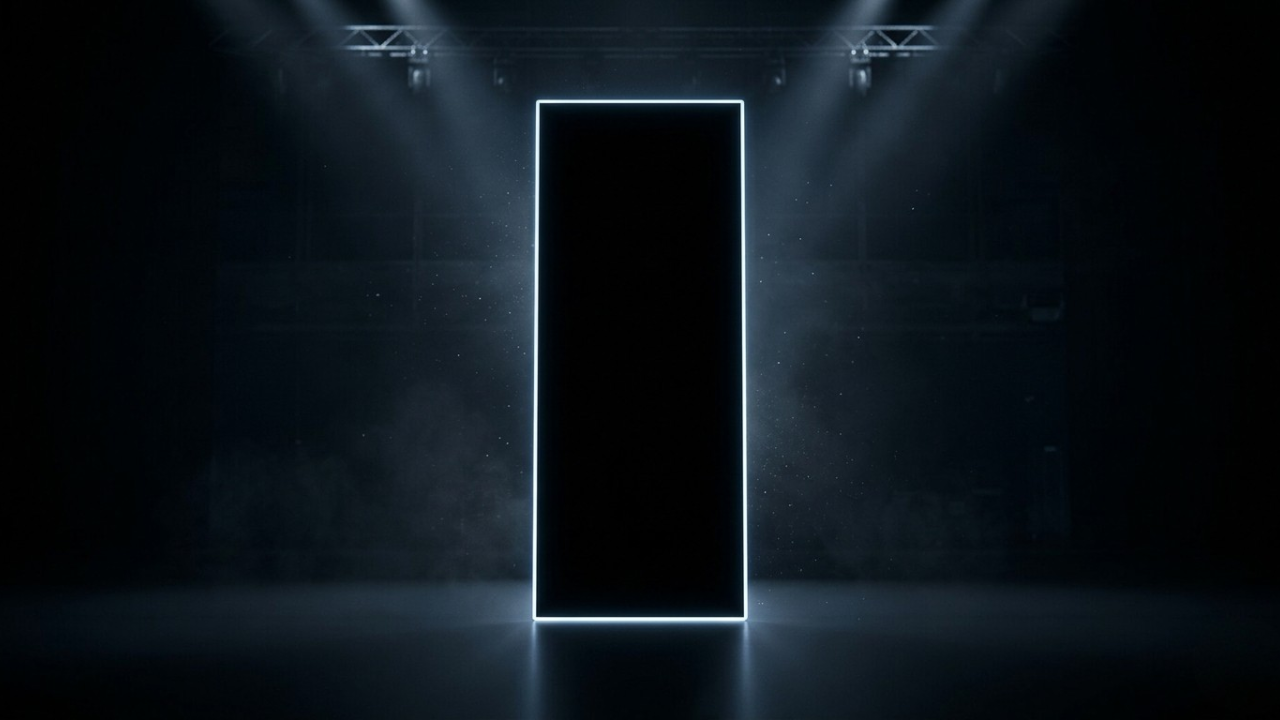
It is a featureless black slab of geometry from 1968.
Stanley Kubrick and Arthur C. Clarke’s 2001: A Space Odyssey features the absolute Ultimate Novum: The Monolith. Look at this thing. It does absolutely nothing. It has no buttons, no user interface, no glowing exhaust ports for a farm boy to shoot a torpedo into. It is the pure, terrifying, mathematical embodiment of the “New Thing.”
And look at the ripple effect. When it drops into the prehistoric dirt, it doesn’t hand the apes a laser gun. It just provides the exact amount of Cognitive Estrangement necessary for an ape to realize that a femur bone can be used to crush a skull. It is the simultaneous birth of technology and murder.
Fast forward a few million years. Humanity finds another one buried on the moon. Again, it does nothing but emit a signal. But its mere existence forces humanity into a new leap of cognitive estrangement, triggering the terrifying leap into deep space and the creation of artificial intelligence. The Monolith is the Ultimate Novum because it demands nothing but evolution. It forces the characters—and the audience—to instantly discard their previous understanding of reality.
The Power-Up
Which brings us to the final power-up. If you are a writer sitting at your desk right now, listen closely.
Stop. Worldbuilding.
Start world changing.
Most amateur writers are permanently stuck at Level One worldbuilding. They spend four hundred hours mapping out the tax codes of a galactic empire, but their characters are just 21st-century middle managers complaining about space-capitalism. Their Novum doesn’t actually touch the human condition. It causes zero estrangement.
Stop trying to build a universe from the top down. Put the worldbuilding bible away.
Find your Monolith.
Find the one, singular, disruptive idea that violently shatters the status quo. Drop it into the dead center of your story, and logically map out exactly how human politics, religion, and relationships must mutate just to survive the shockwave.
Because when you use the Novum correctly, you aren’t just writing about a fantasy world. You are changing the real world. You are taking our ordinary cognition and estranging it to show us our world as a strange new world. You are writing the modern mythos.
So pick your one big lie. And imagine harder.

