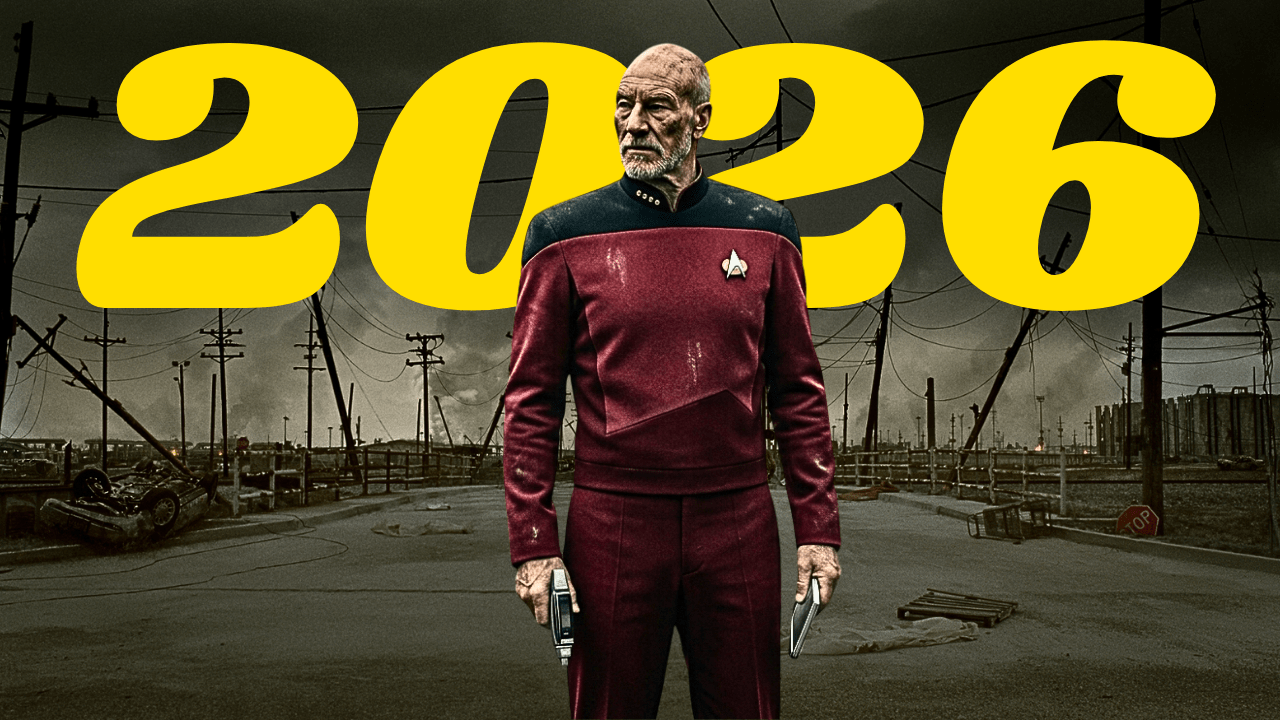
To my Gen-X compatriots, to the Boomers and Millenials, and to Gen-Z who will have to clean up this mess we all made…
…can we agree that Star Trek is the future we would all like?
A future in which poverty is eradicated, disease is a mere curiosity of the past, humanity has put aside petty squabbles over resources, borders, and skin melanin and replaced all of that sh*t with a collective, enlightenment-driven pursuit of knowledge and self-betterment.
A future in which humanity has – to use the rigorous academic term – Grown The Fuck Up
Watch the full video essay here
Is Star Trek a future we can all agree on?
Let us tune out the ideological zealots, the Tankies and the Nazis, who treat our planetary collapse as a competitive team sport, and among the exhausted, fact-based majority, agree on Star Trek as our shared prize.
When we look at the USS Enterprise we do not just see a starship, we see a perfectly calibrated, post-scarcity society. It is the ultimate manifestation of what contemporary political theorists affectionately call FALC: Fully Automated Luxury Communism… in space.
Let’s place ourselves at the intersection of eschatology, speculative fiction, and macro-economics and ask a question of Star Trek – specifically, the teleological trajectory required to actually achieve the utopian federation depicted within it.
Put in layman’s terms–how the fuck do we *get* to Star Trek?
Because there is, unfortunately, one catastrophic, glaring problem with this cultural lodestone.
In the canonical lore of the Star Trek universe, this magnificent, post-scarcity utopia does not emerge from a peaceful, democratic transition. It does not arrive because a coalition of enlightened centrist politicians finally passed the right carbon tax. It happens exclusively on the other side of World War III – a global, thermonuclear, and genetic holocaust that wipes out a third of the Earth’s population and plunges the survivors into a radioactive dark age.
And, according to the deeply unsettling timeline of the Star Trek universe, that war starts right here.
Right now.
In 2026.
Check your watches, ladies and gentlemen. We are right on schedule.
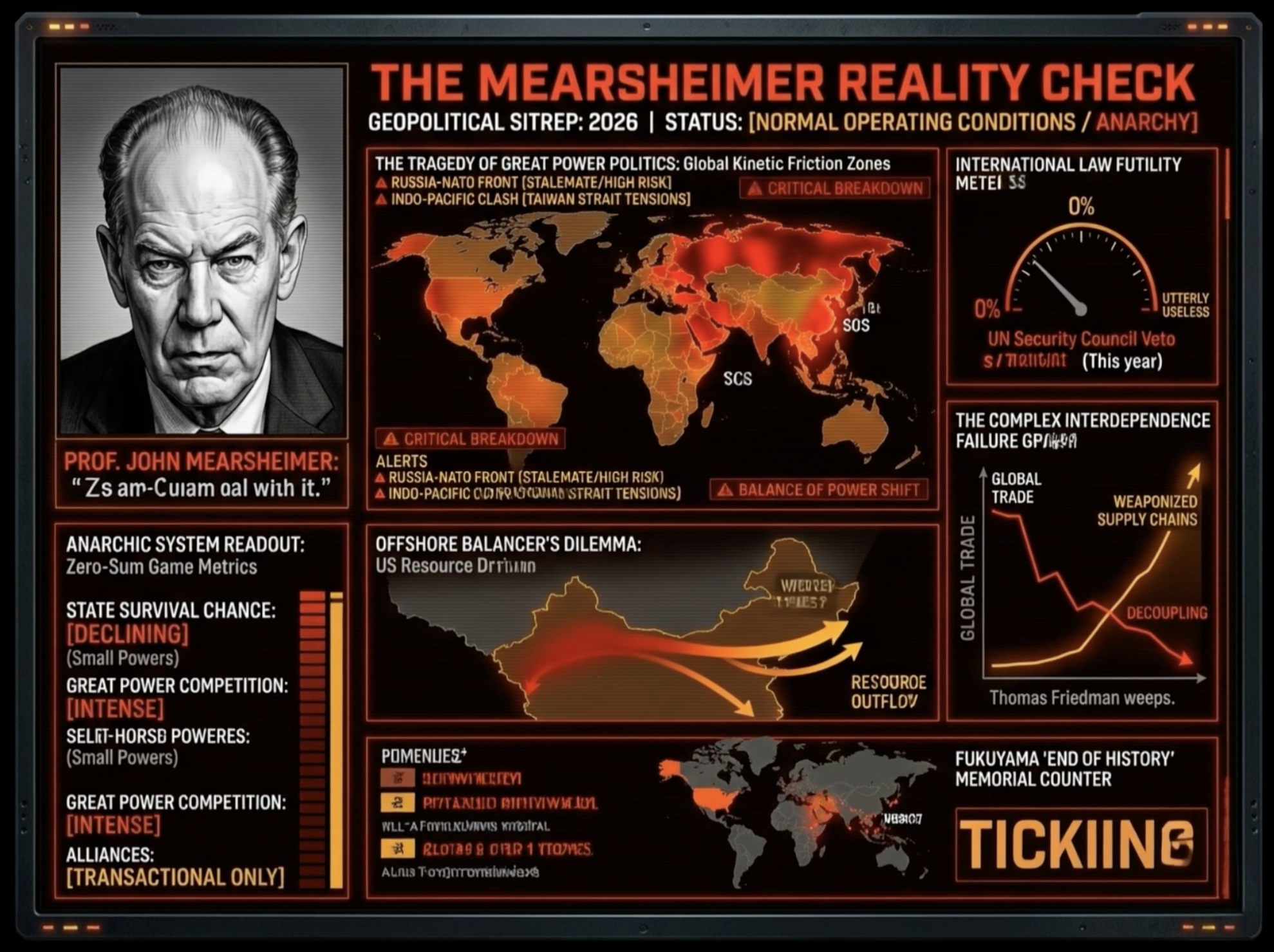
PART ONE: WW3 AND STAR TREK
Signs of WW3 in 2026
I do not need to remind you that it is currently 2026, and the geopolitical dashboard is flashing red across every conceivable metric. We are witnessing an unprecedented convergence of systemic stressors that makes the Cuban Missile Crisis look like a polite disagreement over a parking space.
Check your newsfeed, or simply look out the window
We have the protracted, grinding meat-grinder of the Ukraine war, acting as a proxy battlefield for nuclear superpowers and playground for combat robot gen 1 Terminators.
We have Iran and the broader Middle East locked in a collapsing spiral of kinetic retaliation, vaporising the very oil reserves America started yet another war to secure.
We are drowning in an epistemological nightmare of disinformation, where shared objective reality has fractured into bespoke, algorithmically curated psychotic echo chambers so deranged they make Alex Jones look like a reliable source.
Economic inequality has reached a velocity where billionaires are literally launching themselves into the exosphere while the proletariat attempts to crowdfund their insulin.
Consequently, fascism is no longer a historical curiosity confined to black-and-white footage. It is once again a rising, viable, mainstream electoral strategy.
Immigrants are being demonised and minorities persecuted.
Germany and Japan are re-arming.
If this all looks spookily like the events that drove us through WW1 and WW2 that’s because the systems which caused those wars are once again driving us towards global arma-fucking-geddon.
Which is what we’re really here to think about, not human morality or high drama, but cold, machine logic, the systems driving us to war.
And the one system that those of you in the know will see lurking behind all the others. A system whose name we shall not utter…until later.
And what Star Trek, the ultimate work of systems fiction, can teach us about those systems.
Why WW3 Happened in Star Trek
We must first examine why World War III happened in the Star Trek continuity.
Originally, the writers in the late 1960s, operating under the assumption that the Cold War would inevitably go hot, placed the Eugenics Wars and the precursor to WW3 in the 1990s. When we miraculously survived the 90s with nothing more distasteful than dial-up internet and Nu-Metal, the lore was continuously retconned.
The canonical window for the end of the world is now established as 2026 to 2054.

What the writers of Star Trek intuitively grasped, and what modern science fiction authors like William Gibson have explicitly codified, and what we have already explored together in the channel, is the concept of “The Jackpot.”
The Jackpot is not a single, catastrophic Michael Bay explosion. It is a multifactorial collapse. It is what happens when climate change, pandemics, economic implosion, and localized nuclear exchanges all decide to book onto the same budget holiday tour to Earth.
The specific causes of WW3 in Trek lore reflect this multifactorial nightmare:
Eco-collapse: The environment degrades to the point where resource scarcity triggers mass migration and border wars. We’re already close to the 216 million climate refugees predicted by 2050
Colonel Green and “Humanity First”: The rise of ecofascism, when the elites who caused climate catastrophe start using it as another excuse to persecute the victims, spearheaded by a charismatic military man who justifies mass culling under the banner of preserving a pure, surviving humanity. Is Humanity First better or worse than America first? Maybe they’re both just the same old xenophobia in a new package.

The Eugenics Wars: The disastrous byproduct of unregulated biotechnology and genetic engineering, leading to augmented transhumans (like Khan Noonien Singh) who view baseline humanity as a biological relic meant to be subjugated. Today’s “transhumanists” freezing their heads in cryo and sucking stem cells out of teenagers are just a foretaste of what is to come.
What Is Systems Thinking?
To understand how these fictional events map so terrifyingly well onto our current reality, we must engage in “Systems Thinking.”
In pre-modern times, human beings lacked the ontological framework to understand complex, interconnected crises.
In layman’s terms : we didn’t know why the fuck things went wrong.
When crops failed, plagues spread, and empires fell, we blamed systemic problems on “powers and principalities.”
We blamed demons, angry gods, witches, or that goat with the funny eyes. We lacked the cognitive tools to understand that the problem was not acting upon the system from the outside; the problem was inherent in the system.
In the modern scientific age, we utilize systems thinking.
We define a system as any interconnected set of elements that is coherently organized in a way that achieves something.
A nation, a dog, an economy, the M25 ring road, are all systems.

If you look at a traffic jam on the M25, the pre-modern thinker blames the evil spirit of the highway. The systems thinker maps the feedback loops of urban planning, population density, and individual commuter incentives.
And don’t start assuming just being alive in 2026 makes you a systems thinker. How many of us stuck in a traffic still bkame Jesus Fucking Christ?
How many of us look at the systemic issues of climate change and blame Jeffrey in Norwich for not separating his tins from his plastics? The ancient practice of “scapegoating” that was exploited by a British Petroleum ad campaign in 2004 to make us blame each other and not…
…the system
Star Trek as Systems Fiction
And those of us who can manage some systems thinking today can do so in part because of Star Trek.
Star Trek is one of the few enduring pieces of popular media that operates as “systems fiction.” Every episode the Enterprise arrives at a new planet and analyses it AS A SYSTEM.
When the Enterprise visits a planet where half the population exploits the other half, Picard doesn’t just punch the alien leader.
Ok, yes, Kirk did sometimes often just punch the alien leader.
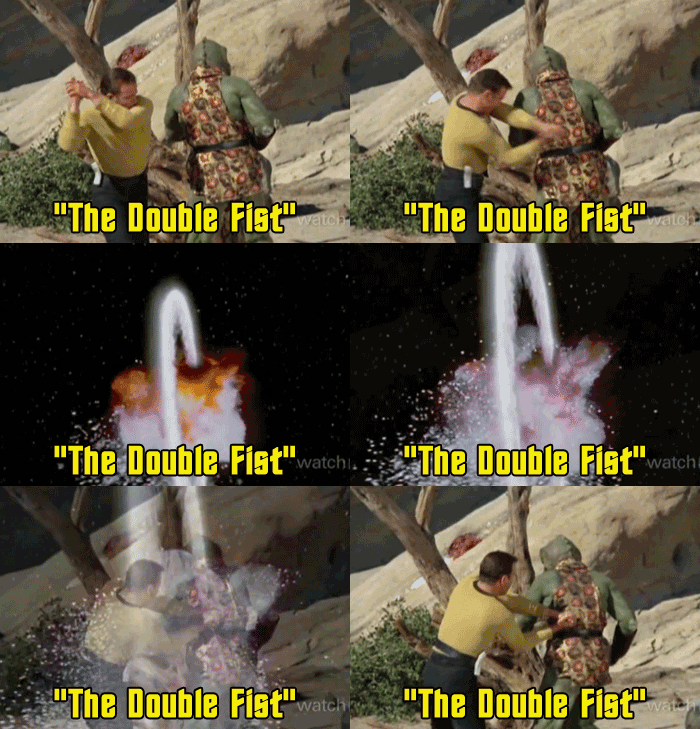
But our Philosopher King analyzes their resource allocation, their historical dialectic, and the systemic flaws in their socio-economic paradigm. He operates as an intergalactic systems auditor.
Star Trek is not a unique sample of systems fiction. The greatest science fiction – Frank Herbert’s Dune, everything by Ursula K Le Guin, the works of Octavia Butler, or Thomas Pynchon, or Don Delillo – are also systems fiction.
Systems FICTION matters because stories are one of humankind’s most powerful…systems. We think and live in stories. Frank Herbert’s Dune takes all the systems of an entire planet and funnels them down into one anti-heroic story.
But systems thinking is rare, oh so rare, in mass media. Star Trek was virtually a lone bastion of systemic analysis in 20th century mass culture. Given to us by one of the great science fiction imaginations.
Gene Roddenberry, the creator of Trek, was a systems thinker. Roddenberry didn’t write Star Trek, he conceived it. He built the playground others would play in to create season after season of mind blowing systems fiction.
And, crucially, Roddenberry understood that complex adaptive systems—like global civilization—do not change their fundamental operating rules voluntarily. They change only because the parts of the system, us, humanity, grow the fuck up.
Or when the failure to grow the fuck up subjects the system to a catastrophic shock that shatters the existing paradigm.
Roddenberry believed that to get to Star Trek, humanity had to go through WW3. The old system had to be violently dismantled because it was fundamentally incapable of reforming itself from within.
Was he correct?
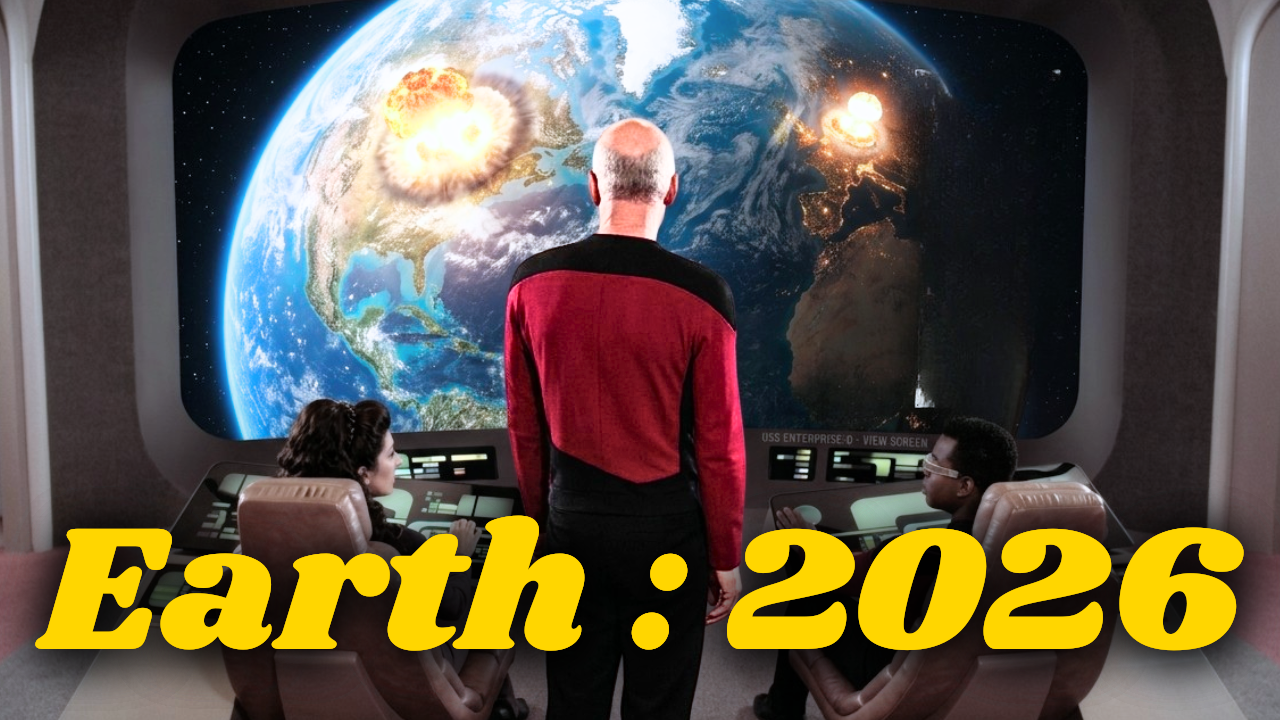
Part Two – The Systems of World War 3: A Typology of Doom
Imagine the classic scifi thought experiment – an alien arrives on Earth and judges our primitive society.
But this is no alien. This is Captain Jean Luc Picard, in orbit in the Enterprise-D, looking down upon us…severely.
Not because our problems are serious. Picard is a compassionate man and if we were doomed by, say, the impending collapse of the planetary crust, he would move heaven and earth to save…Earth.
No. Picard looks down on early 21st century humanity because our problems are dumb and we fail to solve them only because we are too greedy.
Why are we so obsessed with the green paper tokens we use for resource allocation? Why don’t we just fairly share our resources, from each according to our capacity, to each according to their need?
Why are the factories owned by a tiny elite who mostly live in Dubai, Monaco or Manhattan? Why are the means of production not owned by the workers?
Why would 21st century humanity rather fight a third global war than chill out and focus on cool things like exploring the final frontier?
And most of all Picard would scowl down upon the one system driving all others to their doom.
Let us now examine the specific systemic architectures currently operating in our 2026 reality that are leading us, with mathematical inevitability, toward the precipice.
Here I have compiled the many systems leading to WW3 into a literal listicle of doom.
Existential Tech
We are the first generations in the history of the Earth to possess the technological capacity to enact our own extinction. A stone axe can cause a nasty flesh wound, a nuke can vaporise a civilization. This is a profound systemic shift. The proliferation of nuclear arsenals under the doctrine of Mutually Assured Destruction (MAD) created a system where peace is maintained only by a perpetual hostage situation. But it is no longer just nukes. The democratization of biotechnology means that CRISPR gene-editing kits can be purchased by any mildly alienated terrorist group. And the incentives of the free market system mean that no state can choose to *not* build such dangerous toys or risk losing out. Existential tech proliferates exponentially while wisdom declines even faster.
Disinfo: The Semiotic Collapse
A civilization cannot survive if it cannot agree on basic epistemological reality. No human population in which a significant percentage can be convinced the Earth is flat or that Lex Fridman is an intellectual can expect to survive long. We have built a global communications architecture optimized not for truth, but for clicks, resulting in a semiotic collapse, where propaganda, deepfakes, and algorithmic hallucinations have severed the signifier from the signified. A society trapped in a Baudrillardian hyperreality – unable to distinguish between a genuine geopolitical threat and an AI-generated psy-op designed to manipulate a stock price or a prediction market. Because in our global digital media the truth belongs to whoever pays.
Unipolar Hegemony
Following the Cold War, the global system reorganized around a single unipolar hegemon. Which worked kind of until the hegemon had a mid-life crisis and decided it couldn’t be f*cked anymore. The American empire is like late career Elvis. Everything that seemed “cool” until quite recently – the hamburgers, the aircraft carriers, the global financial system – seems suddenly obsolete, kitsch and a tad embarrassing. But the desperate flailing of a declining empire attempting to enforce a unipolar reality on an increasingly multipolar world is a system doomed to generate … doom.
Multipolarity Game Theory Collapse
Conversely, the transition to multipolarity offers no salvation. In a multipolar system with multiple nuclear-armed actors (state and non-state), traditional Cold War game theory collapses. John Nash’s equilibrium only works when the variables are limited and actors are … rational.

In a world with seven or eight or two dozen nuclear powers, all acting on differing ideological, religious, and economic imperatives, the game theory matrix becomes incomprehensibly complex. The system shifts from a predictable standoff to a chaotic n-body problem, where a localized skirmish cascades unpredictably into a zero-sum, planet-wide thermonuclear exchange.
Eco-collapse and Resource Wars
The global economic system is predicated on the delusion of infinite growth on a planet with finite resources. This is a terminal systemic error. As we cross planetary boundaries—ocean acidification, topsoil depletion, atmospheric carbon saturation—the carrying capacity of the Earth plummets. Eco-collapse forces the system into a brutal contraction. When the equatorial regions become uninhabitable, we will see climate migration on the scale of billions. Borders will harden, supply chains will snap, and nations will invariably go to war over access to arable land, fresh water, and rare earth minerals. It is the ultimate tragedy of the commons, enforced by artillery.
Religious Fundamentalism
Systems of extreme religious fundamentalism operate on an eschatological death drive. While secular states might go to war for resources or security, fundamentalist systems operate on a theological teleology that actually desires the end of the world. When you inject nuclear or biological capabilities into a systemic worldview that views the apocalypse not as a failure state, but as a divine prophecy and a prerequisite for salvation, deterrence theory is rendered utterly moot. You cannot deter an actor who believes that mutually assured destruction is merely the quickest transit route back to Jesus.

The Military-Industrial Complex
The system that Eisenhower warned against is not a defensive apparatus, it is an autonomous, self-replicating economic algorithm that converts human blood and public tax dollars into shareholder dividends. By intentionally fracturing its manufacturing supply chains across multiple legislative districts, it has perfectly captured the political process. The system cannot sustain infinite financial growth without continuous kinetic consumption, meaning geopolitical friction must be structurally manufactured to justify the endless production of precision-guided ordnance. World Peace is now literally too expensive. When your fundamental economic paradigm requires the perpetual destruction of surplus capital and human lives just to meet quarterly profit targets, the equation simplifies itself with terrifying mathematical certainty: capitalism is war.
Fascism: The Weakness of the Masses
Drawing on Wilhelm Reich and Deleuze and Guattari, fascism is not merely a political structure; it is a psychological system. It is a symptom of the psychic inadequacy and the weakness of the masses, who, under conditions of extreme economic and social stress, actively desire their own repression. The fascist system relies on the perpetual construction of an “Other” to blame for systemic failures. Because this system is inherently irrational and requires constant escalation to maintain its internal cohesion, its only logical endpoint is an aestheticized politics of total annihilation. It is a suicide pact masquerading as national rebirth.
The Great Filter
The Fermi Paradox asks: if the universe is so vast, where is everyone? Robin Hanson’s “Great Filter” theory provides the systemic answer. The evolutionary leap from a single-planet species to a multi-planetary, star-faring civilization contains a systemic bottleneck—a filter—that almost no species survives. As we survey the cascading crises of 2026, it is overwhelmingly apparent that we are currently slamming face-first into this filter. The combination of god-like technology and primate-level emotional regulation suggests that intelligence itself might be a lethal evolutionary dead-end, a system inherently prone to self-termination.
Algorithmic Escalation Ladder
We have integrated autonomous, machine-learning algorithms into our global financial and military infrastructure. These systems operate at speeds incomprehensible to human cognition. We have seen financial “flash crashes” where algorithms triggered massive economic destruction in seconds. If we apply this same systemic architecture to military early-warning and response protocols, we risk an Algorithmic Escalation Ladder. An AI, processing a false data point, initiates a counter-measure, triggering an opposing AI’s response loop. World War 3 could begin and end in the space of three milliseconds, entirely bypassing human agency.

Sandpile Effect: Self-Organized Criticality
Finally, we must look to physics, specifically Per Bak’s concept of self-organized criticality, often referred to as the Sandpile Effect. If you drop sand grain by grain, it builds a pile until it reaches a critical state. Once at this state, dropping one more grain of sand will trigger an avalanche. You cannot predict which grain will cause it, or how large the avalanche will be, only that the system is structurally poised for collapse. The global geopolitical and economic system in 2026 is a critical sandpile. The inciting incident for WW3 will not be a grand, rational policy decision. It will be an errant drone strike, a localized bank run, a misinterpreted tweet – a single, microscopic grain of sand that triggers the total, systemic avalanche.
CONCLUSION : The system driving all systems
So, Boomers, Zoomers, Alphas, Millenials, and Xers, we arrive at the conclusion of our systems analysis.
The Bad News is mathematically bleak. EVERY system currently operating on this planet is leading directly toward World War 3.
And behind those multifarious systems is a singular system.
Capitalism.
Capitalism demands infinite growth on a finite planet and relentless resource extraction. Our global hegemon is capitalist. Our multipolar powers are trapped in capitalist competition. Capitalism cannot stop building existential tech and capitalism is the military industrial complex.
Capitalism, as we have heard, is war.
The feedback loops of endless extraction, engineered scarcity, military-industrial profit motives, and hyper-individualistic consumption are all converging on the exact same coordinate: complete and utter global collapse.
And the burning nuclear fires of World War 3.
Star Trek gives us hope
The post-WW3 future of Roddenberry’s vision is different from our current reality in one massive, inescapable way:
It is inherently and structurally post-capitalist.
Call it Fully Automated Luxury Communism. Call it Utopia. Call it space socialism.
You cannot have a society where energy is virtually infinite, matter can be synthesized from thin air, and human labor is entirely voluntary, and still enforce a system based on artificial scarcity, wage labor, and quarterly profit margins.
The existence of the replicator fundamentally destroys the capitalist mode of production.
And as our society moves, however staggeringly, towards post-scarcity. As digitisation and the internet make many goods zero marginal cost, and as the looming spectre of AI and robotics automates work.
The potential of a post-scarcity society is there for us to grasp, if we can find a path to post-capitalism.
But capitalism will not let go without a fight
Roddenberry’s thesis was that the capitalist hegemony would, rather than voluntarily relinquish its systemic dominance, initiate a global thermonuclear war.
Roddenberry’s terrible prophecy is not just good television; it is rigorous systemic analysis. The prevailing socio-economic order cannot, and will not, voluntarily relinquish its power. It will drive the ship into the sun before it allows the crew to form a union.
The Good News, hypothetically speaking, is remarkably simple. All we need to do to avoid the nuclear fire and skip straight to the Federation is transcend capitalism. We simply need to abandon the artificial limitations of our economic paradigms, recognize our shared planetary reality, distribute resources equitably, and finally
grow the fuck up.
Which brings us, tragically, to the final piece of Bad News.
All we need to do is grow up.
Yep. We’re cooked.
Listen here

