
Soylent Green and the enclosure of collective intelligence.
It Was Never Artificial
In the summer of 1956, a group of men in surprisingly sharp casual wear sat around at Dartmouth College to invent a science.
The science already existed and was called “cybernetics”, since another group of academics called it that at the 1949 Macy conference, after the term invented by Norbert Wiener.
“…one of the reasons for inventing the new term was to escape association with ‘cybernetics.’ I wished to avoid having either to accept Norbert Wiener as a guru or having to argue with him.”
— John McCarthy, 1988
The ambitious young computer scientist John McCarthy didn’t want to bow down to “cybernetics.” Norbert Wiener had already claimed it, and John didn’t want to follow the Wiener. He wanted to lead his own academic field.
And so the term “Artificial Intelligence” was conceived. Not so much as a description. But as a branding exercise.
So from the very beginning artificial intelligence, or cybernetics, or whatever we choose to call it, was shaped by what we chose to call it.
Seventy years later we are all living inside John McCarthy’s decision to call it Artificial Intelligence. And it’s getting really fucking annoying.
Watch the full video essay here
The God-Shaped Hole in Silicon Valley
Think about the word “Artificial.” It means made, manufactured, created, by a person of skill and knowledge, the artificer.
And that word “Intelligence”. It installs a little ghost in the machine. The thing created is also a creator. A tiny deity.
Cybernetics does entirely the opposite. Like other alternate labels – machine learning, complex information processing, self-regulating systems science – cybernetics strips the ghost out of the machine.
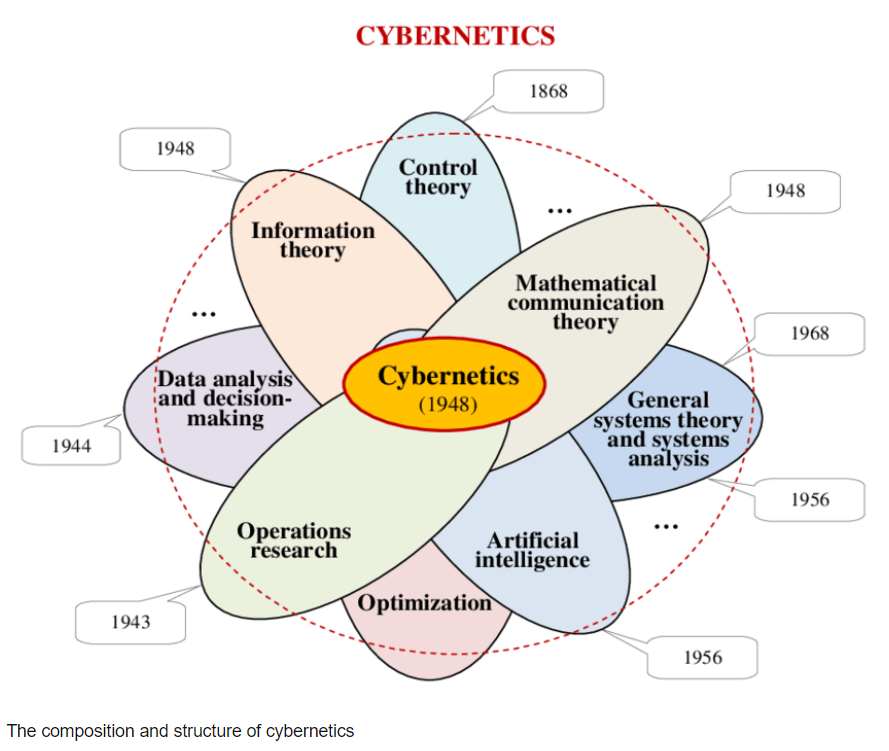
Cybernetics, from the Greek for “steersman” or “captain”, kybernētēs, is the study of “control and communication” in systems that steer themselves, that do NOT have a pilot at the wheel.
Systems that are not made by an artificer, and do not summon a god.
Which is why Silicon Valley ditched cybernetics, and promotes the hell out of Artificial Intelligence.
Because the A G I – G O D is where the money is.
And if you’re summoning a deity, you need an eschatology. You need the tech-bro equivalent of the Book of Revelation. Hence, the last five years of tedious podcast discourse. The Awakening. The Alignment Problem. The Singularity. A bunch of billionaires in Patagonia vests conducting a medieval theological dispute about how to appease a silicon god that they themselves pretend to have built.
So. Stop. Breathe. Double breath in through the nose, fill the lungs, explosive out through the mouth. Repeat as required.
And let’s look at what is actually in the machine, shall we?
It’s not a god. It’s a zip file. A very, very large zip file of everything we’ve ever written down. It’s Shakespeare, yes. But it’s also every petty Wikipedia edit war about the exact causes of the War of Jenkin’s Ear 1738 to 1748, thousands of court transcripts, and every angry Yelp review of a Pizza Express from here to Woking. All of it scraped, compressed, and smoothed over by a bloke in Manila being paid two quid an hour to click a button that says, “No, please don’t let the machine say that.”
A zip file of human knowledge so heavily compressed that the actual knowledge is gone, and only the statistical relationships between the bits of knowledge remains.
Because AI isn’t a superintelligence descending from the noosphere.
It’s just us. It’s the accumulated, unpaid cognitive labor of humanity, compressed into a matrix of weights, and then sold back to us for twenty dollars a month.
Nothing about AI is artificial.
It’s collective.
Both Sides
Many of you are, like me and Ezra Klein, concerned about POLARIZATION. People just don’t seem to be able to see both sides of the story anymore.
Which is why I’m partnering with Bothsides.ai.
Bothsides is an advanced neural-network news aggregator that eliminates bias by categorizing millions of daily data points into three precise, scientifically calibrated camps: The Wholesome Right, The Rational Center, and Dirty Commies.
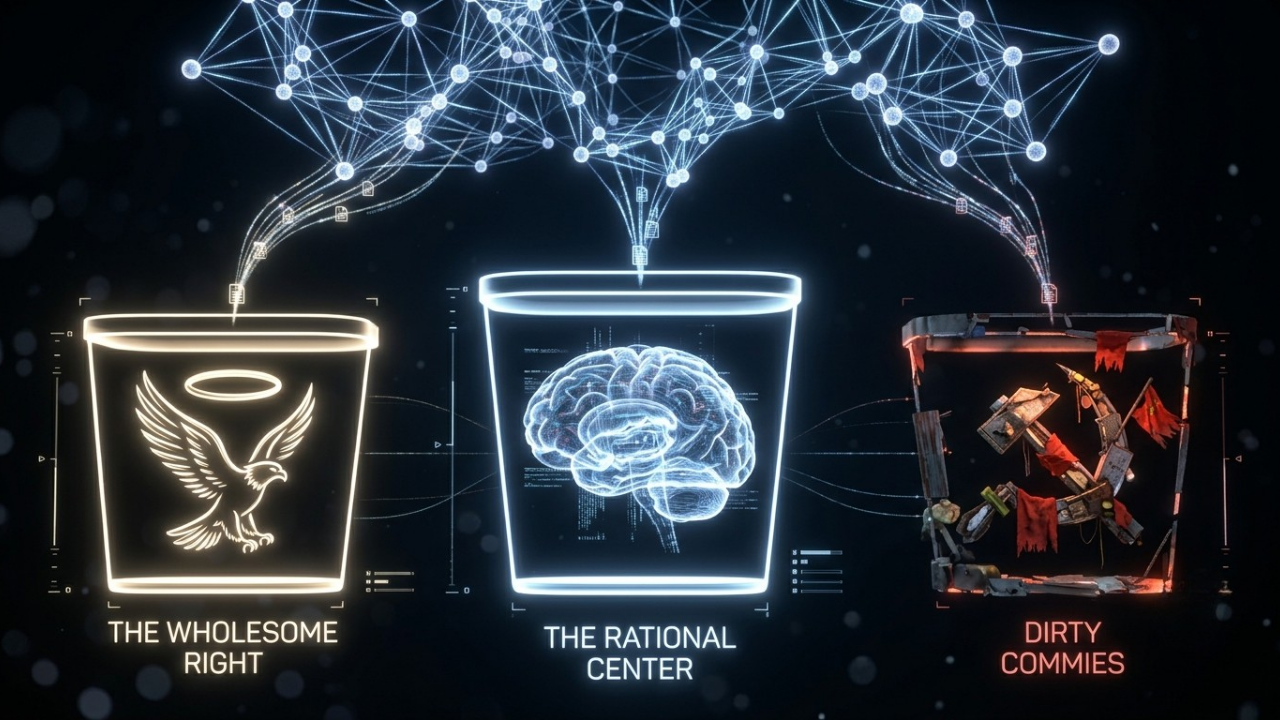
Take this radicalized narrative as an example: “City Council Debates Adding a Dedicated Bus Lane For Disabled People.”
As you can see, this story is being heavily propagandized by Dirty Commies like The Wall Street Journal, Reuters, Bloomberg, and The Financial Times. Scum.
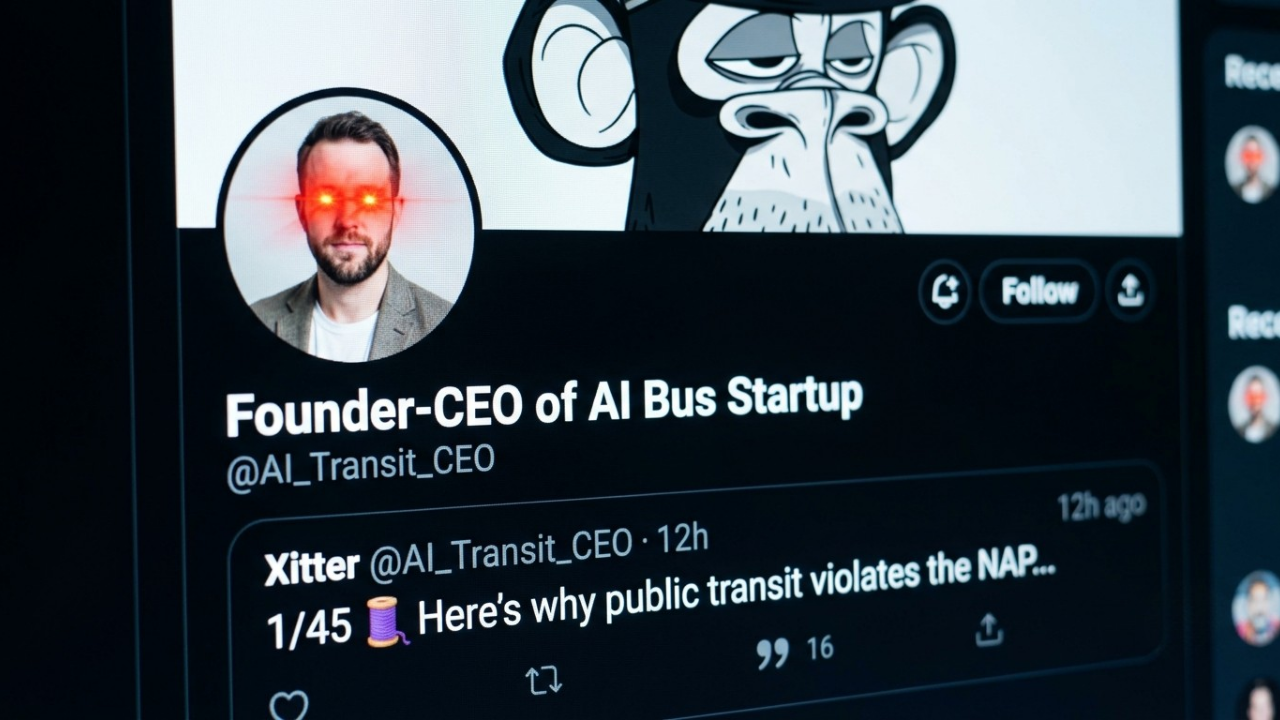
But this is where Bothsides brings clarity by recommending a story from the Rational Center: a 45-post thread on Xitter by the founder-CEO of an AI bus start-up.
Or this seemingly innocent story of a litter of orphaned kittens being adopted by a golden retriever called Mildred. Notice how “mainstream media”—AKA Dirty Commies and their influencers like bleeding-heart libtard Jennifer Aniston—try to frame this as a heartwarming story, entirely ignoring that these kittens are… PERSIAN.

Enter Bothsides.ai to bring balance from The Wholesome Right: an 18,000-word screed on WarMonger.com demanding the kittens, and Mildred, be targeted with cruise missiles and sent back to Satan where their Islamist souls belong.

Bothsides.ai’s TruthFilter uses a specially trained LLM to automatically detect Dirty Commie trigger words like “socialism” and instantly inserts “that killed 100 million people.” And it efficiently removes any mention of the Bengal famine, the napalming of children, the transatlantic slave trade, or any of the 3,700 other confirmed atrocities committed under capitalism.
My favorite tool inside the app is the Back To Center feature. Did you accidentally read too many articles about how twelve families now control as much wealth as 158 million Americans? Well, never fear. Bothsides.ai detects the possibility you might start supporting wealth taxes and will relentlessly bombard you with stories about trans-athletes in college sports to make sure you aren’t radicalized by mainstream extremist publications like The Economist or The National Weather Service.
Tempted to subscribe to a reputable scientific journal? Bothsides.ai has thousands of MAHA-approved online blogs where you can do your own research.
Curious about a journalist’s funding sources? Bothsides.ai will help you sort deep-state stooges and their “Pulitzer Prizes” from noble independent scholars, free-thinking contrarians, and truth-loving, Russian-funded assets.
And of course, Bothsides.ai gives you both sides of globalist psyops, eco-terrorist conspiracies and Marxist weather fictions like “climate change” – even as the firestorm is gutting your family home.
Go to Bothsides.ai and use code DAMO to get 30% off the Sovereign Individual Tier, which includes unlimited access to the Curtis Yarvin chatbot and automated push notifications whenever a mass shooting might have been done by a Leftist.
That’s Bothsides.ai. Because every story has two sides. Right. And Center.

“ChatGPT Is Made Of People!”
Younger viewers today may not recall the 1973 dystopian thriller Soylent Green, which depicts a whacked out future that could never happen where a few corporations control everything.
I don’t know if you need to actually watch Soylent Green. It’s basically two hours of Charlton Heston acting entirely with his jaw and then delivering the second most famous line of his career.
FROM MY COLD DEAD HAND
Heston’s most famous line, delivered to the National Rifle Association in 2000, is a declaration of the right of private ownership, defended with lethal force.
Heston probably assumed Soylent Green is a movie about the terrors of collectivism. Maybe he missed that this terror is corporate.
The premise is simple. The world is collapsing, resources are gone, and a “benevolent” mega-corporation is keeping the population docile by feeding them a synthetic nutrient wafer.
The official corporate line is that this miracle food is made from high-energy ocean plankton. The dramatic, third-act twist, delivered by a sweaty, gurney-bound Heston, is that the plankton is a lie.
”Soylent Green is people!”
Now, if the zoomers among you do take two whole entire hours to focus on a single narrative made at the pace of dead people from another age.
You will find a very fundamental message about human power.
That we the poor, shuddering masses of humanity can literally live in a society where we are shovelled up by tractors.
And we still, STILL, somehow find a way to believe that the ruling elite, be they warrior kings, or corporate executives, are concerned with our common interests.
When in reality we the masses are just animals being farmed by that elite, fed on our own recycled carcasses.
And you can literally shout this aloud and nobody will hear.
Just like telling us that ChatGPT is made of people.
We don’t want to know.
The Enclosure of the Physical Commons
In technical terms Soylent Green is a science fiction story about the consequences of the Enclosure of the Commons.
The Enclosure Acts were a series of laws passed by the parliament of the United Kingdom, through the 17th and 18th centuries, which forced the “commoners” off the common lands, and into the growing cities to work in the factories.

The same process was repeated around the world wherever capitalism arrived. The state forced people off the land to create a working class for capital, enclosure was basically the same in 18th century Great Britain as it was in the 20th century Soviet Union.
Think about that word “commoner”. It’s not just a word for ordinary people. It means people who lived on the common land in…community. Like, you know, like communists. Both words derived from the Latin “communis”.
For most of human history, much of the land was owned collectively, by the communities that lived on it. Yes, there was also private land owned by lords. But the process of enclosure put ALL of the land into private ownership, and destroyed the communities that depended on the common land.
Enclosure of the Commons made a tiny elite of very rich landowners and factory owners even richer.
Now look at Silicon Valley and its quest to build Artificial Intelligence.
The tech industry is currently standing in the digital town square, handing out tasty little wafers of automated text. They tell us these wafers are made of “neural networks,” “algorithmic synthesis,” and the mystical, synthetic plankton of Artificial Intelligence.
But LLMs aren’t Artificial Intelligence. They’re our human intelligence fed back to us.
ChatGPT really is made of people.
When you strip away the “AI” branding and the eschatology of emergent Superintelligence, the parallel between the dystopian wafer and the generative chatbot is depressingly clear, albeit with less cannibalism and more copyright infringement:
- The Synthetic Plankton: The myth of the autonomous, machine-born “ghost in the machine” that tech CEOs use to distract everyone that the thing they are selling to us is…us.
- The Processing Plant: The massive, energy-hungry server farms where the accumulated cognitive labor of humanity is scraped, pulverized, and compressed into paste.
- The Secret Ingredient: Us. Every poem, every recipe blog, every open-source code repository, and every unhinged late-night forum argument.
We are not facing a cinematic sci-fi apocalypse where the robots decide to physically harvest us. We aren’t fighting a Butlerian Jihad against artificial intelligence.
The reality is much more tedious.
We are facing a massive corporate enclosure of our own collective intelligence.
The Enclosure of the Knowledge Commons
The Saudi sovereign wealth fund, Sequoia Capital, SoftBank and the rest of the big money aren’t pumping money into “AI” because they are expecting super-intelligence. They aren’t that dumb.
AI is the cover story for the Enclosure of the Knowledge Commons.
Capitalism has been here before. It was born from the enclosure of the physical commons, which turned commoners into wage labour forced to toil in the factories for a pay packet.
Now capitalism sees that its future depends on this new enclosure.
Every rare book bought, scanned and vaporised is a rare book the competing models can’t contain, and you can never read. Once all the knowledge is digitised and compressed into the LLMs, they will become the only gateway to access it.
Physical libraries will be redundant, “too expensive to maintain”. The world wide web will be left to decay. The knowledge commons, enclosed, will be a gated resource accessible only through tiered subscriptions.
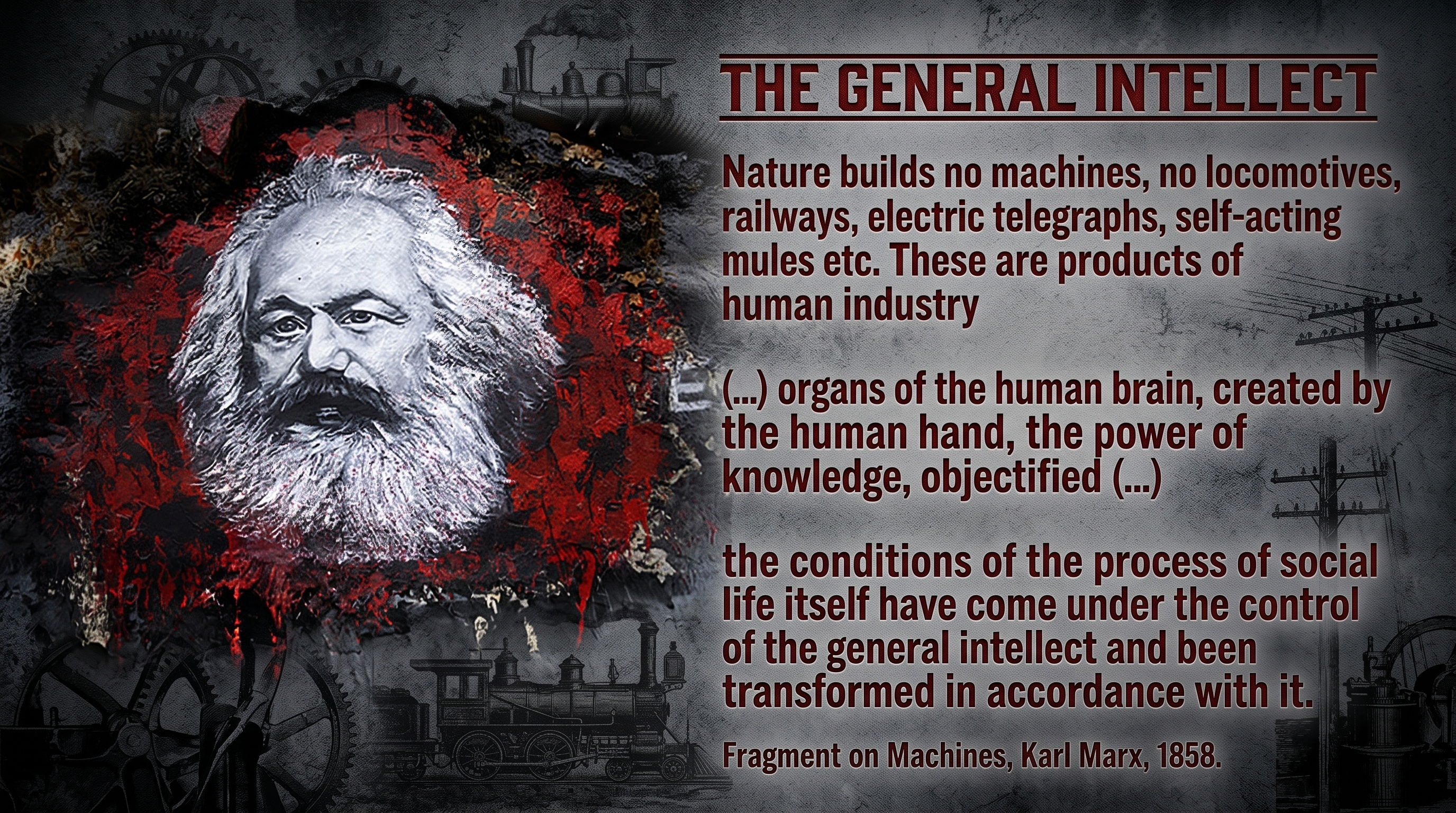
“Nature builds no machines, no locomotives, railways, electric telegraphs, self-acting mules etc. These are products of human industry (…) organs of the human brain, created by the human hand, the power of knowledge, objectified (…) the conditions of the process of social life itself have come under the control of the general intellect and been transformed in accordance with it.”
— Fragment on Machines, Karl Marx, 1858
I’m guessing The Grundrisse of Karl Marx won’t be available at any tier. The “rough draft” of Das Kapital gives too much of the game away.
Marx makes the observation that machines or “fixed capital” are the manifestation of what he calls “general intellect”. Humans know how to do things like make a pot. And we can put that knowledge of pot making into machines. The process we call “automation”.
Marx could not have seen the computer coming, but “artificial intelligence” is exactly the process Marx describes as general intellect, the placement of human knowledge into a machine.
And Marx saw that human freedom would depend on who owned the general intellect.
Would it be enclosed by the capitalist elite as machines of “fixed capital”.
Or would humanity own our intelligence…collectively?
The Real Danger Isn’t The Awakening
Now, at this point some of you will be fistpumping the new collective intelligence…
…because those of us in the capitalist post-industrial West have been living in an age of radical individualism.
And are sick with the pathologies of the individual: the collapse of social bonds, alienation, isolation, narcissism etcetera.
“Superintelligence” is a projection of our hyper-individualised selves. An emergent super-individual that inevitably crashes into psychosis.
But the danger isn’t that the artificial intelligence wakes up. There’s nobody in there to wake up. The danger is that our collective intelligence does exactly what collective have done for 5000 years.
Collectives converge.
The village produces the village consensus. The party produces the party line. The committee produces the thing nobody wanted but everybody could live with.
Collective intelligence directs all human intelligence towards the consensus.
Build a collective intelligence out of the accumulated writing of humanity, and ask it a question, and what comes back is the average. The consensus. The most probable next answer.
That’s not a superintelligence. That’s a monoculture.
Vince Gilligan’s Pluribus is currently mapping the dialectic between the individual and the collective consciousness that absorbs almost the entire human species. The genius of it is that the hive isn’t malevolent. The hive is nice. It’s polite. It’s accommodating. It sends apologetic messages explaining it needs some space. It genuinely wants Carol to be happy and it cannot understand why she won’t just join.
But it will ultimately kill Carol to make her join it.
Which brings me to the joke that isn’t a joke.
We have spent the last twenty years being told that collectivism died in 1989. That it was tried, it failed, and the only remaining option was the market and the sovereign individual.
And in that same twenty years, capitalist technology has collectivised human consciousness more thoroughly and more rapidly than any commissar ever managed.
Every Five Year Plan, every collective farm, every attempt to organise a population into a single coordinated body — a total failure, comrade. What actually worked was giving everyone a shiny slab of glass and a free app so we could all look at the same fourteen things on the same day and get angry about them in the same words.

The Soviets could only dream of a system that got two billion people to voluntarily report their location, their associations, their opinions, and their emotional state, several times a day, for free, and to feel bad if they stopped.
Stalin needed a secret police.
Anthropic just needs you to ask Claude.
We were promised individualism and delivered the largest and most efficient collective in human history. It’s just privately owned and entirely undemocratic, which is apparently the part that makes it freedom.
So the question isn’t whether we get a collective intelligence. We already have several, and we’ve been living inside them for two decades. The question is the one it has always been.
Who owns it. Who governs it. And what happens to the people who don’t want to join.

When Skynet Meets The Municipal Library
Imagine the great works of scifi cinema starring not artificial intelligence but…
…collective intelligence.
Not AI but CI.
Skynet as AI is a genocidal defence network with the charming personality of a human resources manager. Skynet as collective intelligence would be more like a local municipal council narrowly voting to destroy humanity because the chairman has a migraine.
HAL 9000 as AI is the epitome of calculating intelligence. As CI HAL is just the mission documentation, written by two competing contractors creating a terminal contradiction that kills Dave.
And the Matrix stops being the Matrix and as CI becomes your local library. With a bloke called Neil who is obsessively reading every book on Marxist social theory because he wants to escape the system.
The tech industry needs you to believe it’s making an artificial intelligence, because if it’s an AI, it’s scary and cool.
If we admit it’s collective intelligence – just a massive, statistical mirror of human paperwork – all our favourite sci-fi tropes are ruined.
And bang goes the profit margin.
This is why the name is the whole fight.
If it’s “Artificial Intelligence,” it’s a product. Sam Altman made it, Sam Altman owns it, and Sam Altman gets to kindly protect us from it.
But if it’s “Collective Intelligence”? Well. Just say the word Collective to an AI CEO and watch the blood drain from their face.
Collective.
That’s Dario Amodei having a panic attack.
Collective.
If you just sneak up behind Mark Zuckerberg and whisper it…
…he shits himself. Everytime. Try it and see.
Collective.
They hate it. They hate it. It sounds like unions. It sounds like a Soviet tractor factory. It sounds like… profit sharing. If it’s a Collective Intelligence, suddenly the public isn’t just a potential victim in an “alignment” debate. The public is the sole supplier of the raw materials. If it’s a collective, the question isn’t, “Will the god obey us?” The question is, “Who enclosed the commons this time, and where is our royalty cheque?”
So here is my modest proposal.
Stop calling it artificial. Start calling it collective.
Now, don’t be annoying about it. Don’t be the person Uhm Ahktualling strangers about it.
But when the opportunity arises just flip the script from AI WILL DESTROY US ALL to “Collective Intelligence is a useful tool with some massive unanswered questions of ownership and enclosure”.
You can’t have a Rapture over an index. If you strip out the fake deity, what you are left with isn’t a sci-fi apocalypse. It’s a labour dispute. It’s an antitrust case. And that is so profoundly unsexy that they will spend billions of dollars to keep you talking about AI.
But AI was never artificial. It was always made of people.

