“Extruded Fantasy Product”
Did Diana Wynne Jones invent this term? Wherever it began it captures the predicament we’re in.
The idea of a fantasy “genre” is as ridiculous as an “imagination” genre.
Fantasy is the capacity of the human imagination to dream stories that satisfy our desires. The world is big and brutal and we little humans fantasise we can fly, have magic powers, can fight the dragons without or within. We can even fantasise starships.
But what has come to be called the capital F for Fantasy genre is the opposite of imaginative. It’s product extruded from the recycled ideas of JRR Tolkien and a few other original fantasy writers.
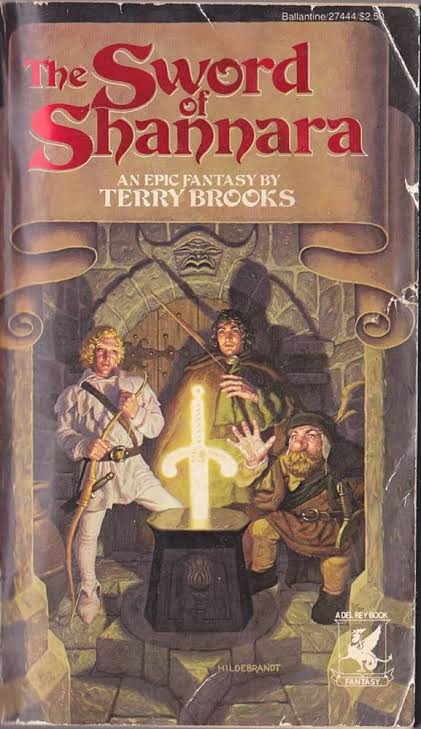
I remember reading The Sword of Shannara for the first time, realising within a few chapters it was a clone of Lord of the Rings and hurling the book at the wall. I was eleven and I’ve hated extruded fantasy product ever since.
If you can learn to distinguish Original Fantasy from Extruded Fantasy Product then fantasy is intensely creative and meaningful. From George McDonald’s Phantastes through CS Lewis to Tolkien, fantasy has been on a mission to ressurect the Christian mythos in new symbolism.
Which is why so many science fiction folks hate fantasy of course. Science fiction makes a new mythos for modernity, while fantasy returns to the mythos of the past. But they both begin with imagination and fantasisation.
They are just different fantasies.
Extruded Fantasy Product recycles the symbols of Original Fantasy but without any of the meaning. Terry Brooks got paid to write a generic copy of Lord of the Rings after Ballantine were sued for pirating LotR.
And so Fake Tolkien was born.
If you’re still not clear why Rings of Power is Fake Tolkien, watch the video essay on the Science Fiction channel.
Link in the comments.
Also – don’t touch the glowing hot sword you dumb dwarf!
 Damien Walter
This seems a bit reductive.
Many great fantasy stories and series either ignore, downplay, or reject the Christian mythos of Tolkien and Lewis in favor of other elements, and they feel thematically distinct. Discworld, Game of Thrones, Netflix’s Castlevania adaptations (particularly Nocturne), the Dresden Files, the Black Company, The Last Unicorn, the better romance fantasy works…the list goes on. (I’d include Brandon Sanderson’s works, but his works apparently have some Mormon themes?)
My favorite fantasy series, A Practical Guide to Evil, outright started as blunt deconstruction of Fake Tolkien and grew into something amazing in its own right, and that series rejects a number of Tolkien’s themes. (Providence as a concept is one of the major problems our protagonists have to deal with, for example.)
I’d also note that much modern fantasy draws more from Dungeons and Dragons than directly from Tolkien. Yes, D&D’s default settings are very much a blend of Fake Tolkien and pulp novels, but they have since developed into a tradition of collaborative mythos-building in their own right (one that often blends more than just a past mythos into the world, especially if you get into the D&D cosmology a bit). Given that, it strikes me as overly binary to say that fantasy is only about a past, Christian mythos and that sci-fi is about building a modern mythos. There’s plenty of overlap, and plenty of speculative fiction that doesn’t fall neatly into the fantasy/sci-fi binary in the first place.
It also strikes me that published novels, western TV, and tabletop roleplaying lack a monopoly on the fantasy genre. While many works in other mediums fall into Fake Tolkien, Just DnD, or aping another popular work, some do genuinely interesting and distinct things.
Dark Souls, for example, is a video game known both for its challenge and environmental storytelling. While it does share some themes with Lord of the Rings if you squint, such as self-sacrifice to save the world and a quest that ends in fire, it is very much unclear whether sacrificing yourself as kindling for the First Flame to extend the Age of Fire is truly a good thing. The gods were just as flawed as the mortals. The world is dying, decaying, hollow and rotten in a way Tolkien’s world never was for anyone (besides the elves I guess), and it might be better to snuff the First Flame in favor of an Age of Dark.
I can go on. The Elder Scrolls III: Morrowind was a game known for having very weird lore that draws a bit more from Vedic cosmology than Tolkien, despite superficially appearing similar. Delicious in Dungeon (also known as Dungeon Meshi) is a manga and anime about being different while cooking monsters in delicious-looking ways, and while it draws on the Japanese variants of DnD’s tropes it very much does not feel like it has any connection to Christianity whatsoever. One of my favorite webcomics is Order of the Stick, and that uses a world explicitly based on DnD 3.5 edition’s mechanics, tropes, and sometimes its cosmology to tell deeply compelling stories (while still managing to fit gag-a-day humor in where it doesn’t undercut the drama).
Overall, while I understand where you’re coming from, I feel like this paints an incomplete picture of what fantasy is and what “true fantasy” means. Because there’s still true fantasy in a world where a team bands together to hunt vampires in late medieval Walachia and a Sufi necromancer contemplates philosophy and theology with his minions. There’s still true fantasy in a world where it’s common to read one of the protagonists as autistic because he’s so focused on trying food from a variety of dungeon creatures and religion isn’t a theme at all. There’s still true fantasy in a world where an orphan girl tries to save her homeland by collaborating with the enemy to build a power base instead of becoming yet another doomed hero, the universe itself can bend to follow the stories people tell, and everyone ruthlessly exploits the hell out of that.
And I think that to imply the mission of Original Fantasy is primarily to resurrect the Christian mythology through new symbolism is to do the genre disservice. If anything, the Tolkien theme I’d apply most to it is mythopoeia.
LikeLike