Every time an act of 4th generation warfare hits the news, I think of Adam Roberts science fiction novel New Model Army.
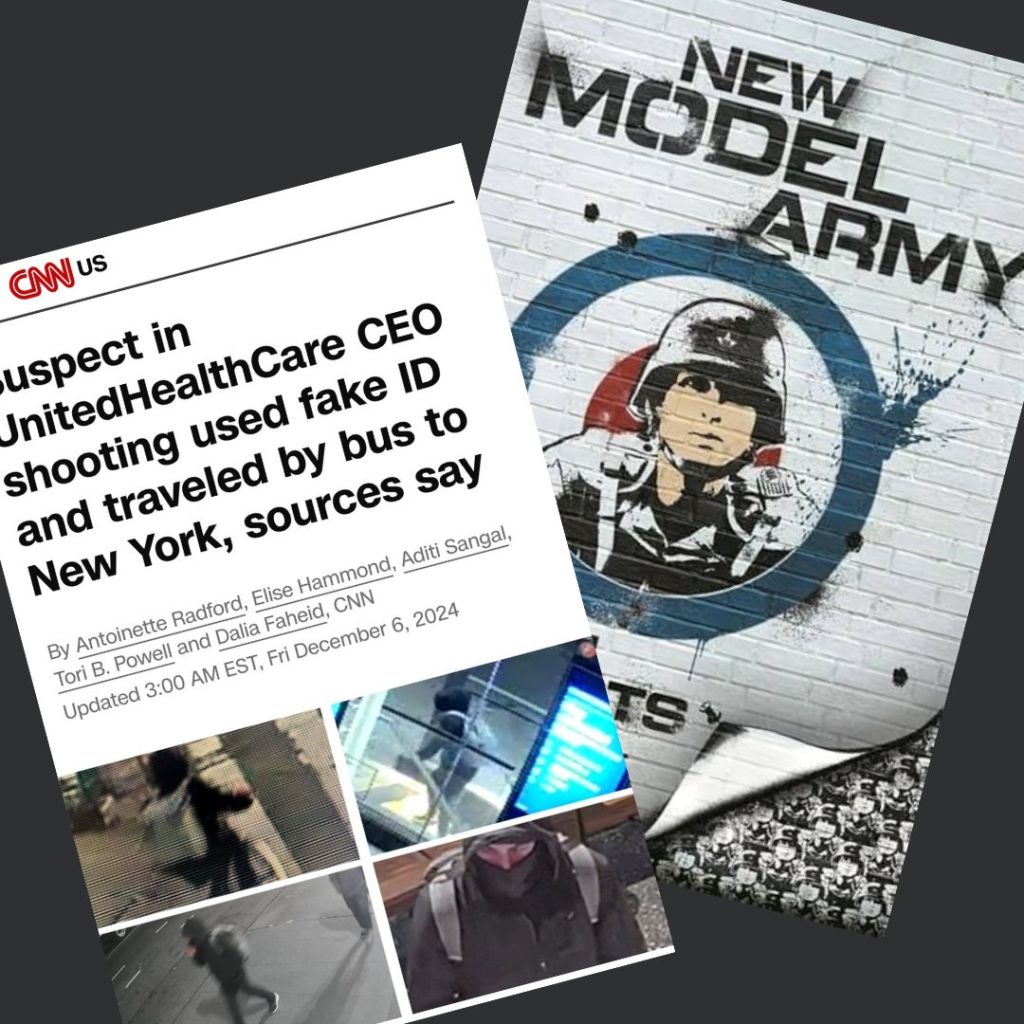
A book that is almost 15 years old now. It predicted much with great accuracy. But England was never the likely epicenter for decentralized warfare.
America is.

Looking at the social media responses to today’s assassination of healthcare CEO Brian Thompson, I realise that we don’t know what escalation of violence looks like in the social media age.
But we’re learning it in real time.
QUESTION :
Will corporate CEOs respond to being gunned down in the street for their unethical business decisions by
A) raising ethical standards to basic human norm
B) replacing the last bits of democracy with full police surveillance state
?
And an entire class of people…by a class I mean the literal class of corporate executives, shareholders, and professional managers who will empathise with the victim of this killing..
…that entire class of people are looking at the hooting, vindictive, vengeful responses to this event on social media, coming from the class of workers who routinely get their healthcare claims rejected
…and that professional class are thinking
- how do we defend ourselves
- how do we hurt our attackers
The sad reality is that 80% of the population are being pushed closer and closer to a violent confrontation by the 10% of LARPers on either side who are now escalating the civil war LARP into a real
4th generation civil war
People have the idea that a civil war will be fought with soldiers and tanks. But a 4th gen civil war will be fought with decentralized acts of violence against powerful individuals, and the powerful retaliating through ever more draconian state security actions.


well blue shield just dropped its new policy of limiting anesthesia. I don’t condone violence but it seems to be a language corporations understand.
LorienB
LikeLike
No, you do condone violence. At least be honest with yourself.
LikeLike
I was shocked by the instantaneous positive responses towards the assassination. Shocked but not surprised.
LikeLike
Already in California we are experiencing the dissolution of private insurance and the preparation of the state to force state run insurance. This is another step toward that end. If private insurance providers have their profits and literal lives at stake – the private industry will die. Socialists cheer this end. But is a people served by state run insurance actually better off without alternatives?
LikeLike
I disagree. I think we can view the response dispassionately and say “I don’t condone violence but it seems to be a language corporations understand” when we see the whole context.
Private health insurance in the US, it can be argued, commits violence also (in United Healthcare’s case pretty regularly, chart linked), but in a banal fashion through the denial of claims – whilst keeping the premium paid, mind you – as a matter of course. These denials can result in the financial bankruptcy of the insured or insured’s family in their bid to have the insured simply stay alive. Even then the results are mixed, meaning some die anyway despite best efforts. This assassin robbed a family of its father. How many families did United Healthcare rob of the same?
What’s more is that all manner of non-violent action (via suit or protest) has been tried to get private health insurance to consider their customers more than their shareholders.
Blue Cross/Blue Shield’s reversal on anesthesia says, to me at least, that they read the room and are admitting, “yeah, you got us. We know we were wrong for that idea…never mind. 😅”
https://www.reddit.com/media?url=https%3A%2F%2Fpreview.redd.it%2Fclaim-denial-rates-by-u-s-insurance-company-v0-7aa6zytdox4e1.jpeg%3Fwidth%3D640%26crop%3Dsmart%26auto%3Dwebp%26s%3De49581f23d51beb176334a27bc66da5a480456c4
LikeLike
The Blue Cross/Blue Shield dilemma is completely misunderstood, no thanks to social media. Vox has an excellent write-up about the issue, and I highly recommend it. It is basically this: the measure was to reduce the reimbursement to anesthesiologists, who happen to be one of the most overpaid doctors in the country. By no means would patients have to pay extra out of pocket expenses for the policy. Because politicians themselves spun this story on social media, it is my personal belief that they had to back down to save face. Ultimately, it was a terrible decision.
The healthcare system in the U.S. is awful, but the root of the problem is at the providers (doctors and hospitals who believe they deserve absurd amounts of wealth for their contributions to society). It is not the health insurance companies.
LikeLike