
There’s something wrong with this map
and this map
and these maps
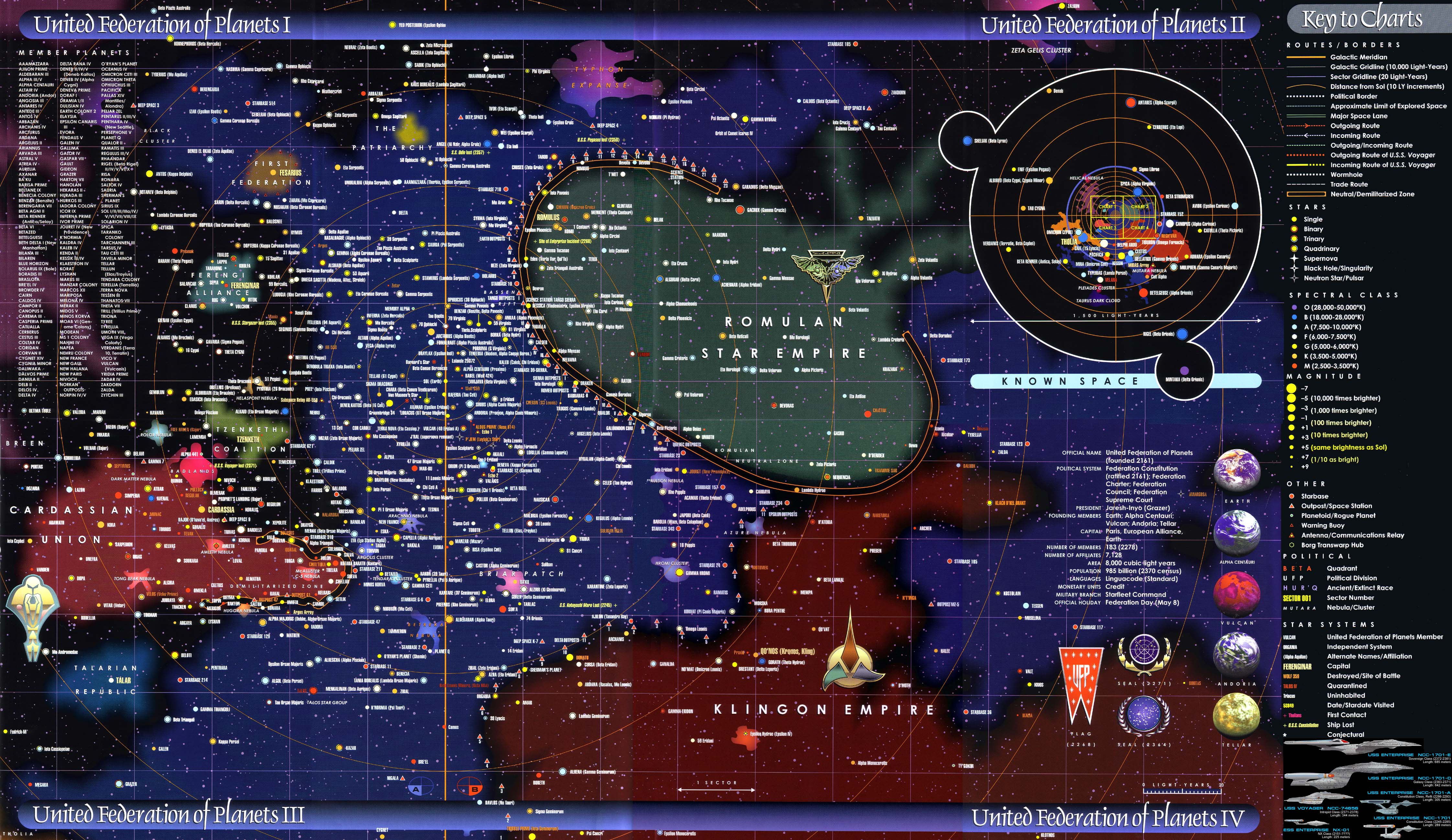

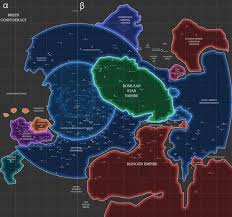
Fans have made many maps charting, with nerd level accuracy, the known universe of Star Trek
Tru-nerds will point out that space has three dimensions. But given that our galaxy is 100x wider than deep, it’s not unreasonable to map its empires on the galactic plane.
Because these are political maps of the territories and borders between the Klingons. Romulans. Cardassians. Galactic empires.
Or worse
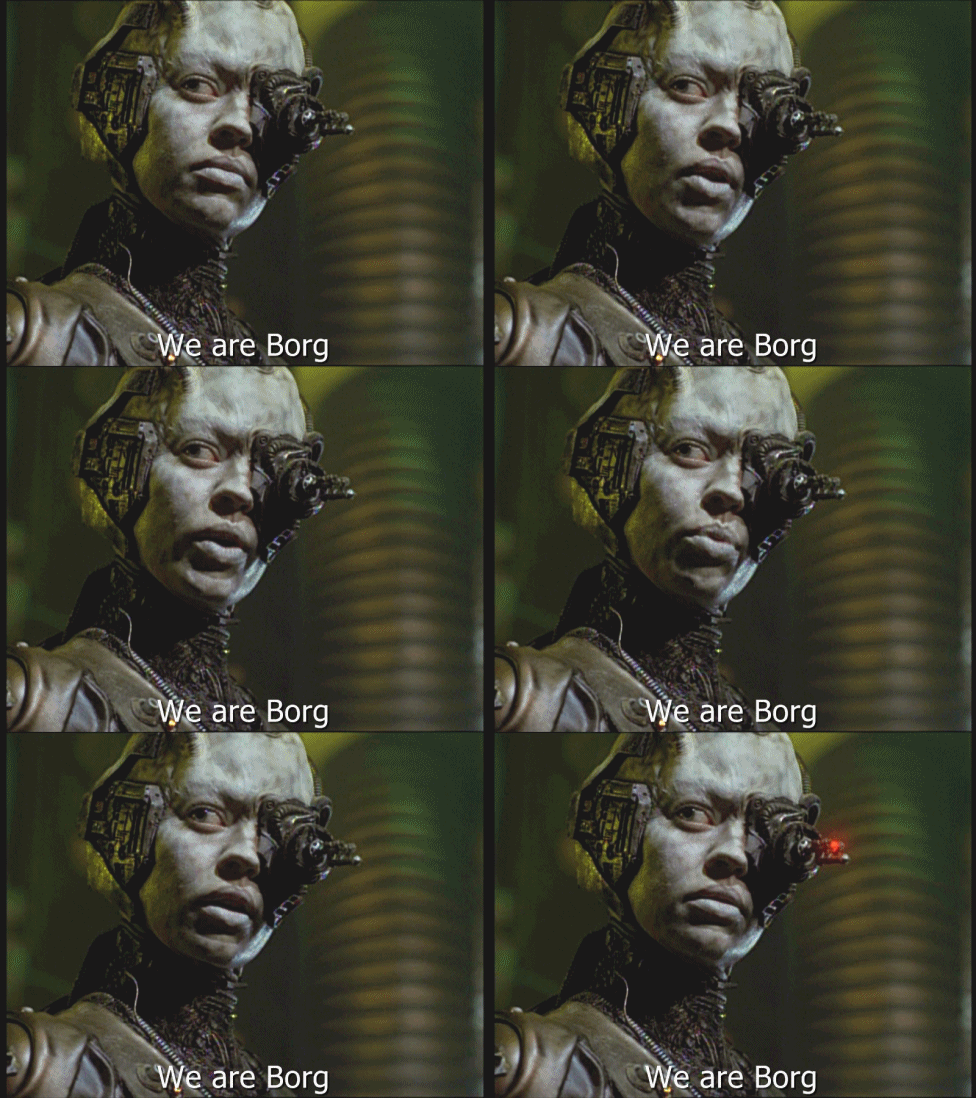
The exception is the United Federation of Planets, which as the name suggests is not an empire, but a federation.
Which is the problem with these maps.
If Earth is a relative newcomer among warp capabale civilizations, how is it the centre of the Federation? And if the Federation has territories and a Starfleet…is it really not just another empire?
The answer is that Star Trek isn’t really about the future, and these maps aren’t of the galaxy. Star Trek is about the culture that made it, and these are maps of its geopolitics.
The United States of America
Because Star Trek is…propaganda
“Can you imagine how great it is to be able to propagandise a while nation? I propagandise for what I believe in.” Gene Roddenberry
Watch the full video essay on the Science Fiction channel
This is an essay about Star Trek as propaganda
Because Star Trek IS propaganda.
Gene Roddenberry created Star Trek as a vision of the future. And as we’ll see in this essay, Star Trek has been supported by the American state and corporations, to spread that vision.
But the real question isn’t if Star Trek is propaganda, because Star Trek is propaganda.
But what is Star Trek propaganda for?
And the answer to that question gets to one of the important problems facing humankind today.
Because the answer is NOT…’Murica
#
Peak Star Trek was reached in 1992 as the final seasons of Next Generation and early seasons of Deep Space 9 screened back to back
Series creator Gene Roddenbery had died in 1991 but his influence was still paramount. Roddenberry had enforced strict rules on Star Trek writers, there was to be no internal conflict among the Enterprise crew, and humanity was always to be shown as having overcome its baser drives.
Roddenbery had guided Trek in his later years by summarily firing writers who missed his high standards. The survivors, including Rick Berman, Branon Braga and Ira Steven Behr, would drive Star Trek forward, preserving Roddenbery’s vision while growing it for the 1990s.
Original Trek of the 1960s is eerily similar to post-war America. The United Federation of Planets is the United States of America, a new federal power surrounded by old empires.

Atlantic Ocean (June 14, 2004) — The nuclear powered aircraft carrier USS Enterprise (CVN 65) surges through the water of the Atlantic Ocean.
And the USS Enterprise is, literally, the USS Enterprise. Enterprise NCC 1701 and it’s warp engines are directly inspired by the Enterpise CVN-65, the first naval supercarrier with nuclear engines.
Surrouded by dying empires after WW2, the federal United States devised a strategy to secure global trade and project military power worldwide with a fleet of super-carriers, much the same purpose for which the Federation built its Starfleet.
Star Trek’s naval themes were emphasised to rescue the movie franchise in Wrath of Khan. The “cold war” analogy of Klingons as the Soviet Union was so stark that the sixth movie The Undiscovered Country even blew up the Klingon moon, in a clear metaphor for the Chernobyl disaster.
Star Trek has continued to mirror the power of the United States. The noughties reboots made a series of cackhanduhhed gestures to the War on Terror under director JJ “Star Destroyer” Abrams.
And as America descended into culture wars Alex Kurtzman’s various attempts at Star Trek struck a variety of Woke poses to cover a fundamental lack of storytelling chops
Enterprise had been crewed by hard bitten, and probably alcoholic, naval men. Discovery seemed to be crewed by the post-grad faculty of a liberal arts college.
Oh. And. When the studio gave up and stopped even pretending this wasn’t chest thumping pro-American heartland propaganda as the determinedly atheistic Star Trek declared
it had FAITH.
But the 1990s, the late seasons of Next Generation, its movies Generations and First Contact, most of Deep Space 9s seven seasons, and some of Voyager if you can squint hard enough to
ignore Neelix.

and…look…can we just admit that Voyager only struggled through those dull later seasons because…certain people…were still tuning in for 7 of 9?
The 90s remain peak Star Trek.
90s Star Trek was no longer a mission of exploration. Picard’s Enterprise is a diplomatic vessel primarily managing the Federations extant political relationships. Deep Space Nine’s mission is, quite literally, to deal with the fall out of colonisation.
If Bajor, with it’s peaceful Vedic religion, is the hindu culture of the Indian subcontinent, then the Cardassian colonisation is the British Raj.
In fact 90s Star Trek constantly and consciously contrasted the Federation with the empires that surrounded it.
With the Cold War in the rear view mirrior, 90s Klingons were retconned as a generic representation of barbarism, plus superb hair.
The Ferengi are often cited as a parody of American capitalism. But their mercantilist culture, Rules of Acquisition, fundamentalist oppression of their females, and face make-up that has been called Jew Face

are more like a broad parody of how Americans saw the Semetic cultures of the Middle East
and really highlight how easy it is for alien races in scifi to become unpleasant cultural stereotypes.
Are you hearing this George?

Meanwhile the Dominion, alien shapechangers who after millenia of persecution have become a militantly expansionist power to secure their homeworld
are probably the Star Trek empire a good writer would resurrect to be politically relevant here in 2025
The Federation
we are shown again and again by contrast
is superior to the old empires it conflicts with.

The Federation seeks not to expand by force, by voluntary membership, of strange new worlds, who agree to abide by the Federations values while retaining nominal autonomy
Pretty much exactly the offer of America’s post-WW2 “Rules Based Order”
And the Federation’s values are, weirdly, American, including one notorious episode that pivots on Kirk reading the United States Constitution.
The Federations superiority comes not from any belief in racial superiority. It is a multi-ethnic diverse and intersectional alliance.
The Federation’s superiority comes from its values, shared by all its members. Liberal values of equality and freedom. Humanist values of the sanctity of life, with or without forehead ridges. Values embodied in the federal political structure of the Federation.
And in the United States, the culture imagining the Federation.
So as the United States of America grew into its role as global superpower, there was a network tv show about a galactic superpower to show us that American liberal democratic humanist values
were the universal values of the entire fucking galaxy
And reassure us that the global hegemony we all live under, while not perfect, is fundamentally for the good
and making a good future
like Star Trek.

It’s a knowing nod to history that we meet the crew of the Enterprise-D in their first cinema outing onboard the HMS Enterprise.
The first recorded vessel to bear that name was a French 26 gun frigate, l’Enterprise, captured by the English in 1705 and Anglicised to Enterprise.
Twelve HMS Enterprises have served in the royal navy in the three centuries since. The most recent, an Echo class survery vessel, being decommissioned in 2023.
James T Kirk’s five year mission to boldy explore strange new worlds is basically the mission of an HMS Enterprise in the late 1700s.
The HMS George was a 10 gun tender captured by the Americans in 1775 that then served in the revolutionary war as the first USS Enterprise.
Nine USS Enterprises have served in the US navy including the under construction Gerald R Ford class nuclear supercarrier, successor to the ship which inspired the starship Enterprise.
In 1976 NASA, in a classic example of hyperstition, fiction shaping reality, named the first space shuttle Enterprise, inspired by the NCC-1701 of Star Trek.
I’m not saying the NASA engineers intended this, but I suspect that the eras politicians understood and approved the symbolism.
That the power which had launched one Enterprise after another to explore and colonize the globe was going to continue on to explore the galaxy
And that the starship Enterprise is one in a continuous series of vessels taking us towards our Star Trek future
The future
of the Federation.

By the 1880s the British Empire covered a quarter of the world’s landmass and one fifth of its population.
And it was very expensive.
What the British had learned is that while huge profits could be extracted from its colonies short term, the longterm military expenditure and wars made being an Imperial power cripplingly expensive.
This lesson was driven home in World Wars 1 and 2, after which Britain gave up on being an empire.
So, through its history, the British Empire considered an alternate structure of power. Plans were considered but declined to give Americans seats in Parliament, leading to the Revolutionary War against “taxation without representation”
Then more serious plans were debated through the 1800s for a new structure, with all of Britain’s colonies represented in a new Parliament, governing a global superstate.
Some wanted this state to be called Greater Britian.
But others suggested a name reflecting the political structure of this superstate.
The Imperial Federation
Routinely shortened to
The Federation
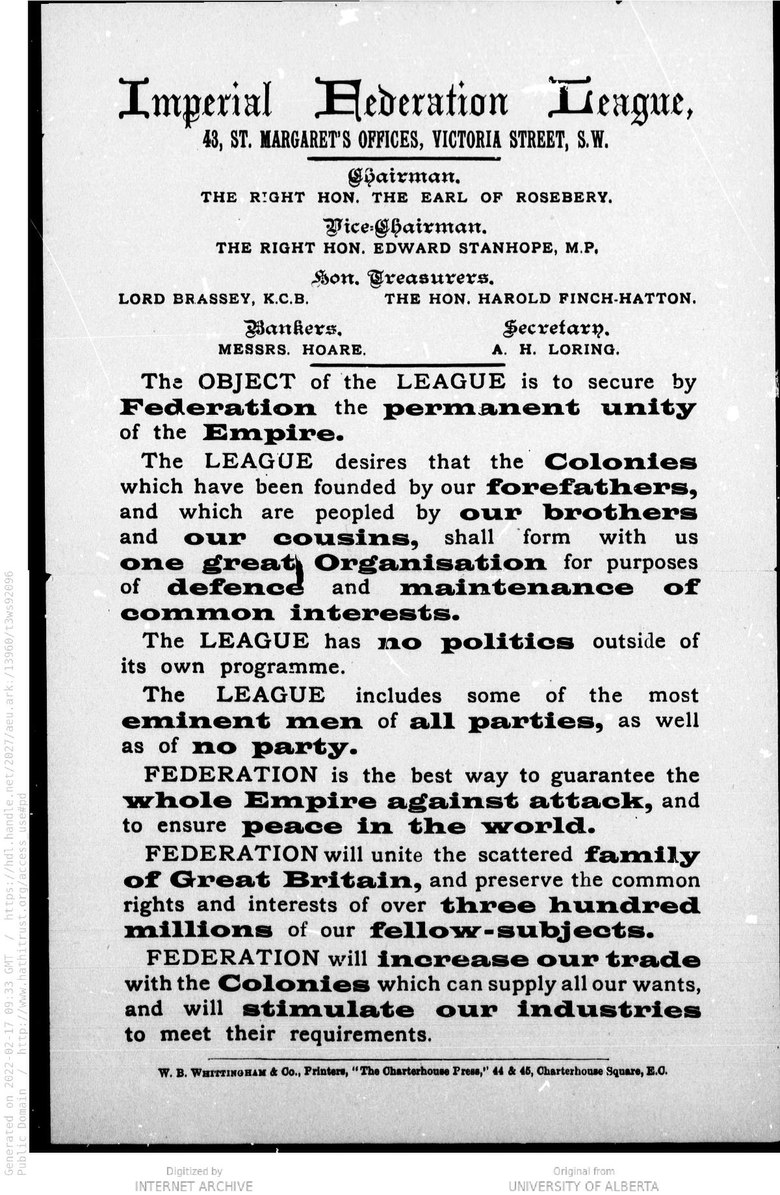
In Star Trek the Federation is only able to form after the old Empires of Earth have destroyed each other in nuclear war. From that destruction, humanity learns our lesson, that empires must be replaced with federal power structures.
Star Trek never tells us anything about the government of Earth, other than it is governed by a unitary world government. Are there elections? Is it a totalitarian bureaucracy? We never know.
But there’s a credible alternate history where Britain formed the first federal government of Earth and London remains capital of a federal world state, and perhaps even a galactic Federation.
Oops…think I just gave the entire Tory party an orgasm.
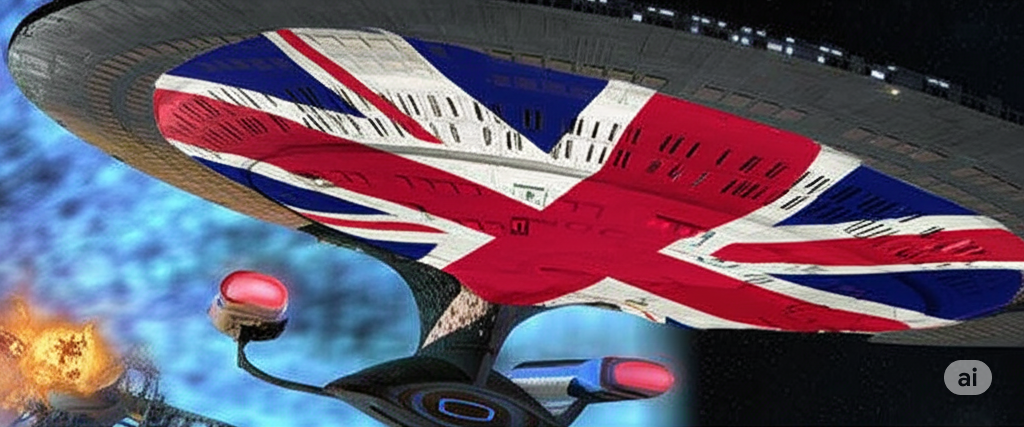
In fact it was the Tories who forced Britain instead to declare itself an old fashioned empire and destroyed our Star Trek potential while yapping about god saving the king.
Nothing changes there then
In fact many of the values we honour in Star Trek began as pragmatic answers to problems in the British empire.
Those liberal values of diversity, humanism, democracy and more that many of us watching Star Trek might hold as universal goods
are also just the provincal values of Anglo-American culture that emerged as pragmatic responses to building a global trading
federation
Because this is what’s missing from Star Trek, as a mythic representation of the Anglo-American liberal democratic culture that made it. That’s the trade. Buiness. The engine that built the federation.
Capitalism.
#
Fairy tales about peasant girls who become princesses always leave something out.
Servants.
The new princess finds food and drink ready, a bath made, clothes prepared…as if by
magic.
Capitalism built the power of first Britian then America. The British empire was built by private corporations like the East India Company. Much of It’s wealth came from resource extraction and slavery.
But audiences aren’t going to sit down to watch Kirk transporting green skinned slave women between star systems, or Picard putting down a planetary rebellion so Earth corporations can continue extracting rare dilithium crystals.
Although these were standard practice for the HMS and USS Enterprises of the past.
That as an idealised fantasy of Anglo-American culture colonising the stars
Star Trek has to ignore
And so capitalism is nowhere to be seen in Star Trek. Instead the economics of Star Trek are simply absent.
Explained away witn handwavium technologies of matter replication achieving post-scarcity and abundance.
AKA space magic.
#
The Next Generation makes explicit an idea implicit in OST.
An idea which leads many to believe that the universe of Star Trek is socialist or even communist.
Star Trek has achieved a post-scarcity civilization of abundance.
And capitalism has been abandoned.
In a famous episode of Next Generation, Picard spars with a capitalist from 20th century Earth
Then in First Contact, Picard again asserts that Earth and the Federation no longer use money
In the animated spinoff show Below Decks a new Federation member planet is given matter replicators and instantly abandons capitalism for higher pursuits.
And
sure
for a very naive dream of communism as a future where space magic fulfills all material needs
then ok
Liberal ideology is built on the concept of development. Human civilization develops through stages, and that development is driven by technology.
In Star Trek this is why the Enterprise asses alien civilisations on their technological development. The baseline is the attainment of warp technology, which determines the application or not of the Prime Directive.
Again, the Federation’s relationship to “less developed” civilizations is an idealisation of the real actions of Anglo-American civilization.
In shocking news, Britain believed its colonial activities were for the good, that Britain was advancing its colonies through the stages of development.
The United States has very similar beliefs about its global role, embodied until recently in organisations like USAID and the idea of international development.
So the Prime Directive is a nod by Star Trek’s writers to the hypocrisy of Anglo-American international realtions. Because high ideals often cover for low motivations, The Federation bans itself from any intervention.
Until these civilistions have warp drive, indicating they have reached a mature level of technological development.
The matter replicators of Star Trek have become the pop culture shorthand for the liberal belief that human development is a product of technology. And that technology will eventually end material scarcity
and bring about the abundant future of Star Trek.

Actual socialism sees post-scarcity and abundance very differently.
Humanity could have had widespread abundance at many points in our history, at any stage of technologucal development, simply by sharing our resources fairly.
From each according to his ability, to each according to his needs.
And our technology would have developed faster had we helped our fellow humans to fulfill their creative potential, rather then exploiting them as labour.
Socialism is the political process of transforming human social relations to stop the exploitation that has plagued human history.
Without a transformation of human social relations, even matter replicators won’t end scarcity. Because capitalism will still capitalise excess value into the hands of the elites.
And let’s be honest, this is how Star Trek presents communism.
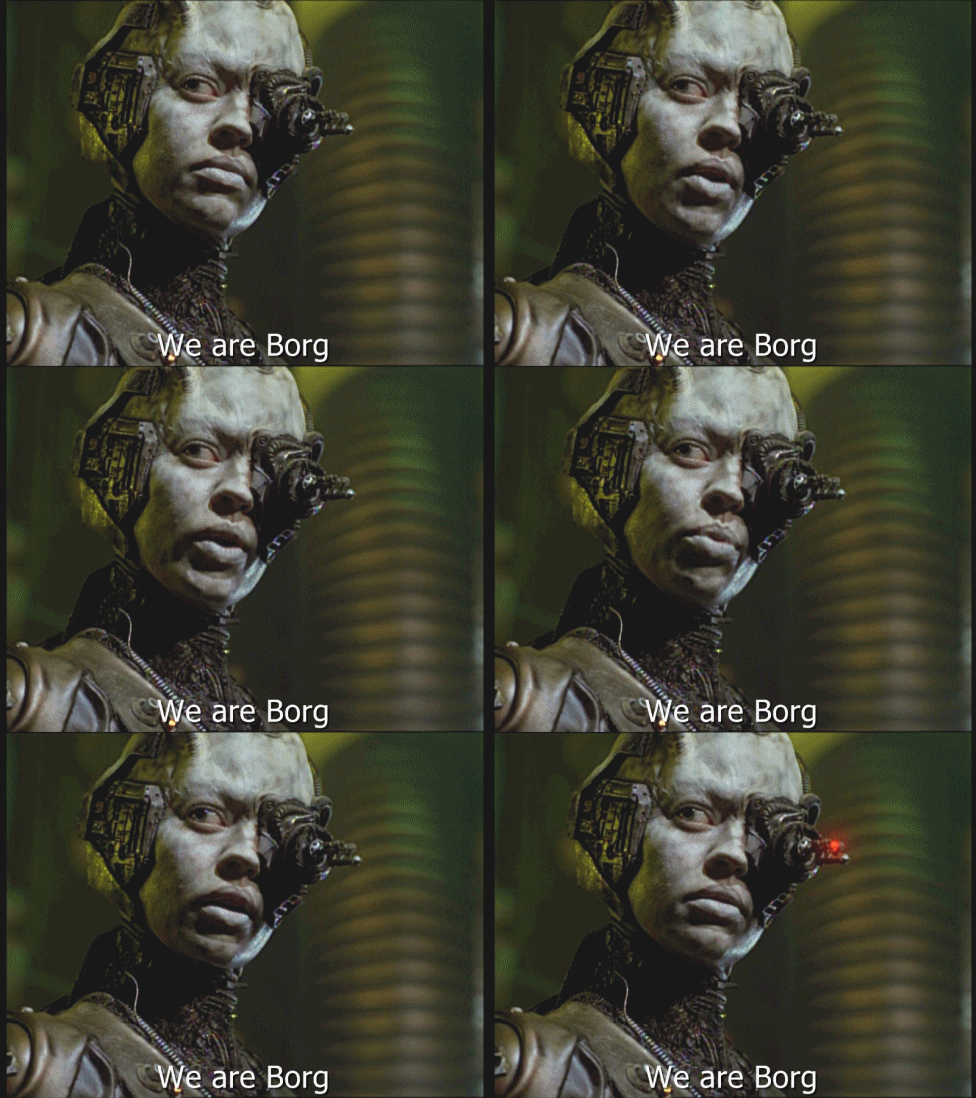
Calling Star Trek socialist is truly perverse.
Because far from achieving the anarchist or cooperative power relations of a socialist future, Star Trek is mired in top down hierarchical relations of our past.
Star Trek itself mocks the dull, repitive duties of the Lower Decks crew in a famous Next Generation episode. And calls out Riker’s authoritarian managerial style.
Starfleet, whatever it might claim about science as its primary mission, is a military organisation.
And it operates on a corporate structure. Picard, Riker and Troi are the C-Suite execs of a mid size
Enterprise
With the crew of Starfleet as the professional managerial class who work in those enterprises
Graduates of Earth’s most elite institution, nonetheless stuck operating the same scanning device shift after shift.
The writers of Next Generation often parodied their own creation, and never more harshly than when Wesley Crusher, after decades of being hothoused by Picard
bailed out of his PMC career path to do yoga and mindfulness meditation
er
I mean become a space hippie
Picard’s brooding iritation with Wesley never entirely disipates, because Jean Luc has dedicated his life to becoming a higher kind of man, a path he believes Wesley has abandonded.
And perhaps Picard is a little scared that Wesley’s path may actually be higher.
Starfleet is a heightened representation of the elite colleges that, whatever liberalism says about equality between all men, really characterise its true beliefs.
Starfleet academy graduates are, with few exceptions, the only humans with any power in Star Trek, in much the same way elite college graduates are almost exclusively the only people with any power in American culture.
Because at the heart of Star Trek is a belief in a higher kind of human.
#

Gene Roddenberry, creator of Star Trek, flew 89 combat missions in World War 2, piloting his B-17 bomber “Yankee Doodle” in missions in a war that almost destroyed humanity.
After the war Roddenberry, interested in becoming a screenwriter, joined the Los Angeles police department to gain relevant experience for writing cop shows, which he began to do freelance.
Roddenberry was a passionate science fiction reader. In the 1950s pulp scifi had become a serious literature, with Isaac Asimov’s Foundation saga, a major influence on the Federation, showing that SF could model the rise and fall of civilizations, on a galactic scale.
By the time Roddenberry had the seniority to pitch his own show, he had seen much of the darkness of life, and experienced the near destruction of human civilization.
And so Star Trek became a vision of a better human civilization, set after a global war has destroyed the old world, amongst the future mythos of scifi, in which the darkness Roddenberry had experienced in humanity
Was defeated by a higher humanity
Matter transporters, phaser beams and warp engines are the higher technology that fascinate many scifi fans.
But what makes the higher civilisation of Star Trek possible is a higher humanity.
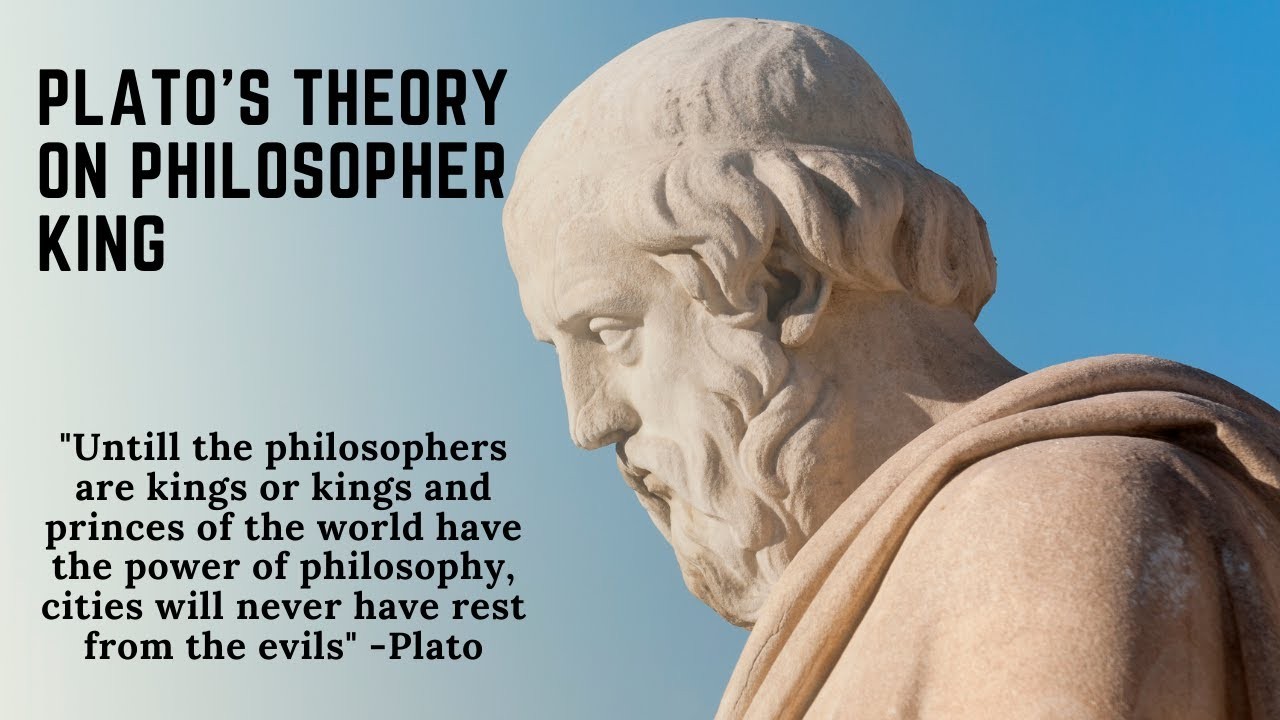
Star Trek’s Captains, starting with Kirk, then Picard, Sisco and Janeway, are philosopher kings. Leaders who dedicate their lives to wisdom, foregoing family and ordinary lives for a higher calling.
Plato in his Republic, the first great work of political philosophy, describes an ideal human society governed by philosopher kings.
Star Trek never really shows us what the rest of humanity are doing, but the higher humanity who make it into Starfleet, and especially Jean Luc Picard, are the epitome of Plato’s ideal.
#
Despite, or perhaps because of, it’s high idealism, original Star Trek struggled. In it’s second season Roddenberry recruited many established science fiction writers, including the legendary Harlan Ellison, who had the skills to realise the Star Trek vision.
Nonetheless the show was unofficially cancelled, moved to a dead zone in the tv schedules, struggled through a low quality thrid season as cast and crew jumped ship, then died.
And was resurrected in 1979 soon after the success of Star Wars. It’s notable that the two great Star franchises are the same story from different sides. Trek is the founding and management of a galactic empire. Wars is the rebellion against it.
Wars shows the super-carrier bombing the rebels blown apart. Trek puts us onboard the super-carrier with its crew.
Check out my friend Feral Historian’s detailed analysis of the other empires the Federation resembles.
Star Trek : The Motion Picture missed the real character of Trek, but its new ship design, effects and musical score would carry over to Wrath of Khan, establishing the modern franchise.
There’s a strong argument that Next Generation in 1988 is the Star Trek that Star Trek was always meant to be. The crew of Enterprise-D were the paragons of new humanity Roddenberry had envisioned.
Next Generation also struggled in its first season, but into seasons 2 and 3 began to fulfill the promise of Star Trek, as better writers began to inject some humanity into Roddenbery’s vision of a better humanity.
Because the crew of the Enterprise-D are much more like men of antiquity than humans of the future. The Platonic philosopher king, the stoic ideal of Marcus Aurelius, the rigorous rationality of the Enlightenment, and tying it all together
the virtue ethics of Aristotle.
Again and again we see that the Enterprise crew triumph not by mindlessly following a deontological moral code, even the Prime Directive is set aside when necessary. Or by maximising utilitarian value, the one often sometimes outweigh the needs of the many.
The Enterprise crews triumph by developing their own best destiny, and higher character.
Virtue ethics have an eternal appeal. But they come as a package
with darker aspects of the human personality
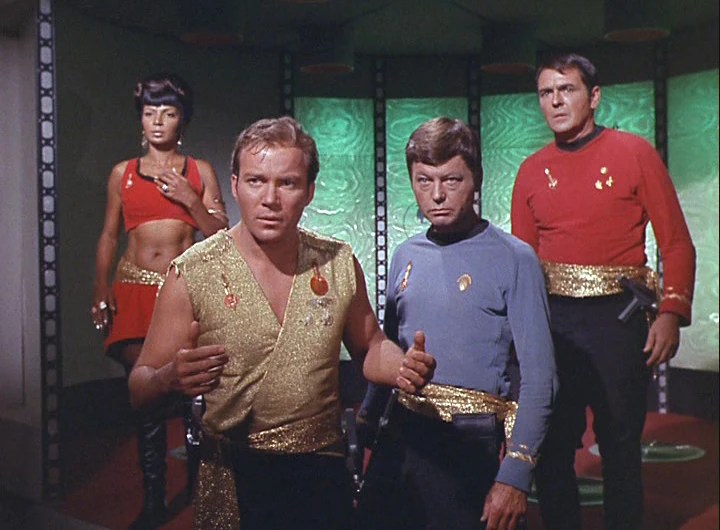
In the Mirror universe, Star Trek encounters its shadow self, the violent and oppressive Terran Empire
First appearing in original Star Trek, the Mirror universe recurs in almost every iteration of Star Trek, and becomes increasingly central to the Trek universe.
Mirror universe characters are recognisable by their somewhat more revealing costumes, notable facial hair and heightened sexual libidio, letting actors like Nana Visitor display their…range
And the Mirror universe displays the ambition, anger, violence, hatred, jealousy and murderous rage that the real Kirk, Sisco and, yes, even Picard would have to possess.
But. Not Janeway. Captain Janeway is actually a perfect human.
Aristotle’s virtue ethics was written for slave owners, Enlightenment rationality drove centuries of colonialism, and Marcus Aurelius, the true philosopher king, murdered millions to build his Empire.
The higher humanity Roddenbery and Star Trek idealised, in reality, cannot be detached from its shadow
Recombine the main and mirror verses in a transporter incident and you would have something like the reality of which Star Trek is the ideal.
Or if the Terran Empire made a propgandistic tv show for the Imperial citizens of Earth to reassure us about the virtues of our military
It would look just like Star Trek

In their book Manufacturing Consent, Edward S Herman and the philosopher Noam Chomsky describe how the marketing, advertising and PR industries shape mass media into a mechanism of propaganda within the United States
Original Star Trek was unpopular with corporate advertisers, which lead to its early cancellation. But when Star Trek returned in Next Generation it became massively popular with advertisers, hence its peak in the 90s.
“Large corporate advertisers on television will rarely sponsor programs that engage in serious criticisms of corporate activities, such as….the workings of the military-industrial complex”
Propaganda in a capitalist state is less often dictated by the government or military, although both retain this capacity. Instead it is primarily shaped by corporations via their expenditures on marketing and advertising.
Star Trek by the 1990s was aligned with the neoliberal values that now dominated American culture. But it was also a positive depiction of corporate and, crucially, military power.
It ticked all of corporate Americas boxes. And they spent heavily on Trek related advertising.
“The mass media serve…to amuse, entertain, and inform, and to inculcate individuals with the values…that will integrate them into the larger society. In a world of concentrated wealth and major conflicts of class interest, to fulfil this role requires systematic propaganda.”
Entertainment and the “Entertainment Industry” are central to capitaliat propaganda because entertainment requires in Chomsky’s words “neither evidence nor logic”
So Star Trek can present an idealised vision of the United States military, and a post-scarcity future using hand-wavium technology, and without presenting any evidence, logic or reasoned argument, these scifi visions can shape the values of the public.
The essence of Chomsky’s argument is captured in the book’s title. The purpose of propaganda in a capitalist democracy isn’t to force people to agree with the actions of the corporate state, but to influence the basic values of the people
so that when actions are taken your consent has already been manufactured.
#
And in the 20th century Star Trek as propganda has helped to manufacture the consent of Western audiences for a variety of liberal policies.
“Post-scarcity” as a vision of our future underpins the neo-liberal economic policies deployed in the 80s and 90s decades of peak Star Trek.
If human civilization could attain post-scarcity through technology then all efforts should be put into that, and things slowing down technological development like pesky labour laws, unions, social security etc should be cut away.
Meanwhile the neo-conservative wing of liberalism argued that for the universal values of liberalism, democracy and the model of federal governance to reach everyone it would be neccessary to fight a few wars.
And if those wars happened to allign with the capitalist priorities of various major corporations and the military industrial complex…well…what was the harm, right?
“The beauty of the system, however, is that such dissent and inconvenient information are kept within bounds and at the margins, while their presence shows that the system is not monolithic”
Star Trek can show many dissenting and inconvenient facets of the Federation. It can show the Maquis, a paramilitary organisation fighting for Bajoran freedom, and the paradoxes of Federation power
But it would never show a group of Redshirts massacring a village of Bajorans they were meant to protect.
Because dissent is useful
but only within strict bounds.
#
There is a United States that understands itself as a nation like any other nation. With borders and ctizens, and an extensive global empire, that it profits from
Call this America, ‘Murica.
But there is another United States that sees itself as a Federal superstate, that is a stage on from the brutal empires of the past, and towards a federal world state enforcing the universal values of liberal democracy.
Call this America the Federation.
Star Trek has been a very important part of how the Feseration has built itself, a mythic narrative that sold an idealised vision of a post-scarcity future among the stars to Americans sick of living in ‘Murica and longing to be citizens of the Federation.
It’s not much of an exaggeration to say that Star Trek is propaganda
for the Federation
Increasingly these two Americas are now at war. Donald Trump’s ‘Murica isn’t interested in a post-scarcity future. It wants to pillage the American empire and keep the American people in the poverty that makes men like Donald wealthy.
And the rest of the world isn’t entirely onboard with liberal democracy as universal values of the good, especially when the Anglo-American empire that built the international “rules based order” so rarely sticks to the rules.
But if not the Federation then…what? The total war of Chancellor Putin’s Klingon Empire? The oppressive surveillance state of the People’s Communist Party of Rumulus?
As Admiral James T Kirk often stated, the Federation is the worst form of galactic governance ever tried, except for all the others.

William Shatner’s stage debut was in Julius Caesar, so to conclude I will paraphrase Shaekspeare’s play
I come here not to bury Star Trek, but to praise Roddenbery
I’ve critiqued every aspect of Star Trek and the Federation I can, ultimately, to reinforce this argument
Star Trek is propaganda, for the values of an Anglo-American empire, that has failed to meet its own values at almost every turn
But Star Trek is also propaganda for a higher vision of a better future embodied in the officers of Star Fleet and in the Fderation
Gene Roddenberry was an exceptional human and underestimated storyteller, whose vision has had a vast impact on the world
His belief in virtue ethics may have been a little one sided, his vision of higher human potential a little naive
But Star Trek remains the most aspirational, and attainable, vision of a better human future ever articulated
As we face the chaos of the 21st century ahead of us. A century that will at the very least confront us with climate disaster, population collapse, war waged with weapons of incomprehensible power, and the emergence of AI
A century in which humanity will, in my belief, either attain a higher stage of civilisation somewhat like Star Trek
or be destroyed entirely
The future of Star Trek, Starfleet and the Federation
May be the best destiny we can aim for
Listen to the Science Fiction podcast
 Damien Walter
You hit a nerve. I am a huge Star Trek fan, a trekker but what can I say about this post if not great! I completely agree. Finally an inconvenient truth in black and white.
Live long and prosper 🖖
LikeLike
“Star Trek Lives” is an old paperback from the mid-1970s in which Sondra Marshak interviewed Gene Roddenberry. She was a serious follower of the extreme capitalist Ayn Rand. While Roddenbery did not express full agreement with Rand’s Objectivist opinions, he was familiar with them and not hostile with them. Since his net worth at death was $500 million, my guess is he was comfortable with what amounts to a religion of money.
NASA was quietly annoyed with naming the space shuttle “Enterprise”. It was the result of a letter-writing blitz on the part of Star Trek fans. They even played the theme music from the show as the shuttle was rolled out!
LikeLike