Owning The Universe
In 2023, the Walt Disney Corporation released a film called The Marvels. A film that cost a reported $220M and grossed only $200M. An MCU movie that did the unthinkable.
Lost money.
For the first time the Marvel Cinematic Universe, once an infallible, guaranteed money printing machine, looked like just another “entertainment franchise”.
Which is funny because when Disney bought Marvel in 2009, they genuinely thought they were buying a universe.
Disney’s homegrown franchises were tired. Mickey, Pluto, and the rest of the anthropomorphic animal gang were essentially decorative taxidermy. The company had spent seventy years strip-mining the European fairy tales of Grimm, Perrault, and Andersen, until there was nothing left to make but yet another direct-to-DVD Tinkerbell sequel.
So Disney, operating exactly like an aging, vampiric entity seeking fresh blood, courted two juicy younger franchises. First Marvel in 2009, then Lucasfilm in 2012.
They thought they were buying an inexhaustible play chest. Endless characters. Endless plotlines. A “cinematic universe” in which they could make endless movies, and endless shows, and endless games. Endlessly. Without end.
Watch the full video essay
And print eternal profits. Disney’s purchase of Marvel marked the beginning of the end of Hollywood studios, and the new era of the Corporate Entertainment Complex. Hollywood stopped making movies, and started making content
And for twenty-two movies, it actually seemed to work. Disney and Marvel made superheroes the biggest thing in cinema. And that twenty-two movie arc from Iron Man to Endgame? Genuinely great cinema, if you can ignore Mickey Rourke. They really were a “cinematic universe”.
And BOY did they make money. Grossing $21.4 billion at the global box office. Almost enough to pay for an AI data center.
But when others tried to imitate the MCU, they floundered. DC had Batman and Superman, two of the most recognizable fictions in human history, and they couldn’t build a universe. Star Wars under Disney made money, but it lost the fans.
And then, even Marvel began to crumble. Avengers: Endgame marked peak MCU. The franchise was no longer growing, the average box office was still profitable but the profits were declining. The long, expensive slide down into the bonfire of The Marvels had begun.
So now, with the desperation of an over-the-hill boxer stepping back into the ring just to remember what the blood tastes like, Disney is fielding the first new Avengers movie in seven years.
Nobody really doubts that Avengers: Doomsday will smash the box office. But whether it can rescue the “cinematic universe” business model’s longer-term prospects is far less clear.
My guess is: No.
Because what Disney entirely misunderstood about Marvel is that they were never buying a franchise. They never owned a universe. The entire multi-billion-dollar valuation of the MCU actually rested on just one character. And one story.
One hero. And one myth.
And once that story was told… the Marvel Cinematic Universe was done.
Pixar ate Disney
On May 5, 2006, the Walt Disney Company paid 7.4 billion dollars to successfully assassinate itself.
In theory, Disney bought the digital animation studio, Pixar. In practice, Pixar simply moved in and took over the dying, mouse-shaped corpse of the Walt Disney Company.
Disney’s new boss, Bob Iger, made the offer. But the deal was engineered by the most successful capitalist of his day, Steve Jobs.
If you go back to 1986, Jobs, having just been pushed out of Apple, placed a side bet on digital animation. He bought a computer graphics division from George Lucas, spun it out, and called it Pixar.
And at first, Pixar wasn’t even really a film studio. It was a hardware company. They sold a very, very expensive graphics computer. And just to show potential buyers what this very expensive computer could actually do, the animators made a little short film. About a lamp. A happy… desk lamp. Just jumping about.
A few Oscars and a run of hits from Toy Story to The Incredibles later, and Jobs owns the hottest studio in Hollywood. Plus RenderMan, the software half the industry is now licensing to render its own effects.
So when the buyout happens, Jobs ends up as the largest individual shareholder in Disney. He’s got a board seat. And Pixar’s executives, Ed Catmull and John Lasseter, are quietly installed at the head of both studios, Pixar and Disney Animation.
Fundamentally, Disney did not buy out Pixar. Pixar ate Disney from the inside out, then wore the old corporate branding like a mouse eared skinsuit.
But this wasn’t just a boardroom power play. Jobs saw that digital animation and CGI were the inevitable future of film production. Pixar had the most advanced technology, but Disney… Disney had the resources to scale it into the biggest digital content farm in the world.
So you have to stop thinking of Disney as a film studio. It isn’t. It’s the managerial heart of the corporate entertainment complex. An administrator of high value IP to be fed into the digital CGI factories and converted into shareholder profits. A production line, that can never be allowed to run short of raw material.
A vast gaping maw, that Marvel and Star Wars were about to be fed into.
Because what better source of raw material could there be, for the dark satanic CGI mills of Disney, than the gods of ancient myth.
SERUM
As Dr. Abraham Erskine famously observed, right before he was shot in the chest, Super-Soldier formula doesn’t actually change who you are. It simply amplifies what is already inside you. Good becomes great. Bad becomes worse.
Which is why SERUM partnered with the United States Department of War and a shadowy cabal of former Nazi scientists to make you even more you.
SERUM is the world’s first radically honest bio-optimization supplement. Other nootropics promise to turn you into a jacked genius 4AM cold-plunging ubermensch.
SERUM doesn’t lie to you like that.
Packed with four thousand milligrams of military-grade, unregulated additives, SERUM simply takes your existing personality defects and magnifies them to mythological scale.
Are you a suburban Karen who screams at service workers for minor annoyances? Within just two weeks of dry-scooping SERUM, you will become a vengeful Greek goddess tormenting mortals for chuckles.
Are you the kind of man who smiles while remembering your most recent road rage incident? SERUM will make you the conquering musclebound mythic hero you secretly already believe you are.
Look, if you’re already a deeply compassionate, self-sacrificing kid from Brooklyn, sure, take SERUM and go punch a fascist. We love that for you.
But if you’re an insecure, narcissistic tech-bro with a massive superiority complex… well, SERUM will have your face looking like a bright red skull by Tuesday.
Stop trying to become a better person. Just become a much louder, more aggressive version of the person you already are.
SERUM is not available in stores, online, or anywhere, because it doesn’t exist. But Patreon does. Go to patreon.com/DamienWalter and use code TENDOLLARS to donate now.
SERUM. Because the biggest problem with democracy, is us.
Supergods
The Avengers are, to steal a phrase from Grant Morrison, a pantheon of “supergods.”
Morrison, being one of the great comics writers of our time, essentially proved this thesis during his run on JLA by deliberately rebuilding the Justice League as a literal pantheon. Then he wrote All-Star Superman, and then he politely explained the entire joke to the rest of us in his non-fiction book, Supergods.
And once you see it, once you realize that the Avengers, and superheroes in general, are just modern iterations of ancient gods, it becomes so crushingly obvious that it’s almost embarrassing to talk about.
But we will. Here is the brief list.
Tony Stark is Vulcan, or Hephaestus, the wounded blacksmith building armor in his cave. Vision is Talos, the bronze giant forged by the blacksmith. Natasha Romanoff is Artemis the hunter. Doctor Strange is Thoth the magician. Black Panther is Horus, the living god-king. Spider-Man is Anansi, the spider trickster outwitting creatures far more powerful than himself. Thor is… well, Thor is just Thor. They didn’t even bother changing the name.
You can carry on with this list forever, bleeding into other universes. Superman is Apollo, the sun god. Batman is Hades, brooding in his underworld.
Now, you can sit there and say, “These are just broad archetypes. It’s just a coincidence. It wasn’t intended by the creators.” Except Jack Kirby literally put the Norse gods into Marvel comics in 1962, and when he finally moved to DC, he opened his New Gods series with the splash line: “There came a time when the old gods died!”
So, yes. They knew.
However you try to cut it, you cannot escape the basic, underlying reality that the Avengers, and this multi-billion-dollar cinematic factory we’ve built around them, are just the continuing adventures of a modern pantheon of pagan gods.
And that is the problem.
Because there is one major Marvel character who absolutely does not fit on this list.
Yes. One, and only one, major modern superhero who is not a reincarnated pagan deity.
Heroes are aristocrats
”We love our superheroes because they refuse to give up on us,” Grant Morrison writes. “We can analyze them out of existence, kill them, ban them, mock them, and still they return, patiently reminding us of who we are and what we wish we could be.”
You can think of the pagan pantheons as the optimates of human potential. Which, incidentally, is what the Romans called their aristocrats. The Optimates. Hold on to that thought. It’s about to get depressing.
They are the archetypal role models. The beautiful young woman. The brave young man. The wise old woman. The powerful old man. You might never match the gods, but it’s something to aim for, isn’t it? The heroic ideal.
For most of human history, heroes were at least semi-divine. They were the children of gods and mortals. Zeus turning up as a bull to carry off Europa. Zeus turning up as a swan to carry off Leda. Let’s not dress this up. These are, by any modern legal definition, elaborate tales of sexual misconduct. But the gods weren’t ashamed of it. They were bragging.
Or you get the bloodlines. Arthur, son of Uther. Or the half-breeds with demonic blood, like Merlin, fathered by an incubus. However you slice it, the heroic tradition has always depended on one very basic, very depressing idea:
A few humans are simply fitter, stronger, and faster than all the others.
Heroes are, fundamentally, aristocratic.
In the ancient world, the ruling aristocrats didn’t so much worship the gods as cosplay them.
In Egypt, the pharaoh wasn’t just favoured by the gods. He was the living Horus. Just walking around. In the Inca empire, the Sapa Inca was the son of the sun. And when he died, they kept his mummy in the palace. They dressed it, they fed it, and they wheeled it out to consult on matters of state. Looking at our octogenarian presidents, nothing much changes.
The Maya kings turned it into theatre. They put on god masks and divine regalia for huge public rituals. They built it into the architecture. Step pyramids, ziggurats, acropolises. Artificial mountains raised entirely by peasant labour, just to lift one ruling family above the farmers in the dirt, so they could live like Olympians.
The ruling ideas of every age are the ideas of the ruling class, as some bearded German bloke once said. The gods were simply the ruling aristocracy’s idea of itself.
The Optimates. I told you it gets depressing.
And the MCU Avengers do not change this. They just put it in IMAX.
Tony Stark is a billionaire’s son. T’Challa is a monarch. Thor is a literal god, the son of a literal god-king. Doctor Strange is an elite surgeon initiated into a highly exclusive secret order. Wanda gets her powers from an Infinity Stone. So does Carol Danvers. The X-Men are rare mutations, genetically superior from birth.
Every single one of them gets their power from above. From birth. From capital. From a god. From a stone. From a patron. From a lucky, radioactive bite.
Every one of them. Except one.
There is exactly one character who elevates the Avengers above a loud, expensive spectacle of aristo-gods just throwing things at each other.
And he is born not of strength, but of weakness.
The Weak Have No Place
The stable lad who pulls the sword from the stone then discovers he was always the king’s son. The farm boy who just happens to be the son of the most powerful Jedi ever.
What about David then? Anointed king before he even Goliath. Jesus? Literal son of God.
The origin story of our heroes matters because it mirrors how we understand the origin of our own potential as humans.
For most of history our potential came only from above. From god. From bloodline and lineage. From magical powers or secret knowledge. Today from the “special forces” training provided only by the state.
Then heroes of super-intelligence like Sherlock Holmes or of super-science like Bruce Banner.
Heroes are superior. Stronger. Never weaker.
Take the founding myth of Western civilization. The Iliad and Odyssey. The only time an ordinary weak man stands up to kings, Thersites, a lame hunched cripple, is beaten half to death by Odysseus as the army laughs.
An aristocrat beating a cripple for speaking. Thanks, Homer.
The weak have no place as heroes.
Until Steve Rogers.
Nearly three thousand years after Thersites, a skinny kid gets beaten in an alley in Brooklyn, staggers back to his feet, and says “I can do this all day.”
That’s what Captain America is. The weak man made the hero.
And he was written that way, literally from issue #1, to be the antithesis of the “might is right” of aristocracy.
It’s right there on the very first cover. Cap socking Adolf Hitler in the jaw.
Hitler, leader of the Nazis, the German fascists. The Nazis believed that only the “strong” had value. From 1939 they were rounding up the “weak”, the sick, the disabled, the mentally ill, and killing them. The programme became known as Aktion T4. By the summer of 1941 more than seventy thousand people had been gassed.
Joe Simon and Jack Kirby were two Jewish kids from New York. Kirby grew up on the Lower East Side, small, scrappy, brawling with the street gangs. And they made Steve Rogers everything the fascists despised. A frail young man the army rejects as unfit, who volunteers anyway.
Now, to be honest about the history, the 1941 comic doesn’t spend long on Steve’s inner life. It’s a quick origin and then a lot of punching Nazis. The bullied, compassionate kid from Brooklyn was built out more after Cap’s resurrection-from-ice by Kirby and Stan Lee in 1964.
But it’s the 2011 movie where that Steve Rogers fully arrives.
I Can Do This All Day
Now, it’s widely believed that the success of the MCU began with the first Iron Man movie, and that the arc of phases 1 to 3 hangs on the redemption story of Tony Stark, from Jesus cave to Messianic finger snap.
This is wrong.
The first Iron Man is a great movie but theeeeeen 2 and 3 suck. And Tony’s story arc isn’t really about Tony. It’s about Tony being shown what real heroism is…
…by Steve.
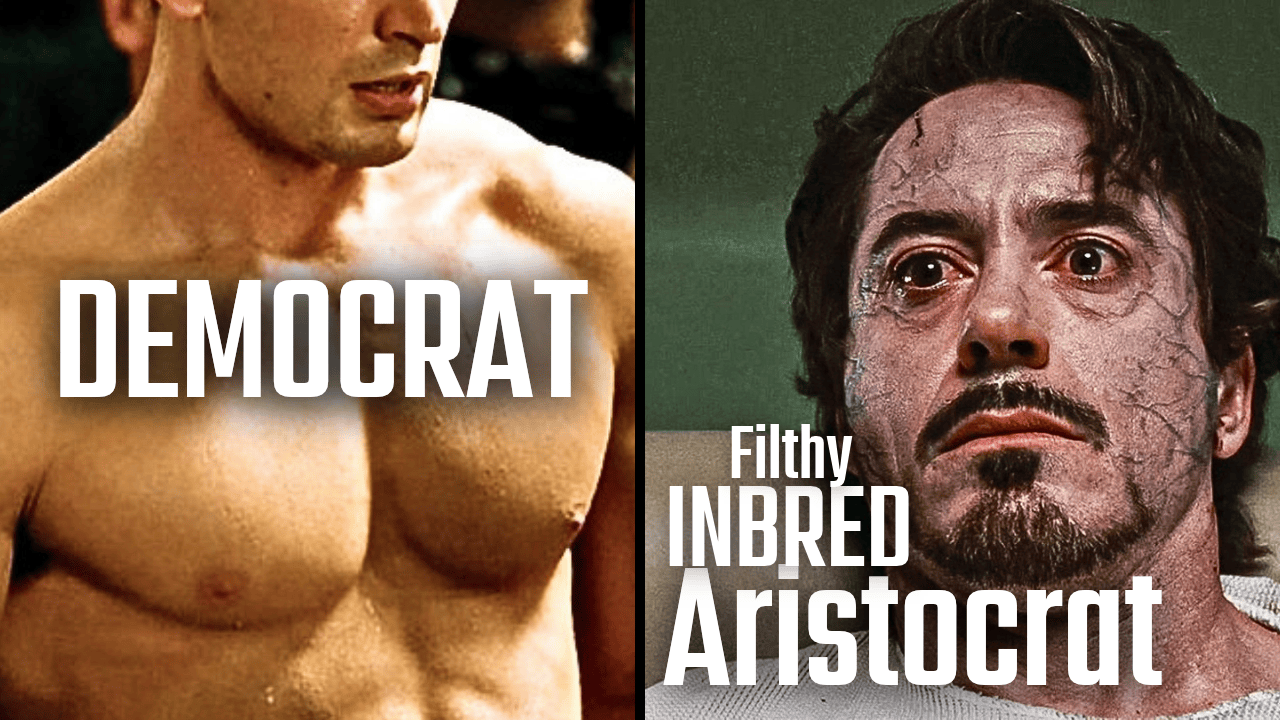
Captain America: The First Avenger is where the MCU really comes alive. Sure, yes, Chris Evans’ perfect pectorals are certainly part of the appeal. But the first act, Evans’ head digitally grafted onto a skinny nerd, is where the movie’s heart is.
Look at Steve’s first fight. He keeps getting up. He grabs a dustbin lid to defend himself. His first shield. And, bleeding, fists raised, knowing he cannot win, he says the line.
“I can do this all day.”
Steve isn’t brave because he can win. He’s brave knowing he’ll lose.
Not wanting to kill, just hating bullies. Jumping on a grenade to save the squad. Chosen for the Supersoldier Serum because it magnifies what is already inside men. Good becomes great. Bad becomes worse. That’s what happened to the Red Skull.
And then the line that is basically this entire essay. A strong man who has known power all his life may lose respect for that power. But “a weak man knows the value of strength.” And knows compassion.
“Not a perfect soldier, but a good man.”
That’s the whole of Steve Rogers. The serum gives him a body. Everything that makes him a hero, he embodied before the serum.
And once you see that, you see what Tony’s story is really about.
The first time they properly face off, in The Avengers in 2012, Steve asks Tony what he is without the suit. Tony’s answer: “Genius, billionaire, playboy, philanthropist.”
Listen to that. Genius. Billionaire. Playboy. Philanthropist. That’s every kind of aristocratic power in four words. Superior confidence. Inherited wealth. Sexual conquest. And charity, handed down from on high.
And the aristocrat doesn’t sacrifice themselves for the greater good.
But at the end of that very movie, Tony flies a nuke through the portal, fully expecting to die. His first sacrifice play.
Learned from Steve.
The rest of Tony’s story, all the way to Endgame, is him learning that lesson properly.
And while the MCU is up and down…Mickey Rourke being a major down…the films built around Steve, The First Avenger, The Winter Soldier, Civil War, Endgame, are fucking superb. And Age of Ultron…well even Steve couldn’t rescue that.
Because the MCU does have a central character.
And that character is Steve Rogers.
The Democratic Hero
So. If Tony Stark, and the Avengers, and all superheroes really, and basically all heroes ever, are idealised symbols of shitty inbred aristocrats.
What does Steve Rogers, Captain “America” stand for?
Well let’s think about Cap’s non-Avengers story arc.
Steve signs up to punch Nazis, the modern incarnation of ancient aristocratic values.
Then when Steve wakes up from the ice, he discovers that the Nazis have infiltrated America. So Captain “America” turns against America to protect a higher value.
Then when asked to bow to the oversight of the state, Steve refuses, once again choosing a higher value beyond the state.
What is it that the Avengers do? They don’t Obey. They Assemble. The assembly of independent individuals coming together to serve a higher value.
What is the opposite of aristocracy? What does America symbolise, but rarely if ever embody? What should the state be ruled by, but almost never is? What is the value that empowers ordinary men to tell puny gods we will not bow to them?
That would democracy.
Steve Rogers is the democratic hero.
A New Kind of Mythos
Democracy isn’t a vote every four years. Democracy is the belief that all humans are equal.
Democracy isn’t the belief that heroes are half god. Democracy is believing that we are defined not by our blood, but by our character.
The American poet Walt Whitman argued in his essay Democratic Vistas that the art of the past was all feudal. “The great poems, Shakspere included, are poisonous to the idea of the pride and dignity of the common people.”
Free, democratic society could, in Whotman’s words, never prove itself until it “founds and luxuriantly grows its own forms of art, poems, schools, theology.”
America had the political machinery of democracy but not the myths, and without them, Whitman warned, it would rot into money worship.
Written amid Gilded Age corruption, it reads like a diagnosis of now.
Whitman, also, believed the glue of democracy was not heroism. But comradeship. Steve and Buck “till the end of the line” is pure Whitman.
And what did the great American poet write when Lincoln was shot? “O, Captain. My Captain.”
Captain’s being, typically, the highest rank that lives and dies with the men.
Now, there are modern stories rich in democratic values. Mr Smith Goes To Washington. It’s A Wonderful Life. Twelve Angry Men.
But what we have never had, until the MCU, is a 22 movie epic narrative hymn to democracy, built around the absolute democratic hero.
Only the worthy can wield Thor’s hammer. So Steve Rogers wields it. Because he believes all humanity is of equal worth.
When Tony wants his dad’s shield back.
“My father made that shield!”
The billionaire’s son claims the symbol by inheritance. By bloodline. My father made it.
And the democratic hero simply lays it down. He doesn’t need it. Our shields, our weapons, were never where our strength came from.
Now I know some of you are finding this a bit cheesy. So, let’s acknowledge that, yes, Steve can also be kinda self righteous and annoying, also a core Democratic quality, but that is acknowledged when Cap has to fight his own annoying self.
And I know some of you are like “Damo, you’re taking this superhero slop awfully serious”. And maybe that’s true of recent years.
But the 22 movies up until Endgame are the great mythic cycle of democratic society. They are our Iliad, Ramayana and King Arthur rolled into one.
“On your left.”
And if you aren’t tearing up at a bloody, near beaten Cap, facing down the absolute avatar of aristocratic arrogance, when who comes to help but the diverse armies of democracy…
…then you’re missing one of the truly great moments in cinematic history.
And how does the democratic myth end?
With the hero choosing ordinary, mortal life.
And handing the shield on, giving the power away.
An idea, not a universe
Way back in 2009 Disney thought they were buying a franchise. They thought they were buying a universe.
Disney’s business plan was to feed that universe as raw material into the CGI mills, churn out movies and streaming shows, to just print money.
And for a while the plan worked. But then it stopped working. And attempts to replicate it failed. And seven years since the plan peaked, Disney still don’t get why it failed.
Disney didn’t buy a universe.
Disney bought an ideal.
For their entire history, through millennia of myth and generations of story, heroes have expressed the aristocratic ideal. The rare few who have the strength to act.
Steve Rogers is the first true hero of a new ideal. He is a hero not because he is strong, but because he was weak. It is only in the experience of weakness that we learn true strength.
Steve Rogers is the ideal democratic hero.
All Disney wanted to do was feed Marvel into the woodchipper to generate profit. But the Marvel spirit was so strong that it gave us the first great mythic cycle of the democratic world.
And then that story ended. As all stories do.
That was it. Done. One of the truly great moments in cinema history.
Everything after which in the MCU is an irrelevant footnote at best.
And now Disney are bringing it back, with a tease that Steve will return to. And maybe it will work. Maybe not.
In the years since Endgame the world has continued the greatest decline in democracy since the rise of fascism in the 1930s. The arsenal of democracy was put in the hands of an a**hole from reality tv.
And many, too many people, who grew up protected by the shield of democracy, are foolish enough to believe that “might is right” aristocracy would be better.
So it’s more than mere coincidence that Steve Rogers returns just weeks after Americans voted not for Red or Blue, but in defense of the fundamental principle of democracy itself.
So, maybe Avengers: Doomsday will honour the values our Captain stands for.
Or maybe it will just print money for Disney.

